A straight line passes through the points (-6, -1) and (-3, -7). Another straight line passes through the points (3, 1) and (5, 3).
These two lines intersect (cross) at some point (x, y).
What is the value of x + y ?
ID 16824
The two lines:
y = x + 3 and y = -2x +4
split the infinite Cartesian plane into 4 regions.
Which region is represented by
y < x + 3 AND y > -2x + 4
(NOTE: The Cartesian axes themselves do not separate the regions.)
ID 16821
For what values of x is the inequality true?
To help you out we should explain that the vertical bars give the absolute value (magnitude) of the contents, which is to say the result is always non-negative. Thus |-1.2| has a value of 1.2 and |3| equals 3.
The cryptic symbols at the bottom right of the image read "x is an element of the set of real numbers". In other words x is a real number. This tells you that it could be positive or negative, and it is not necessarily a whole number. It could be expressed as a decimal such as -1.234 or 13.
ID 16820
For what values of x is the inequality true?
To help you out we should explain that the vertical bars give the absolute value (magnitude) of the contents, which is to say the result is always non-negative. Thus |-1.2| has a value of 1.2 and |3| equals 3.
The cryptic symbols at the bottom right of the image read "x is an element of the set of real numbers". In other words x is a real number. This tells you that it could be positive or negative, and it is not necessarily a whole number. It could be expressed as a decimal such as -1.234 or 13.
ID 16754
Which is bigger?
( ln() is the natural logarithm function, which is to say logs to the base of exp(1) )
by Leslie Green
ID 16585
The top left of the image reads "For all n, where n is an element of the set of natural numbers". We can translate that into: "n is a positive whole number".
The left hand side of the expression reads as "the limit as x tends to infinity". We can translate that into "the value of this expression when x increases and increases, without end".
Evaluate the expression.
by Leslie Green
ID 16577
How many of the roots of this equation have the same magnitude?
HINT: Some might consider parts of this problem imaginary.
ID 16575
Find the natural value, n, which satisfies the equation given.
ID 16568
Given that x and y are natural values, find the sum of x and y.
HINT: Factorise the left-hand side (LHS), although there may be a bit left over.
by Leslie Green
ID 16270
The sum of two numbers and the sum of their squares are both equal to four.
Find the product of the two numbers.
ID 16254
The image shows the graph of a general polynomial in x, but 'zoomed in' so closely that any curves appear straight. The axes are not visible at this scale.
We consider moving from the point x to a new point x + h a tiny distance away. In this case the graph goes up by a tiny amount v. We wish to find the slope of the graph, which will be v/h.
f(x) = a + bx + cx2 + kx3 + ... in general (where a, b, c, and k are constants). We will consider the simpler case where b=c=0 (constants for the fourth power and above are zero as well).
What is v/h?
by Leslie Green
ID 14882
A particular area of difficulty for students is the manipulation of equations. They are told to "do the same thing to both sides of the equation". For example you might add 5 to both sides of the equation in order to "move" an unwanted -5 from the left hand side of the equation to the right hand side.
We will express the idea of "doing the same thing" as applying some function, for which we have provided a list in the picture.
Suppose we have some general equation such as a = b + c + d where a, b, c, d could be simple numbers of more complicated expressions.
For the given list of functions, in how many cases can we "do the same thing ..." by applying the functions to the individual terms on the right hand side?
A player threw 6 darts at a board three times. We don't know the values of the rings, but we know how many points he got the first two times.
How many points is the third game worth?
ID 14227
What happens to the value of f(n) as n increases without limit?
The graph text is a bit small so we will say that f(1)= 0.5 and f(10) is roughly 1E17. f(n) is the 20th power of n divided by the nth power of 2.
by Leslie Green
ID 14146
For real values a and b, and with i2 = -1,
evaluate Z × Z*,
when Z = a - i·b
If the question makes no sense, try an easier one first.
ID 14102
Skip this question if you have not yet studied Calculus.
p(x) is a tenth order polynomial in x. b ≥ a
What is the resultant value?
NOTE: Nobody is likely to have ever told you the answer. It is the sort of question some people like to use as an interview question, since it is unfamiliar, and you are forced to think from first principles. Do you freeze up, or do you genuinely understand your basics?
ID 14092
The image is intended to represent a graph of some general continuous function, zoomed-in so much that the curved part looks straight. We want to find the area under the blue curve, and our first estimate is the dotted rectangular box. On this scale the dotted box looks like a pretty poor estimate for the light blue area. Specifically, the area estimate is too high by an amount equal to the triangle formed by the dotted red lines and the blue line of the function.
What happens to the total error if you change from one strip of width w to two strips, each of width w/2?
ID 14083
Let's read the image to you out loud. Some function f of x is equal to x raised to the power of n. n is a positive integer.
What do you get if you differentiate the function (n + 1) times with respect to x?
ID 13399
In this game of strategy you start from S. Using only up (U) or right (R) moves you must get to F. Your opponent picks a square to block your path.
Of course a 4 x 4 grid like the one shown is too easy for you. You will have a 10 x 10 grid for your game.
F is still in the top right corner of the new grid, with S in the bottom left corner. Blocking square 1 is still immediately to the left of square F.
How many paths are blocked when your opponent chooses square 1?
If you haven't yet studied any Calculus, skip this question.
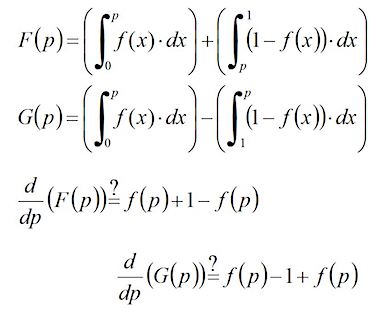
In most Calculus courses you should have seen that differentiation and integration are inverse processes to each other. If you differentiate an indefinite integral you are returned to the original function. Likewise if you integrate a function which was differentiated you are returned to the original function, although some constant information has been lost. But what happens if you make a function which has its variable as part of the integral limits?
What happens when we differentiate such a function? We have evaluated two differentiated functions by discarding the integral, and swapping in the variable of differentiation. The results are different, but why?
by Leslie Green
ID 13145
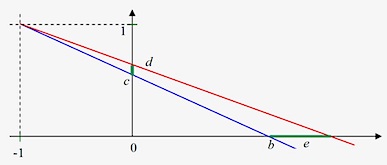
Imagine that the image represents a ray-trace where we are projecting the tiny green line segment d onto the (Real) x-axis, forming a 'shadow' of length e.
Imagine that d is tiny, so the drawing is not to scale.
Consider the ratio e / d.
ID 12605
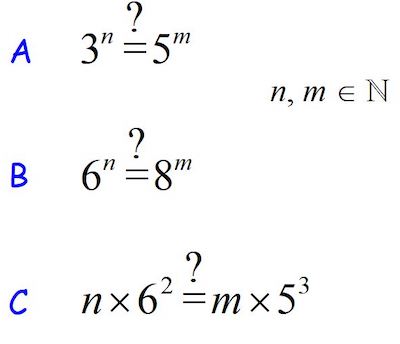
Consider the three proposed equalities, based on positive whole numbers (n > 0)
How many are possible?
ID 12269
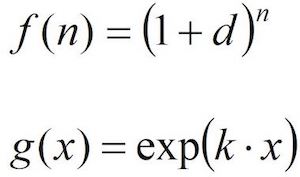
I claim that the geometric function f( ) with the integer argument n is related to the exponential function g( ) of the real argument x as follows:
ID 11926
What is the intended value of A, very approximately.
ID 11276
In such a question it is reasonable to suppose that n is a positive integer.
Pick the best correct answer.
by Leslie Green
ID 11245
Simplify the inequality.
by Leslie Green
ID 11223
The image shows a linear Diophantine equation. The key thing to note is that the variables x and y are both integers (whole numbers). With ordinary equations you typically get as many equations as unknowns, so the system of equations can be solved for the unknowns. With Diophantine equations you often get less equations than unknowns.
What is the best solution you can give here?
by Leslie Green
ID 10930
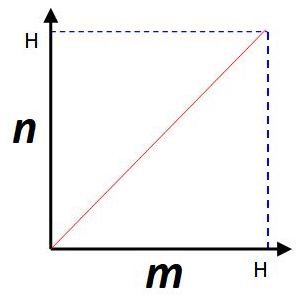
A rational number is the ratio of two natural numbers, n and m, written in the fractional form n/m.
Any point within the square dotted region represents a specific rational number. All rational numbers with n < H and m < H are contained within the dotted square region. We consider H to be so HUGE that all possible rational numbers can be included within the dotted square.
The red line has n = m, so that for any values that are within the dotted square and below the red line, the rational value is below 1. Since half the area of the square is below the red line, we can reasonably say that half of all rationals have a value below 1.
For some value k, with k > 1, what proportion of rational numbers have a value less than k?
(HINT: Draw the line for n/m = k)
by Leslie Green
ID 10568
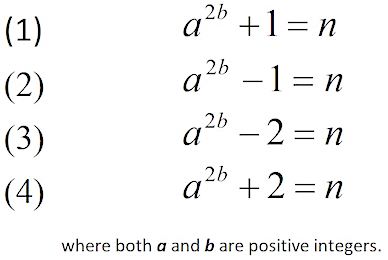
A composite number is an integer which has non-trivial factors.
5 is not composite as its factors, 1 and 5, are considered trivial. 5 is prime.
6 is composite as it has the non-trivial factors, 2 and 3.
Which formula only generates composite values of n?
ID 10322
A group of kids shares some coconuts from a basket.
If everybody takes one, then 5 coconuts are left over. If they try to take two each, then 5 kids receive nothing.
How many correct answers are there to the question: "How many coconuts were initially in the basket?"
ID 10316
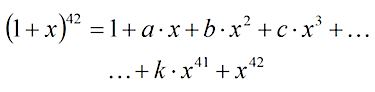
Multiplying out the term in brackets gives a polynomial in x.
Often the coefficients a, b, c, ... k are written as a set of subscripted constants, but that doesn't work well in plain text.
So we ask the question, what is the value of k? (obviously we will have run out of single-letter-constants too quickly, but don't worry about that)
ID 10129
Alex, Betty, and Craig solved 100 math problems altogether. Each solved exactly 55 problems.
The problem is considered as easy if all three of them solved it, and hard if only one solved it.
How many more hard problems than easy problems did they solve?
ID 8392
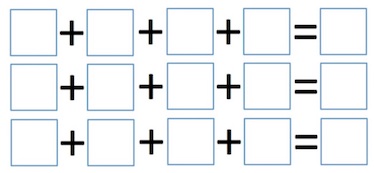
In each of the squares write a single unique non-zero hexadecimal digit, such that each of the three equations are true.
Remember that in hex we write A for 10, B for 11, ... up to F for 15.
What is the sum of the right-hand sides of the equations?
ID 8327
Use the pattern on the left to solve for the unknown on the right.
Suggested by a problem shown on UK TV News (Jan 2019) by a Singaporean exchange teacher.
ID 8314
A grandmother wants to share her gems among her grand-daughters.
If she equally shares the gems among her grand-daughters and her 5 grand-sons, then everybody gets 2 gems less. If she shares the gems among her grandchildren and her 4 children, then everybody gets 3 gems less.
How many gems does she share?
ID 8087
A rational number, formed from the ratio of two counting numbers, can be represented by either a terminating decimal sequence, or by an infinitely repeating decimal sequence as shown in the image. An irrational number has an infinite non-repeating sequence of decimal digits.
All the numbers shown were generated using a 32+ digit calculator.
Is the last number shown rational or irrational?
by Leslie Green
ID 7867
We have a left point L which has a single numerical value such 2.1245, then we have a right point R which has another value in the same sort of format. Maybe it is 4.2356.
What we want is a formula to move linearly from the left point to the right point by means of the variables N and M. If N=0 we are at the left point. If N = M we are the right point.
Which is the correct formula for V, the value of the required point?
by Leslie Green
ID 7814
In the 17th century, French mathematician Pierre de Fermat found a number that is one more than a square of an integer number and one less than a cube of another integer number.
How many such numbers are there?
ID 7790
For what values of A does the system of equations have no solutions?
ID 7601
We wish to use a 2 x 2 matrix to perform the transformation from the blue square (x, y) to the red parallelogram (x', y').
What is the value of the matrix element 'a' ?
by Leslie Green
ID 7503
When a fraction has infinity on top its value is infinity. When a fraction has infinity underneath its value is zero. But when a fraction has infinity on top and infinity underneath the ratio can seem a bit indeterminate. We can nevertheless evaluate the ratio by observing what happens as we get closer to the limiting value.
For f(x) = 6x3 + 2x2 + x; g(x) = x3 + 6x2 + x
Evaluate f(x) / g(x) as x gets closer and closer to infinity.
by Leslie Green
ID 7496
We wish to use a spreadsheet to evaluate the number of breadrolls R required for the school picnic.
Each boy B wants 3 rolls. Each girl G wants 4 rolls, unless she is sitting next to a boy, in which case she has only 2.
Boys and Girls pair up as much as possible.
Which is the correct relationship?
The format of the if() expression given is if( boolean_test, [result if test is TRUE], [result if test is FALSE] )
by Leslie Green
ID 7459
An alchemist suggests that you choose two portions of magic powder. There are two kinds of powder and nine available portions. All portions look the same. If you choose two portions of the same kind, you get a poison. If you mix two different kinds of magic powder, you get an elixir of life, also known as an elixir of immortality.
He said that the probability of being immortal or dead is fifty-fifty.
What are the numbers of portions of the two different magic powders?
ID 7415
A population grows by 2% every year, a geometric growth.
How would you model this as an exponential growth?
(N is the number of years and exp( ) is the exponential function.)
by Leslie Green
ID 7409
A bike rental company in the Wild Adventure National Park charges $20 per bike per day and rents 40 bikes per day.
Experience shows that for each $1 decrease in the rental price, the number of bike rentals will increase by 4 people.
What is the possible maximum daily income?
ID 7354
Alex, Bill, and Cindy leave for a beach 25 miles away. They walk at 4mph (miles per hour) and travel in a car at 38mph. First, Alex walks, Bill and Cindy travel in a car. After some time Bill gets out the car and walks to the beach while Cindy goes back and picks up Alex. Cindy takes Alex to the beach.
If Alex and Bill walk the same distance and all three arrive at the same time, how far does Alex walk?
ID 7314
Leslie Green asks:
In elementary Calculus we are often given y as a function of x and have to evaluate dy/dx. In real life we do not necessarily have y and x.
Suppose we have V = k•p where k is a constant.
What is dV/dt?
ID 7241
Which of these complex numbers is not one of the four fourth-roots of 16?
ID 7240
How many different values of x make the equation true?
ID 7236
The product of three consecutive integers (whole numbers) is equal to their sum.
How many sets of the three numbers exist?
Presh Talwalkar credits the problem to Ken Edwards
ID 7234
For which value of the real constant A is the imaginary part of Z equal to zero?
ID 7233
What is the product of W and Y?
ID 7232
What is the sum of W and Y?
ID 7225
The determinant of a matrix can be represented by the same symbols as magnitude bars, but it is also convenient to use det ( ) in text-based applications.
What is the value of det ( I x C x I ) , where I and C are defined in the image to the right?
ID 7211
Which of these is a complex number?
ID 7210
What is the magnitude of the complex number of
a + b.i
?
ID 7209
What is the complex conjugate of
a + b.i
?
ID 7119
Which area is larger?
ID 6678
Two ships are at a distance of 30 nautical miles from each other. They each sail with a constant speed, while the first ship at 20 knots is twice fast as the second.
What is the maximum possibile time the first ship has to sail to intercept the second one?
The problem is derived from the Apollonius pursuit problem. The circle of Apollonius is any of several types of circles associated with Apollonius of Perga, a renowned Greek geometer.
The knot is a unit of speed equal to one nautical mile (1.852 km) per hour, approximately 1.15078 mph.
ID 6256
Leslie Green asks:
We put something into the blue box and something new comes out.
Now we are asking what do we need to put in to get something?
Can you decode the mystery of this 300+ year old mathematics?
ID 5983
The image shows two parabolas,
f(x)= x2 - 4 and g(x) = -x2 + 4.
Estimate the area enclosed between the two curves.
Author: Leslie Green
ID 5870
Express X by two other variables.
ID 5574
The sum of the first N positive odd integers is N2.
What is the sum of the first N positive even integers?
20% of girls and 30% of boys were on a 3-day trip to the Wild Adventure National Park. There is a total of 240 students and 20 teachers on the trip.
What is the ratio of boys to girls in the school?
ID 5321
Which of the following is equal to fourteen divided by nine?
ID 5272
A cube is painted on the outside and then divided into one-unit cubes. The total number of painted faces equals the total number of unpainted faces.
What was the side length of the cube before it was painted?
ID 5255
A grocery store sells Brazilian cacao in 15-kg bags and Ecuadorian cacao in 25-kg bags. A restaurant bought a total of 95 kg of cacao.
How many bags of cacao did it buy?
ID 5177
Find the ratio of the areas above and below the parabola
y = x2,
given that the axes and the parabola are of infinite extent.
(NOTE: the area below the X-axis is not considered.)
ID 5168
Leslie Green asks:
Given Cartesian axes of infinite extent, find the ratio of the areas below to above the semi-infinite 45° inclined blue lines shown.
ID 5167
The stand-in mathematics teacher is forced to choose two students to go on a field trip and he can only choose between the two best girls and the two best boys in the class. He hates the idea of a girl being paired up with a boy, but knows that if he first picks a boy it is much more likely that the next pick will be a girl.
He devises this scheme: He labels 4 otherwise identical tokens with the names of the four students. He puts the tokens into a bag and then reaches in and takes two tokens at exactly the same time, one in each hand.
What is the chance of a boy being paired with a girl with this cunning plan?
The problem was suggested by Leslie Green
ID 5129
Two men and two women want to cross a river.
The boat will only hold one man or two women. How many times does the boat cross the river?
Find the minimum number.
ID 5044
If the sum of two numbers is 9 and their difference is 11, what is their product?
ID 5037
Water increases its volume by 1/11 when freezing.
By what part of its volume will ice decrease when it melts and turns back into water?
ID 5026
0.123123123123123 . . . . What fraction is it?
ID 5020
The occupancy percentage of a hotel is 64% for the four summer months and 46% for other months.
What is the average occupancy percentage for the year?
ID 4920
How many pairs of prime numbers add up to 101?
ID 4912
Gerry and Jane are exactly 100 km apart. Gerry leaves his place running at 10 km/hour and Jane leaves her house two hours later biking 30 km/hour.
How far to Jane's house do the young people meet?
ID 4897
If 3 pens and 5 pencils cost as much as 5 pens and 2 pencils, by how much is a pen more expensive than a pencil?
ID 4491
The balance is in equilibrium.
Find Z.
ID 4425
Divine the value of the Divine proportion AC.
ID 4270
What is the sum of the squares of the whole numbers from 1 to 10?
ID 4068
X + XY + Y = 34 Find all positive integer solutions of the equation, for which neither X nor Y is zero.
What is largest possible value of X ?
ID 4029
Find x.
ID 4004
The wind in the open-air swimming pool increases the westward swimming speed and decreases the eastward swimming speed by 1 mile per hour.
Will this swim take more or less time than the swim without the wind?
ID 4000
In a recent election, 1111 people voted for two parties. If the ratio of the number of voters for the Coffee Party to the number of voters for the Tea Party was 10 : 12, how many more voters for the Coffee Party would make the score equal?
ID 3978
The product and sum of two positive integers X and Y are added together. The result is 224.
How many different sets of X and Y exist?
ID 3967
A series of 10 books were published at two-year intervals. The sum of the publication years was 20,000.
When was the first book published?
ID 3960
How many "yes or no" questions are needed to guess any 5-digit code?
ID 3956
"A coach leaves London for York and another at the same moment leaves York for London. They go at uniform rates, one faster than the other. After meeting and passing, one requires sixteen hours and the other nine hours to complete the journey.
What total time does each coach require for the whole journey?"
Lewis Carroll
ID 3954
In a city, sixty percent of the men are married to eighty percent of the women.
Estimate the percentage of the married adults in the city.
ID 3938
The Smith family consists of parents, children, and animals. Some of them are absent in the picture. The average age of the family is 22; the father is 42 years old and the average age of the others without the father is 20.
How many people and animals are there in the family?
ID 3937
A group of 22 scouts goes on a trip. They prepare enough food to last 18 days.
If 14 additional scouts join them at the last minute, how many days will their food last?
ID 3933
Two tourists paddled downstream for 2 hours and then upstream for 4 hours. The rate of the current was 4 mph. When they stopped, they were 12 miles downstream from their starting point.
How many hours will it take them to paddle back to their starting point?
ID 3929
Two trains, each 400 meters long, pass each other completely in 10 seconds when they are moving in opposite directions. Moving in the same direction, they pass each other completely in 20 seconds.
Find the speed of the faster train.
ID 3926
Mike’s age, M, is equal to the sum of the ages of his four children. His age N years ago was twice the sum of their ages then.
What is M/N?
ID 3923
The weights of each pair of these boxes are 98kg, 101kg, and 102kg.
What is the difference between the heaviest and the lightest box?
ID 3919
There are 190 coconuts in a basket. Sailors one after another take out half of them and one each time until one is left.
How many sailors are there?
ID 3915
Evguenia walked to school. Twelve minutes after she left, Sasha started. His speed was triple Evguenia’s speed.
How many minutes did it take for him to catch the girl?
ID 3897
What are the smallest and largest integers that will make this expression true?
ID 3883
A car starts traveling at an initial speed of 120 km per hour (kmph), the maximum allowed speed in Switzerland. At the end of every hour of driving the speed is suddenly decreased by 5kmph.
How much time will it take to travel a distance of 500 km?
ID 3881
What amount of water should be added to reduce 200 milliliters of 5 percent fat milk to 2 percent fat milk?
ID 3880
A tree increases its number of nuts at the rate of 100% every year.
What was the number of nuts 5 years ago, if this year it gave 3,200 nuts?
ID 3878
In an examination, there were 4000 candidates, of which 2200 candidates were boys and the rest were girls.
If 45.5% of the students and 40% of the girls passed, then how many boys passed?
ID 3836
A swimming pool is 12.5 x 8 x 3 meters. The average volume of a human body is 0.066 cubic meters. How much does the volume change if 10 swimmers jump into the pool?
ID 3767
How many solutions are there for X?
ID 3698
Estimate the ratio of the large rectangle width to height if the two rectangles in the picture are similar.
ID 3636
Find Y.
ID 2254
Which function gives the angle in degrees between the hour and the minute hands of a clock?
Assume that H is the hours and M is the minutes.
ID 1927
A square game board begins with a dark square alternating with light squares. The ratio of light to dark squares is approximately 0.96.
What are the dimensions of the game board?
ID 1782
How many points of intersection do these three rays have?
ID 1515
Ten teams enter a basketball tournament. Each team plays one match against each of the other teams, getting three points for a win, one point for a draw and none for a defeat.
Which of the following is a possible value of the total number of points earned by the teams at the end of the tournament?
ID 1356
Xia and Yvonne collect buttons. Xia only collects the ones with two holes and Yvonne only collects the ones with four holes. Xia has 10 more buttons than does Yvonne. The total number of holes found in all of their buttons is 200.
How many buttons do they have in total?
ID 1196
Three points of four are on a line. Which point is not on the line?
ID 1188
Which equation represents the axis of symmetry of the graph of the parabola?
ID 1152
Find the point of intersection of these two lines.
ID 1115
How many integer values of x are the solutions of these two inequalities?
ID 1096
If y is the fraction of the white area of the square, which graph shows the y – x dependence correctly?
ID 1084
Which of the following gives the biggest answer?
ID 995
How many digits are in the result of the expression?
100111
ID 965
Which of the following graphs represents all values of x, such that:
ID 939
Find the center of the prism with the following vertices.
A(1,1,1), E(3,3,3), B(5,1,1), F(7,3,3), C(5,1,7), G(7,3,9) D(1,1,7) and H(3,3,9).
ID 937
Which equation describes a line of symmetry for the shape?
ID 933
Line AB has the equation
y = 0.5x + 3
Line CD is parallel to line AB.
Identify the equation for line CD
ID 928
Which of the following points lies on the line 3x + 4y = -12
ID 923
Choose the condition when the inequality (2 + n)n > (1 + n)n is always true.
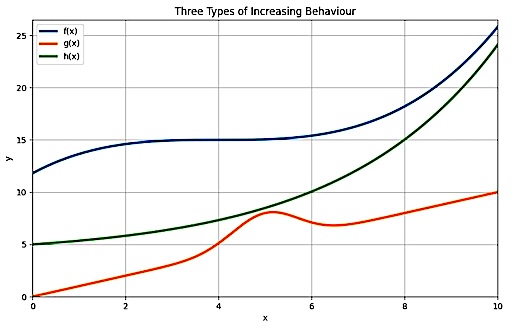 We have three labels which could be uniquely mapped to the three functions given in the image.
 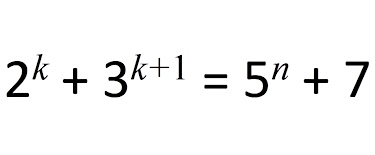 How many solutions does this equation have, given that k and n are natural numbers, which is to say whole numbers greater than zero?
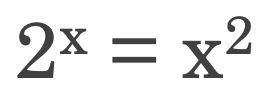 How many positive solutions does the equality have?
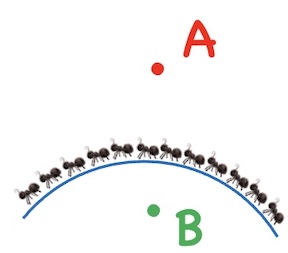 There are two springs in Sweet Meadow: one with vinegar in point A and the other with honey in point B.
 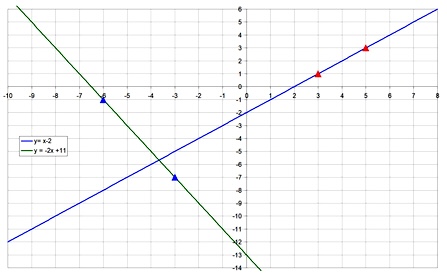 A straight line passes through the points (-6, -1) and (-3, -7).
 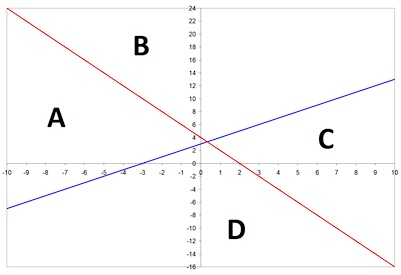 The two lines:
 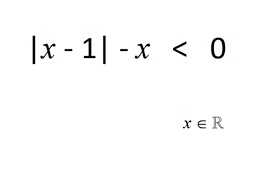 For what values of x is the inequality true?
 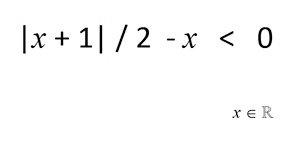 For what values of x is the inequality true?
 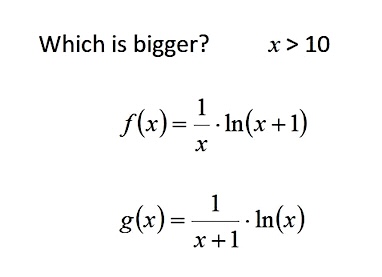 Which is bigger?
 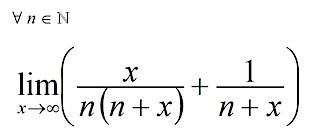 The top left of the image reads "For all n, where n is an element of the set of natural numbers".
 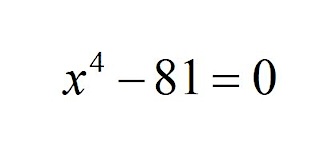 How many of the roots of this equation have the same magnitude?
 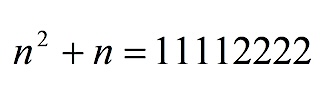 Find the natural value, n, which satisfies the equation given.
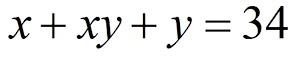 Given that x and y are natural values, find the sum of x and y.
  The sum of two numbers and the sum of their squares are both equal to four.
 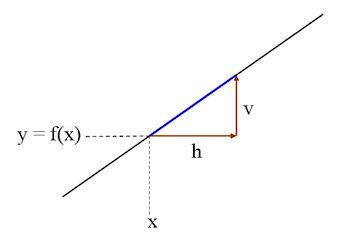 The image shows the graph of a general polynomial in x, but 'zoomed in' so closely that any curves appear straight. The axes are not visible at this scale.
 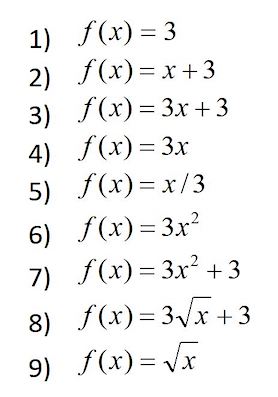 A particular area of difficulty for students is the manipulation of equations. They are told to "do the same thing to both sides of the equation". For example you might add 5 to both sides of the equation in order to "move" an unwanted -5 from the left hand side of the equation to the right hand side.
  A player threw 6 darts at a board three times. We don't know the values of the rings, but we know how many points he got the first two times.
 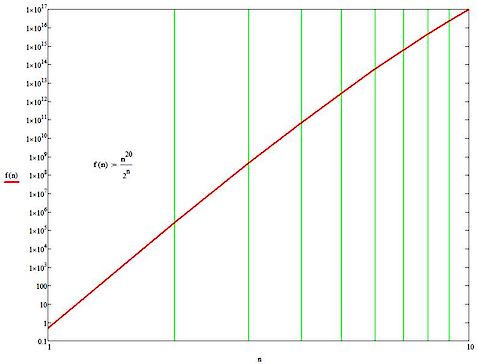 What happens to the value of f(n) as n increases without limit?
  For real values a and b, and with i 2 = -1,
 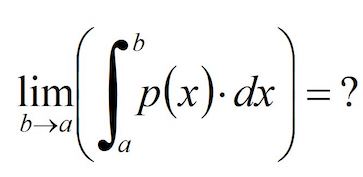 Skip this question if you have not yet studied Calculus.
 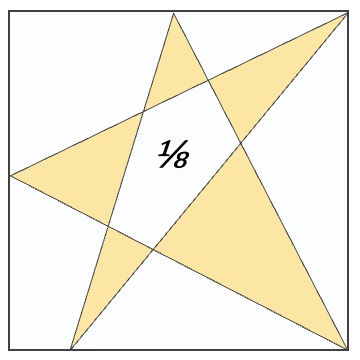 The image is intended to represent a graph of some general continuous function, zoomed-in so much that the curved part looks straight. We want to find the area under the blue curve, and our first estimate is the dotted rectangular box. On this scale the dotted box looks like a pretty poor estimate for the light blue area. Specifically, the area estimate is too high by an amount equal to the triangle formed by the dotted red lines and the blue line of the function.
 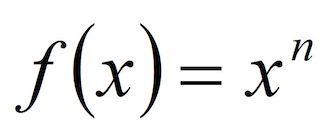 Let's read the image to you out loud.
 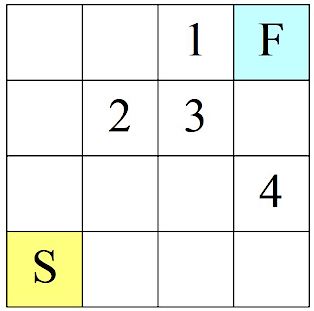 In this game of strategy you start from S. Using only up (U) or right (R) moves you must get to F.
  If you haven't yet studied any Calculus, skip this question.
  Imagine that the image represents a ray-trace where we are projecting the tiny green line segment d onto the (Real) x-axis, forming a 'shadow' of length e.
  Consider the three proposed equalities, based on positive whole numbers (n > 0)
  I claim that the geometric function f( ) with the integer argument n is related to the exponential function g( ) of the real argument x as follows:
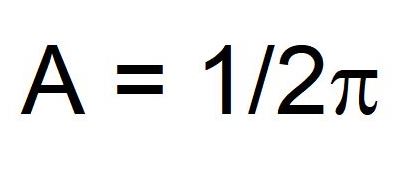 What is the intended value of A, very approximately.
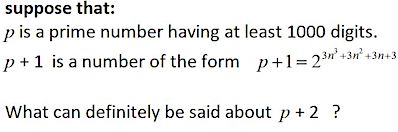 In such a question it is reasonable to suppose that n is a positive integer.
 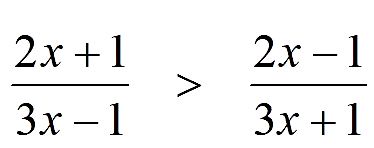 Simplify the inequality.
 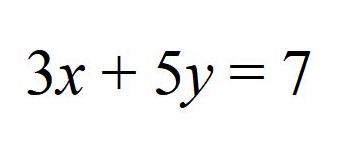 The image shows a linear Diophantine equation. The key thing to note is that the variables x and y are both integers (whole numbers). With ordinary equations you typically get as many equations as unknowns, so the system of equations can be solved for the unknowns. With Diophantine equations you often get less equations than unknowns.
  A rational number is the ratio of two natural numbers, n and m, written in the fractional form n/m.
  A composite number is an integer which has non-trivial factors.
  A group of kids shares some coconuts from a basket.
  Multiplying out the term in brackets gives a polynomial in x.
  Alex, Betty, and Craig solved 100 math problems altogether.
  In each of the squares write a single unique non-zero hexadecimal digit, such that each of the three equations are true.
 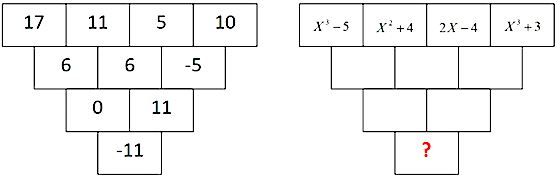 Use the pattern on the left to solve for the unknown on the right.
  A grandmother wants to share her gems among her grand-daughters.
 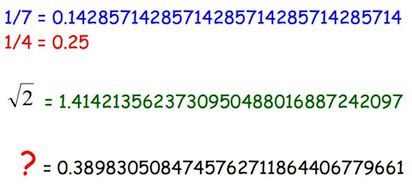 A rational number, formed from the ratio of two counting numbers, can be represented by either a terminating decimal sequence, or by an infinitely repeating decimal sequence as shown in the image. An irrational number has an infinite non-repeating sequence of decimal digits.
  We have a left point L which has a single numerical value such 2.1245, then we have a right point R which has another value in the same sort of format. Maybe it is 4.2356.
 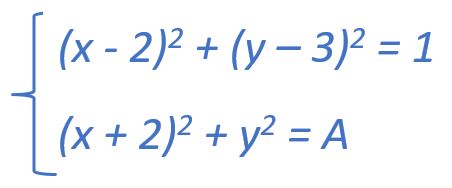 For what values of A does the system of equations have no solutions?
 We wish to use a 2 x 2 matrix to perform the transformation from the blue square (x, y) to the red parallelogram (x', y').
  We wish to use a spreadsheet to evaluate the number of breadrolls R required for the school picnic.
  An alchemist suggests that you choose two portions of magic powder. There are two kinds of powder and nine available portions. All portions look the same.
  A population grows by 2% every year, a geometric growth.
  A bike rental company in the Wild Adventure National Park charges $20 per bike per day and rents 40 bikes per day.
  Alex, Bill, and Cindy leave for a beach 25 miles away. They walk at 4mph (miles per hour) and travel in a car at 38mph.
  Which of these complex numbers is not one of the four fourth-roots of 16?
 How many different values of x make the equation true?
 The product of three consecutive integers (whole numbers) is equal to their sum.
  For which value of the real constant A is the imaginary part of Z equal to zero?
 What is the product of W and Y?
 What is the sum of W and Y?
 The determinant of a matrix can be represented by the same symbols as magnitude bars, but it is also convenient to use det ( ) in text-based applications.
  Which area is larger?
 Two ships are at a distance of 30 nautical miles from each other. They each sail with a constant speed, while the first ship at 20 knots is twice fast as the second.
  Leslie Green asks:
  The image shows two parabolas,
  Express X by two other variables.
 There are 1000 students in a high school.
  A cube is painted on the outside and then divided into one-unit cubes. The total number of painted faces equals the total number of unpainted faces.
  A grocery store sells Brazilian cacao in 15-kg bags and Ecuadorian cacao in 25-kg bags.
  Find the ratio of the areas above and below the parabola
  Leslie Green asks:
  The stand-in mathematics teacher is forced to choose two students to go on a field trip and he can only choose between the two best girls and the two best boys in the class. He hates the idea of a girl being paired up with a boy, but knows that if he first picks a boy it is much more likely that the next pick will be a girl.
  Water increases its volume by 1/11 when freezing.
  The occupancy percentage of a hotel is 64% for the four summer months and 46% for other months.
  Gerry and Jane are exactly 100 km apart.
  If 3 pens and 5 pencils cost as much as 5 pens and 2 pencils, by how much is a pen more expensive than a pencil?
 The balance is in equilibrium.
  Divine the value of the Divine proportion AC.
 What is the sum of the squares of the whole numbers from 1 to 10?
  Find x.
 The wind in the open-air swimming pool increases the westward swimming speed and decreases the eastward swimming speed by 1 mile per hour.
  In a recent election, 1111 people voted for two parties.
  A series of 10 books were published at two-year intervals.
  How many "yes or no" questions are needed to guess any 5-digit code?
 "A coach leaves London for York and another at the same moment leaves York for London. They go at uniform rates, one faster than the other. After meeting and passing, one requires sixteen hours and the other nine hours to complete the journey.
  In a city, sixty percent of the men are married to eighty percent of the women.
  The Smith family consists of parents, children, and animals. Some of them are absent in the picture.
  Mike’s age, M, is equal to the sum of the ages of his four children.
  The weights of each pair of these boxes are 98kg, 101kg, and 102kg.
  Evguenia walked to school.
  What are the smallest and largest integers that will make this expression true?
  A car starts traveling at an initial speed of 120 km per hour (kmph), the maximum allowed speed in Switzerland.
  What amount of water should be added to reduce 200 milliliters of 5 percent fat milk to 2 percent fat milk?
 A tree increases its number of nuts at the rate of 100% every year.
  In an examination, there were 4000 candidates, of which 2200 candidates were boys and the rest were girls.
  How many solutions are there for X?
 Estimate the ratio of the large rectangle width to height if the two rectangles in the picture are similar.
 Find Y.
 Which function gives the angle in degrees between the hour and the minute hands of a clock?
  A square game board begins with a dark square alternating with light squares.
  How many points of intersection do these three rays have?
  Ten teams enter a basketball tournament.
  Xia and Yvonne collect buttons.
  Three points of four are on a line.
  Which equation represents the axis of symmetry of the graph of the parabola?
 Find the point of intersection of these two lines.
 How many integer values of x are the solutions of these two inequalities?
 If y is the fraction of the white area of the square, which graph shows the y – x dependence correctly?
  Which of the following gives the biggest answer?
 How many digits are in the result of the expression?
  Which of the following graphs represents all values of x, such that:
  Find the center of the prism with the following vertices.
  Which equation describes a line of symmetry for the shape?
 Line AB has the equation