For some reason you keep being invited to dice games.
For this evening's entertainment you get to nominate your winning number, then throw two fair standard 6-sided dice.
You pay $10 per game. You win if and only if exactly one die shows your number.
Which is the lowest payout you would be willing to accept to play this game?
ID 18148
Greta is delivering a parcel to the house shown on the map. She can't drive, so she has to enter the next grid region location and the AI will drive her there. The interface is very simple: she enters U to go up one grid region and R to go right one grid region. Due to the Energy Efficiency Act of 2036 the AI cannot go down or left when making this delivery.
The Acme AI Corporation Ltd wants her to upgrade her AI, at a cost which is a significant proportion of the GDP of Liechtenstein. She has refused, but now the AI has developed a "fault", which seems far too systematic to be genuine. It is 4 grid steps to the destination, but she knows that at exactly one random step on this path, the AI will go in a random direction (U or R with 50:50 chance) which may or may not agree with the next step she programmed.
If she fails to make the delivery after the 4 steps, she will be fined.
What is the chance that she will be fined, given that she is an experienced courier with an advanced degree in graph theory?
ID 18127
A bag is filled with 100 red balls and 100 black balls. We randomly remove 150 balls using one of two methods.
Method 1: remove red and black balls with equal probability, Method 2: remove red balls with probability R / (R+B) where R and B are the counts of red and black balls respectively when the ball is removed.
We run an experiment 10,000 times using method 1 removals, saving the number of red balls remaining after 150 balls have been randomly removed. We repeat the experiment using method 2 removals.
What do we see in the histograms of the two experiments?
ID 18102
Gerry and Jane are paired-up to do an experiment in a science class. The experiment is looking at flipping 3 fair coins, all at once, to look at outcome probabilities.
Gerry lists the possible outcomes in the table shown. Jane checks the table by making sure that heads and tails occur equally often. Coin 1 has 3 out of 6 heads. Coin 2 has 3 out of 6 heads. Coin 3 has 3 out of 6 heads. Each coin has a probability of 1/2, so that looks correct to Jane.
Each of 8 pairs of students flip 3 fair coins 60 times. The number of TTT results are summed over the whole class.
What is the best estimate of the number of TTT results recorded?
ID 18094
What is the minimum number of fair coins that need to be flipped, all at once, to give a less than one in 1 million chance of not even getting one head?
ID 17923
In the ancient kingdom of Diceon it has been decreed that the standard 6-sided dice that have been used for millennia are offensive to the gods. From now on, in any game involving dice, the numbers 3 and 4 are no longer acceptable outcomes. If such an invalid number is thrown, the player must utter a simple incantation and take that throw again.
What is the probability of throwing a 6?
by Leslie Green
ID 17888
Which of these proper subsets of the naturals is smaller?
These sets have been written in set-builder notation.
Some people would prefer to write the sets in this way: A = { 2, 4, 6, 8, ... } B = { 12, 22, 32, 42, ... } C = { 1!, 2!, 3!, 4!, ... }
Recall that 4! = 4 x 3 x 2 x 1
NOTE: The upper-case N within the set-builder notation has been used for the set of natural numbers. This is normally written with a double-struck N, but that symbol was not available within the equation editor used.
by Leslie Green
ID 17884
A startup company has lots of young employees so at Xmas they like to do a Secret Santa scheme. Each employee is both a giver of one present and a receiver of one present in one-to-one correspondence, although they are never assigned to give a present to themselves. Drawing names from a hat is horrible because every time somebody draws their own name they have to put the paper back in the hat and try again. And if the last person draws their own name, the whole process is ruined, forcing a complete restart.
Therefore the Secret Santa scheme is done using a computer program.
Program 1 assigns each staff member to give a gift to a chosen staff member. Having done all required assignments, if one or more staff are assigned to give a present to themselves the computer clears all the assignments and starts again until a suitable arrangement is found.
Program 2 randomly assigns a giver to a receiver, but as soon as a person is assigned to give a gift to themselves only that choice is redone. In this program, if the last person is assigned to themselves the whole assignment sequence is discarded.
Are these assignments unbiased?
by Leslie Green
ID 17769
In a cold, dark, and distant tavern the locals play a game using fair standard 6-sided dice. Two dice are rolled, one being red and one being blue. Blue wins if and only if the blue die value exceeds the red die value. A draw is not possible.
Playing as red costs £1.00 per game whereas playing as blue only costs £0.68 per game. Whoever wins takes both payments, but has to pay £0.01 to the tavern.
On average, and not including the costs incurred by the tavern for hosting the game, who wins the most?
ID 17766
There are 5 otherwise identical balls in a box.
What is the probability that three randomly chosen balls all have different colors?
ID 17734
The Mechanical Engineering department of the prestigious LongWeiHaway University constructed a small safe with a beautiful 6-digit combination lock - using only the digits 0 to 6 (all codes being allowed).
Four of the digit tumblers were fake, having no internal connections, but the lock had been carefully constructed so that nobody could tell which tumblers were fake by the feel of the mechanism or by using an electronic listening device. The lock mechanism was also lead-lined so x-raying the lock would be ineffective.
The Mechanical Engineering department had a long-standing rivalry with the Mathematics department, and presented the safe to the Mathematics department as a challenge.
With this 6 position code they thought that 76 = 117,649 trials of at least 10 seconds per trial would keep the Mathematicians guessing.
How many trials are actually needed to guarantee opening the lock?
A prototype of a children's combination padlock has been made. It's specification is that it should have 3 digits, where each digit is one of {1, 2, 3, 4 }.
Unfortunately one of the tumblers has not been connected internally, so only two digits are required to open the lock. Sadly we don't know which is the unconnected tumbler. There is no way to tell which one is not working without pulling the prototype apart.
Only when a code has been set can the lock be tested to see if it will open.
How many tries are needed to guarantee that the lock will open?
ID 17726
The original code for the old lock was 4 different digits.
The lock is now defective and will open if at least one of the digits is correct.
Using an optimal guessing strategy, what is the probability of opening the lock after three tries?
ID 17678
There are four prisoners numbered 1 to 4 (inclusive) with big numbers on their chests. Every Christmas the warden allows them to be released only if all four of them find their numbers in the secret room after at most three guesses. The prisoners have all year to decide on a strategy, but on the day they are not allowed to communicate at all.
The guard takes each prisoner into the secret room where there are four numbered opaque baskets, each covering a large numbered tile. These numbered tiles are arranged in some random fashion. The guard has been chosen as somebody of impeccable character (honest and fair minded).
The prisoner picks one basket to lift. If the prisoner has found his number he leaves, and the guard notes the success. If the result was a failure the prisoner gets two more chances. He leaves in any case, but the guard notes the success or failure. The guard then returns the baskets to their original positions so later prisoners gain no information by basket alignment. The prisoner always leaves by a different door than the one they came in.
Using the optimum strategy, what is the chance that the prisoners are released at Christmas?
ID 17342
Ann, Ben, and Cenn visit Triangular city.
Ann starts at point A, and each minute, walks one block in the direction of red arrows randomly choosing one of the two directions.
Ben starts at point B, and each minute, walks one block in the directions of green arrows randomly choosing one of the two directions.
Cenn starts at point C, and each minute, walks one block in the directions of blue arrows randomly choosing one of the two directions.
What is the probability that at least two of them meet at an intersection during their walks?
ID 17243
In a best-of-three tennis match, the first player to win 2 sets wins the match.
For a best-of-three tennis match, would you bet on the match finishing in 2 sets or in 3 sets?
If you randomly break a stick into three pieces, what’s the probability that they can form a triangle?
ID 17145
An urn contains two red balls, and thirteen blue balls. Jane and Gerry take turns randomly picking a ball from the urn, with Jane going first.
Which is the probability that when Jane takes the last ball from the urn, it is red?
ID 17138
An urn contains two red balls, one blue ball, and one white ball. Jane and Gerry take turns randomly picking a ball from the urn, with Jane going first.
How much more likely is it that Jane is the first to draw a red ball?
ID 16766
Gerry has a coin, but not a fair standard 6-sided die.
He simulates throwing a die by tossing a coin.
What is the average number of tosses needed?
ID 16599
A Langford pairing takes two sets of natural numbers, {1, 2, ... N} and places them in a single row of length 2N such that the gap between each matched-pair of numbers is equal to that number.
In the image we demonstrate the matched-pair of value 1, with a gap of 1 between them. Likewise the matched-pair of value 2 have a gap of 2 between them. Overall, this placement up to 3 (and therefore of length 2 x 3 = 6) has failed because the matched-pair of value 3 will not fit in the blank spaces correctly.
For N=4, a row of 8 cells is required. Which matched-pair should you try to place first?
(NOTE: By all means find the full placement for N=4 before checking the answer.)
ID 16591
Every day a jar of sugar appears on the kitchen floor, which everyone assumes comes from some vast, all knowing, all seeing, beneficent deity.
Every day the Lord High Chief General Ant instructs his infinitely large army of soldiers to carry off the individual granules of sugar, but to leave exactly one granule in the jar for some mystic purposes that only a Lord High Chief General can comprehend.
The Council of Philosophers has deduced that in every jar there is exactly one red granule of sugar, identical in all other respects to every other granule. The probability of the red granule being the last granule in the jar is zero, since the jar contains infinitely many granules. But since all granules are otherwise identical, and nobody bothers about the colour of the granules, the probability of any other granule remaining is equal to that of the red granule remaining, namely zero.
The Council concludes that the soldiers are not following their orders, as no granules can be left in the jar, since all have zero probability of remaining.
What should be done?
by Leslie Green
ID 16590
(1) A HUGE number of otherwise-identical consecutively numbered balls, starting from 1, are placed into an urn.
(2) We designate a particular ball as special, for example number 17.
(3) We wish to randomly remove sufficient balls from the urn so that the probability of the special ball remaining in the urn, whilst not identically zero, is arbitrarily close to zero.
(4) If the initial HUGE number is inadequate to achieve the requirements of step 3, we increase the HUGE number of balls before starting the experiment.
(5) We define P(17) as the probability that ball 17 remains in the urn after removing sufficiently many balls as defined in step 3.
(6) We realise that P(17) = P(31) = P(93), and in fact the probabilities of any particular ball being left in the urn are identical.
(7) Since the probability of any particular ball being present is essentially zero, we conclude that there are no balls left in the urn.
Comment on this result.
by Leslie Green
ID 16540
This infinite geometric series soon settles down (converges) to a definite value.
Which is it?
ID 16527
Aarna is excited to have discovered this new equation, which she has written in the cryptic language of mathematicians.
"For all natural numbers greater than c, suitable natural values a and b can be found to satisfy Aarna's equation".
Is this correct?
NOTE: We are using the convention that the natural numbers are positive integers, which is to say that 0 is not included.
ID 16464
An algorithmic pseudo-random natural number generator is known to very occasionally start-up in a fault-state, such that it produces only random natural numbers which are not divisible by 10.
How many numbers do you need to test to be very confident that the fault-state is not present?
ID 16458
John has a collection of rare artefacts, each of which has a unique barcode label. Each barcode has an error correction scheme built-in so the ID of each item is always read with no reasonable probability of error.
John has 375 of these artefacts, each with a 16-bit binary ID. Every month all the artefacts are scanned to ensure that none are missing. Rather than relying on his fading memory, John stores a single 16-bit binary word which he claims will tell him which artefact has been stolen, provided that at most one artefact has been stolen.
How is this possible?
(NOTE: XOR is an abbreviation for exclusive-OR.) (NOTE: If A and B are both 3 bit words, for example, they might be written as A2A1A0 and B2B1B0 respectively. For a bitwise operation, each bit position is evaluated independently, so for example Q1 = A1 AND B1 in the case of a bitwise-AND operation.)
ID 16431
The image shows 3 steps to Galilean 1:1 correspondence between the even numbers and the natural numbers.
STEP 1: List two sets of the natural numbers, each on its own row of a table.
STEP 2: Remove the odd numbers from the upper set and relabel as even numbers (E).
STEP 3: Slide the even numbers down to show the Galilean 1:1 correspondence.
Comment on the procedure.
ID 16417
Which of the infinite sets shown have equal quantities of members (elements) in them?
by Leslie Green
ID 16371
It is the start of the spring season, and Hilbert's Hotel is currently empty. Sadly, all the odd numbered rooms have yet to be cleaned, so they cannot be allocated to new guests. The new desk clerk has just started his first ever shift, after having completed his mandatory 4 minutes of training. He has simply been informed that Hilbert's Hotel has infinitely many rooms, sequentially numbered 1, 2, 3, 4, and so on.
The first trans-dimensional bus has arrived, and it contains infinitely many passengers. Each passenger is uniquely identified by a ticket bearing their sequential seat number, 1, 2, 3, 4, and so on.
The clerk, being new to the job, has not understood his role correctly. He assigns passenger 1 to room 21, passenger 2 to room 22, passenger 3 to room 23, and so on.
Once all the guests are settled in, what fraction of Hilbert's Hotel is full?
by Leslie Green
ID 16346
I claim that exactly 1 in 3 consecutive natural numbers is evenly divisible by 3. For example in {4, 5, 6}, only 6 is divisible by 3.
I claim that exactly 1 in 3 consecutive even numbers is evenly divisible by 3. For example in {10, 12, 14}, only 12 is divisible by 3.
Can you make a broader valid claim?
by Leslie Green
ID 16343
A deck of 52 cards is shuffled.
What is the expected number of cards in their original positions as before the shuffle?
ID 16275
Manty, the mathematical ant, comes from a long line of genius mathematical ants. After a lifetime of mathematical enquiry, Grandad ant learned to count from 0 to 2. Anything above two was too much for his ant brain to comprehend, and was therefore deemed to be infinite. Grandad ant spent hours watching the infinity machine shown in the image. (The arrow is not part of the machine, it just shows the direction in which the pegs move.) Grandad ant counts the pegs as they pass the fixed green line, and sees that there are infinitely many blue pegs, and infinitely many red pegs.
Grandad ant gets old, but before he dies he makes sure he has passed on his wisdom to his son. He also passes on a mystery to be solved. Are there more blue pegs, more red pegs, or are they equal infinities?
Daddy ant adds to the knowledge of his father, and learns to count in the range -4 to +4, a skill which his father could never have aspired to. Anything outside this range was either minus or plus infinity. Daddy ant devised a new counting scheme where a blue peg counts as +1 and a red peg counts as -1. Daddy ant observed that whenever he started counting the result always got to +4 and then became infinite, at which point all counting had to stop. After a year of contemplation of the result, Daddy ant realises that it means there are certainly more blue pegs than red pegs, despite both quantities being infinite.
Daddy ant gets old, but before he dies he makes sure he has passed on his wisdom to his son. He also passes on a mystery to be solved. How many more blue pegs than red pegs are there?
Manty is standing on the shoulders of his ancestors. He quickly learns to count in the range -10 to +10. Anything outside this range is either minus or plus infinity. Manty does the same experiment as his father before him. Now he reaches the dizzying height of a count of +10 before infinity interrupts his counting. After a year of painstaking experiments, he discovers the answer to his father's question. Both sets of pins are infinite in quantity, but there are twice as many blue pegs as red pegs.
How does he conclude this?
by Leslie Green
ID 16210
That infinities can be of different sizes is something which people find hard to think about, especially given the abundance of misinformation available on the subject. We therefore pose an interesting problem to get you to think more clearly on the subject.
Suppose you have an infinite set, which we take in this example as the set of natural numbers: { 1, 2, 3, 4, 5, 6 ... }. Suppose you now halve the amount of elements in this set, for example by discarding every second number. Then you repeat this halving process infinitely many times.
How many elements remain?
by Leslie Green
ID 16186
We move from point A randomly choosing one of the available directions.
In which point is the probability to finish the journey the highest?
ID 16130
You press three buttons and try opening the safe's door. If it does not work you can start again. The secret combination is MAG in that exact order.
If you don't know the secret combination, how many times on average do you randomly press the three buttons until the door is open?
ID 16048
On day one I was given a half of a pie.
On day two I was given a third of what was left of the same pie.
On day three I was given a quarter of what was left of the same pie.
At the end of day N, how much of the pie had I been given up to that point? (To be clear, at the end of day 1 I had been given 1/2 of the pie.)
ID 15998
We have a list of natural numbers, the differences between these numbers being consecutive primes.
The first two natural numbers in the list are prime.
The sum of the list of these natural numbers is 89.
Which is the last number in the list?
ID 15976
Everyone with even a passing understanding of probability theory knows that if you toss a fair coin three times, each of the 8 possible sequences of H and T are equally likely.
Matt makes an offer to Mark. Mark can choose any 3 toss sequence of Heads and Tails. Matt will then choose his own (different) sequence. They will toss a single coin repeatedly until the last three tosses match one or the other of the sequences. As an example if Mark chooses HHH and Matt chooses TTT and the coins land: HTTHHTTT then Matt wins.
Mark is dubious about playing such a game, so Matt 'sweetens the deal' by taking $5 if he wins, but giving $6 if he loses. They play hundreds of games.
Who wins on average?
ID 15925
A square tile has been placed near the middle of a large floor. It is permanently fixed in place.
As a first step two tiles are simultaneously but randomly placed next to the first tile, such that their edges are completely aligned. To be clear, the two new tiles are placed next to the first tile.
As a second step a single tile is randomly placed next to at least one of the existing tiles, and aligned with at least one edge. To be clear, we consider all tile positions with at least one aligned edge to be equally likely.
What is the probability that a square shown at the right has been formed?
ID 15868
Ann hits a small target 80% of the time and Bob only 40% of the time.
After they shoot together an arrow each, only one arrow hits the target.
What is the probability that Ann's arrow misses the target?
ID 15798
A bunny has four burrows in a field, all in a line. Every night the bunny moves from one burrow to a nearby burrow, not more than one burrow away. Every morning the farmer comes out and checks just one burrow to try to capture the bunny - which is eating the farmer's valuable crop.
How many days does it take for the farmer to capture the bunny, assuming the bunny is extremely evasive?
ID 15681
For natural numbers, N, some have the property
sumOfDigits( N ) = sumOfDigits(N2)
This equality holds for at least { 1, 9, 10, 18, 19 }.
Does this equality hold for any natural numbers above 1 million?
ID 15265
You throw a fair die. I will give you as many dollars as are shown on the die, from 1 to 5. But if the die shows a six, I will give you $5 and you throw the die again. This may continue indefinitely.
What is the expected amount of money you will win?
ID 15236
We randomly pick two squares on the 4 x 4 grid.
What is the probability that the squares share at least one common vertex?
ID 15213
We randomly pick two squares on the 4 x 4 grid.
What is the probability that the squares share a common side?
ID 15206
We randomly pick two squares on the 3 x 3 grid.
What is the probability that the squares share a common side?
ID 15129
In this type of problem you are required to move one digit in order to make the equality correct.
Imagine a computer trying to solve this problem by "brute force", which is to say trying every single possibility.
How many transpositions (and subsequent calculation checks) would be necessary in the worst case?
ID 14958
If we split a shuffled deck of playing cards into four sets of 13 cards, all arranged face-up so that all the cards are visible, is it always possible to intelligently select a heart from one pile, a club from a second pile, a diamond from a third, and a spade from the fourth?
A scientist wishes to run a test using frequencies from 1000 Hertz to 2000 Hertz in 1% steps.
What formula should be used to estimate the number of steps required?
ln( ) is the natural logarithm function. 1.01100 means 1.01 raised to the power of 100.
ID 14849
You are going to test thousands of random numbers which uniformly range between 1 and 8 (inclusive). You are allowed only one command instruction, "Test [N]", where [N] is the value you are choosing to test. As an example you might command "Test 2". The response will be one of three values: greater, lesser, equal.
For each random number given, you have to find its exact value using as many command instructions as necessary.
On average, how many command instructions are needed per random value?
ID 14733
A professional magician invites you to inspect a $1 coin. It is a fake, having two heads. You are then invited to inspect 10 other $1 coins, which are all genuine.
You then inspect a purely mechanical coin flipper, where all the parts are made of transparent perspex so that no cheating or manipulation can occur. You also test it by using it to flip the known good coins, and sure enough you see both heads and tails occurring.
The magician takes back the two-headed coin, and you pick a coin from the table which you recheck to verify it is a standard coin. All other coins are removed from the table. From now on, only you handle the coin. You slide the coin into the flipper, flip the coin, and record the result. (You are not allowed to further inspect the coin.)
How many times do you have to flip the coin, getting heads every time, before you are sure that the magician has outsmarted you and rigged the result?
by Leslie Green
ID 14297
We have four infinite sets, each of which is a proper subset of the natural numbers. These infinities are markedly different in size.
To clarify the set-builder notation we will read the definitions to you:
A is a subset of the naturals such that the square root of any element in A is also a natural number.
B is a subset of the naturals such that any element in A is evenly divisible by one billion.
C is a subset of the naturals such that the cube root of any element in A is also a natural number.
D is a subset of the naturals such that the 1234567th root of any element in A is also a natural number.
We ask the bizarre question, "How many of these four sets have zero natural density?" which means that the proportion of natural numbers belonging to the set is almost zero.
by Leslie Green
ID 14244
Evaluate the convergent infinite series shown.
from the UKMT Senior Challenge (1999) via Meditations on Mathematics blog.
ID 14239
The value P is defined by the finite product shown in the image. It seems difficult to evaluate exactly, so we try to find upper and lower bounds for it. The closer the bounds get to the exact value, the more accurate they are.
Which are the most accurate bounds for P that you can justify?
ID 14154
As a task at school, everyone has been asked to evaluate the infinite alternating series S. The teacher has collected the answers, three of which have been presented.
Which is the correct summation of S?
by Leslie Green
ID 14147
Does this infinite series converge to a definite value?
HINT: This is a complex problem
ID 14108
We have an infinite alternating series. To group the negative terms we add and subtract them, producing a bracket containing only negative terms.
We then notice that the resultant negative bracket is identical to the positive bracket, so they cancel. The result is zero.
Comment on the result.
by Leslie Green
ID 14013
Imagine a dusty prairie where fence posts have been placed at uniform intervals in a straight line, heading off in both directions as far as the eye can see. There are so many fence posts you could say they are uncountable.
Each fence post has been labelled with a real number such as 327.37283... Pigeons like to sit on fence posts, but pigeons are sufficiently big that only one pigeon can sit on any particular fence post. For some bizarre reason the pigeons have been given labels which are rational numbers such 31/23.
There are as many fence posts as real numbers. There are as many pigeons as rational numbers.
As night falls, all the pigeons land on a fence post, if such a post is available. They do not necessarily land on a numerically relevant fence post.
Is there a pigeon on every post?
by Leslie Green
ID 13710
This is more like a logic puzzle than a problem in mathematics.
It is all a question of spotting patterns.
What is the value of S?
ID 13685
Let us decode the cryptic symbols for you.
The image reads as follows:
"What is the limiting value of the given expression as the natural number n increases indefinitely (forever), given that the parameter k is strictly greater than 1?"
ID 13628
We wish to evaluate the infinite series shown, but we have no clue how to do so.
It has been suggested that we should split the left-hand-side into two parts using the partial fraction method.
Can we now solve the problem?
HINT: Don't worry too much about the big Greek E-like character (sigma). It just says to add terms using the dummy variable r. It is like a for-loop from computer programming. The right hand side of the equation demonstrates how it works.
by Leslie Green
ID 13594
Consider the value V as shown in the picture.
It is ....
ID 13591
Evaluate S.
Hint: S is convergent.
ID 13575
Anne, Bob, and Carrie play a game arranged by an eccentric genius. Anne chooses from 10 identical boxes, exactly one of which contains a fabulously expensive gemstone. Anne was not able to handle the boxes, so her choice was purely random. Bob was standing next to Anne the whole time.
The genius pushes a button, and a computer controlled machine opens and discards 8 empty boxes, although Anne's chosen box is not touched. Only the computer knows the location of the gemstone. Anne does not get to open her chosen box, she merely designated it by its location number. There are now two identical boxes, and Bob chooses the one Anne did not pick. Again he does not actually open the box.
Carrie now enters the room, and is unaware of what has happened so far. She randomly picks one of the two boxes.
Who is most likely to have picked the gemstone?
ID 13569
A fair standard 6-sided die is thrown seven times. On each throw a win consists of throwing either a 2 or a 6.
What is the probability of exactly 4 wins in these seven throws?
ID 13400
Suppose it were possible to imagine simple infinities which had different sizes. If you matched up the elements of the set of natural numbers with, for example, the elements of the set of natural numbers which are evenly divisible by 7, would it be reasonable to conclude that both sets had the same amount of elements?
We demonstrate this by showing two lists.
The heading for the list on the left reads as follows: "the set of all n, such that n is a natural number"
The heading for the list on the right reads as follows: "the set of all n, such that n is a natural number, and n is evenly divisible by 7"
by Leslie Green
ID 13398
In this game of strategy you start from S. Using only up (U) or right (R) moves you must get to F.
Your opponent picks a square to block your path.
Which blocked square most restricts your available paths?
ID 13326
A binary number consists of exactly N digits, where N is greater than 71, and with each digit initially being set to 1.
The binary number is iteratively operated upon, one step at a time.
A step consists of selecting a random digit that happened to be '1' (other than the least significant digit), and changing it to 0, then toggling the state of the adjacent less significant bit (0 becomes 1, and 1 becomes 0).
What happens if this process is continued for an adequate number of steps?
This question was adapted from the movie "X+Y" ("A beautiful young mind" in the USA).
by Leslie Green
ID 13156
In an after-hours class, 6 students sit in the front row of desks, there being 12 desks in this row.
In how many distinct ways can the students arrange themselves?
ID 13155
There are 5 discs of identical weight, colour, texture and so forth such that they are indistinguishable to your gloved hand. You randomly draw a number of these discs from a bag in such a way that you do not see the number written on the disc.
The discs are uniquely numbered from 1 to 5.
How many discs must be drawn from the bag to guarantee that you can sort them, and find a pair which sums to 7?
ID 13146
The image is adapted from Fig 14.1 of "Book of Proof" by Richard Hammack (3rd ed). What it is supposed to show is that numbers in the range 0 to 1 (up the y-axis) can be placed in 1:1 correspondence with all the numbers from zero to infinity along the x-axis. This is claimed to mean that there are as many points in the interval (0,1) as there are in the interval (0, INFINITY).
Comment on this proof.
by Leslie Green
ID 13134
In early school work you would be very happy that if x and y were any sort of numbers then x + y and y + x would give the same answers. Likewise for multiplication of x and y.
On the other hand, x / y and y / x would not be the same in general. To be clear, they could be equal in certain cases, but in general they should not be expected to be equal. The order in which you perform the operations is important.
There is a special name for operations which can be done in any order, they are called commutative.
Which of the set operations shown in the image are not (in general) commutative?
( If you are unfamiliar with set-difference notation, we give an example here).
ID 13123
We have two sets, A and B, defined as shown in the image. A - B is a new set with all elements from A except those that are also in B. For a set S, |S| counts the number of elements in S. It is called the cardinality of S.
Evaluate the difference in cardinalities requested.
ID 13118
A set is a container which holds things like numbers, letters, or even other sets. Some authors like to portray a set as a box (which can contain things).
Obviously if you have a container (box), it is nice to be able to count how many things there are inside it. Mathematicians re-use symbols so much, it is sometimes necessary to state which definition you are using at any time.
If S is a set, then |S| asks or answers how many things are in it. If S = { }, then |S| = 0
Suppose S = { { }, {{ }}, {{{ }}} }
What is |S| now?
ID 12920
This is a deliberately confusing problem, so pay attention. There is a function called the prime counting function, which is represented by a π symbol outside of function brackets. The question asks what the value of the prime counting function is for the argument π2, where this π is the ordinary ratio circumference/diameter for a circle.
The prime counting function returns the number of primes not greater than the argument of the function.
Representing the prime counting function with the π symbol is horrible, stupid, ridiculous, and not our fault! Calling the parameter inside the function brackets the argument of the function is also not our fault. Some things just are, and you have to suck it up and live with it.
ID 12863
The Acme Widget Corporation has a problem with its machines. Mostly the Widgets produced are perfect, but on an occasional basis a machine gets into a weird state wherein 1% of the Widgets are randomly faulty. The machines are switched on in the morning and off at night. Only after a batch has been produced do we know if the machine turned on in the faulty state.
Widgets are very inexpensive items, but shipping a faulty widget to a customer is very harmful to the company's reputation. It is therefore essential to sample each day's output to ensure that there are no faulty widgets.
There are 500,000 widgets in the crate at the end of the day. How many random samples should be tested daily?
by Leslie Green
ID 12843
A number of the form M = 2n - 1 can be called a Mersenne number (although some authors prefer to only call them Mersenne numbers when n is prime).
What does the Mersenne number, 21234 - 1 look like in binary?
ID 12807
Take a freshly shuffled pack of ordinary playing cards. Remove the top 3 cards and place them face-up on the table next to each other in a line: A, B, C.
What is the probability that there is at least one match, A with B, B with C, or both? (SNAP!)
To be clear, a match occurs when the same card in a different suit is placed next to the first card. There are 4 suits: hearts, clubs, diamonds, and spades. There are 13 distinct cards in each suit.
ID 12599
There are more than a few interesting patterns to be found within Pascal's triangle. Here we consider the numbers in any single row.
If we ignore the 1's at the start and end of the row, is there a pattern within the numbers in some or all rows?
by Leslie Green
ID 12494
We have a whole number m which is formed by raising 3 to an even power, then subtracting one.
Which is the largest factor we can be sure of for n > 4 ?
by Leslie Green
ID 12467
A grandmother has four grandchildren, Alain, Brain, Cain, and Daine. Alain calls her every second day, Brain calls her every third day, Cain calls her every fifth day, and Daine wants to choose the rule, so that the granny has the smallest number of days without calls.
What is the best strategy for her?
ID 12307
Here we consider an infinite collection of infinite sets, subscripted by the index of the first prime number in the set. The first prime number is 2, so we index that set as 1. The second prime number is 3 so we index that set as 2, and so on. Each subscripted infinite set starts with a prime number.
The last line shows that the larger set S is the UNION of all the other sets. In other words the set S contains all of the elements in all of the subscripted sets.
We claim that all the subscripted infinite sets are disjoint, meaning that no element from any one set is shared by any other of these infinite sets. (See the previous problem).
If we neglect 0 and 1, are all other values present in the combined infinite set S?
by Leslie Green
ID 11839
It is Claimed that:
"For counting number N > 6, the sum of N consecutive integers can be equal to N."
Make an authoritative ruling on this Claim.
by Leslie Green
ID 11776
More than four coins are placed on a table, with exactly half of them being heads up.
A coin flip is defined as picking a coin, and turning that coin over so that, for example, a head is converted into a tail, or vice versa.
After exactly five coin flips the new situation is that one third of the coins are then facing heads up.
Which total numbers of coins on the table is NOT possible?
ID 11554
Talia is playing a dice game of her own design. Using a single standard 6-sided die, she wins if she throws a 1 on her first throw, or a 2 on her second throw, or a 3 on her third throw, and so on up to 6 throws. Otherwise she loses.
What is the probability that she wins?
ID 11543
Jane and Gerry take turns tossing a coin. The first one to toss tails wins. Jane starts first. To compensate Jane's advantage, Gerry tosses the coin twice.
Who has the greater chance to win?
ID 11425
Is this claim true for natural numbers greater than 1?
Hint: It may help to consider n = 3k + r
by Leslie Green
ID 11419
Here we would like to consider numbers of the form (4k + 3), in other words numbers whose modulo 4 residue is 3. Rather than only considering a single such number raised to a power N, we would like to broaden the claim to N such numbers multiplied together. We are just too lazy to write this out as (4a + 3) x (4b + 3) x (4c + 3) x ... for a, b, c, ... all positive integers. We have stipulated that both k and N are positive natural numbers. This is redundant in many cases, since the natural numbers are usually defined to be { 1, 2, 3, 4, ... }. But sometimes zero is included, so by saying only the positive ones we explicitly exclude the zero.
Given that we are too lazy to use yet another variable name, the value of k on the right-hand side of the equals sign is not the same as that on the left hand side!
What is the result?
ID 11365
The first step is to be able to read and understand the image. This is a very well known rule. To help you out we will read the first part of the last line: "3 divides N if and only if …"
How can such a rule exist?
by Leslie Green
ID 11324
A teacher splits a group of eight kids into two groups of four. Every day the groups are different.
How many days can she do this?
ID 11232
The image shows the definition of the function R( ) for the natural argument n.
How does R(n) behave as n tends to infinity?
(Hint: The base 2 logarithm of 3 is 1.58)
by Leslie Green
ID 11196
A miner is trapped in a mine at a junction containing 3 unmarked doors. One random door leads to a tunnel that will take him to safety after 10 minutes of walking. Another random door leads to a tunnel that will take him to a similar junction with 3 random doors after 20 minutes of travel. The final random door leads to a tunnel that will take him to yet another similar junction with 3 random doors after 30 minutes of travel. The miner has no idea which door is the safe exit, and he cannot go back.
What is the expected time until he reaches safety?
ID 11195
What is the chance to get a parking ticket in 15 minutes if the chance to get a ticket in an hour is 0.9984?
The time of automatic control via webcams is absolutly random. The robot checks if the place is paid or not in a given moment. If not, a violation 'ticket' is issued immediately.
ID 11105
Austin and Bart are serial entrepreneurs with many promising ideas. They need initial investment for their ideas. A venture capitalist Craig decides to invest one million dollars in a new business. One at a time, Austin and Bart ask Craig for the initial investment.
Austin starts first and he has 25% chance to convince Craig in an attempt. They have equal chances to get $1,000,000 at the end.
What is Bart's probability to get $1,000,000 in a single attempt?
ID 10869
A tetrahedron (triangular-based pyramid) has four faces. Dice can be made from regular tetrahedra, with the faces numbered 1, 2, 3, and 4.
Having thrown two such dice, the product of their two values is chosen as the score.
What is the most frequently occurring score?
ID 10852
What this scary looking expression means is consider what happens to the value of the ratio of one million raised to the power of n divided by n factorial as n increases indefinitely.
Does it settle down to some sort of limiting value, or does it do something else?
Feel free to use an abacus, log tables, a slide rule, a calculator, a computer, a supercomputer, or a quantum hypercomputer to solve this problem.
Health Note: If your brain melts and leaks out through your ears, or you end up in an asylum for Madematicians, we disclaim all liabilities.
ID 10809
We wish to form as many distinct (unique) sequences of the letters A, B, A, C and A as possible.
How many are there?
ID 10804
N is some unspecified positive integer.
If 2N fair coins are all flipped at once, 1,000,000 times, estimate the mean number of heads that will have occurred.
ID 10780
Bernie has one fair coin which he will flip. Ernie has ten fair coins which he will flip.
What is the probability that Ernie flips more heads than Bernie?
ID 10773
Laura plays a game of dice with her younger brother Harry. Each has two fair 6-sided dice.
Laura's score is the lowest value of her two dice. For example, if she throws 3 and 6, her score is 3.
Harry's score is the highest value of his two dice. For example, if he throws 2 and 5, his score is 5.
What is the probability that Harry's score exceeds Laura's?
Rather than make you work out all the intermediate values for yourself, we have made a little table which should be read as follows:
The probability of Laura scoring 3 is written as PL(3). The probability of Harry scoring 4 is written as PH(4).
ID 10770
Ben throws a single fair standard 6-sided die.
Ann throws a pair of fair standard 6-sided dice, and adds the score of both of them.
What is the probability that Ben gets a higher score than Ann?
ID 10767
In a Secret-Santa scheme, people are randomly assigned somebody to give a present to. If the system (such as drawing names from a hat) directs somebody to give a present to themselves, the assignment method is considered to have failed.
For two people the probability of success is 1/2. For three people it is 1/3. For four people it is 3/8.
Estimate the probability of success amongst lots of people, say 50 or more. To be clear, success means that nobody is required to give themselves a present.
ID 10761
The image shows 4 dice drawn flattened out, each with 6 sides, but with unusual numbers. Four such dice have been made, but it is guaranteed that they have not been biassed with weights or otherwise.
We will play a game consisting of many throws of the dice, and for each throw of the dice, whoever has the largest value facing upwards scores 1 point. The winner of the game is the one who has the most points after 100 throws. We each pick our own die, and leave the remaining dice out of the way.
You may choose first, so you know that I am not cheating. Which die will you pick?
by Leslie Green
ID 10632
What can be done in a greater number of ways?
ID 10628
As at December 2019 the A+click website had 10,000 free problems on it. The site Admin was interviewed by a reporter from the Daily Tattler, and the reporter asked about the possibility of problems being duplicated within that number. The site Admin, without even taking time to breathe, responded that the probability of any two questions being sufficiently similar to be considered as duplicates was "one in a million".
Assuming this (highly dodgy, made-up-on-the-spot) statistic was true, how many duplicated questions does that suggest?
ID 10596
In some near future postal sorting office, the whole operation is controlled by a central Artificial Intelligence (AI) and a robotic workforce. Due to an outdated deal with the unions, just one human worker per site is retained. The AI gives the human the task of sorting 3 letters per day, one into each of 3 sorting bins. It is improbable that the human will sort all the letters incorrectly, such that no letter gets into its correct bin. In such a case the AI is allowed to dismiss the human worker for deliberate sabotage.
Sadly the AI's morals option has been set to the level "dirtbag", so the AI gets extra credit as an "equal opportunity" employer by using only blind human operators, without encoding the letters with Braille, and without providing a read-aloud scanner.
What is the probability that the useless human can be dismissed within the first 3 days of being hired, assuming that the human tries not to get sacked?
ID 10545
Consider a piece of paper with a long side, L, and a short side, W.
The paper is repeatedly cut in half across the long side as shown.
What happens to the L/W ratio after a large number of such cuts?
ID 10537
The probability of the school bus not arriving on time in the morning at some point during the school term is 0.95.
The probability of the school bus being late due to a flat tire (tyre) during term time is 0.31.
What is the probability that a school child who uses this school bus will be late for school at least once during term time?
ID 10535
It is hard to describe malaria as simply a very nasty disease, since 1 million people die of it each year. Nevertheless, holidaymakers still travel to locations in which malaria is endemic (constant and widespread within an area).
In order to reduce the whole premature death thing, travellers then take prophylactic (preventative) medicines such as proguanil, doxycycline, mefloquine, or chloroquine, which can give a 90% reduction in malaria. Great, but then we have the staggering understatement that these medicines are "well tolerated" by between 60% to 80% of people.
Putting that the other way around, between 20% and 40% of holidaymakers using these prophylactics could suffer significant side-effects such as nausea, vomiting, abdominal pain, diarrhoea, insomnia, paranoia, hallucinations, or blurry vision. (Sounds like a great holiday!)
To give a numerical example, consider the risk of contracting malaria on a particular holiday when unprotected as 1%, and the likelihood of a significant adverse reaction to the prophylactic medicine as 10%.
What is the chance of the holiday making you ill if you properly protect yourself with the prophylactic medicine?
ID 10491
If you filled a cup with liquid you would be confident that the internal surface was covered.
The image shows Torricelli's Trumpet which is created by rotating the curve y = 1/x around the x-axis, starting from x =1 and heading out to infinity.
This shape has the perplexing property that it has a finite internal volume, but an infinite internal surface area.
What happens when you fill it with low-viscosity ('thin'; 'runny') paint?
by Leslie Green
ID 10486
A perfect square is an integer formed as the square of another integer. A perfect cube is an integer formed as the cube of another integer.
Let S represent the percentage of all counting numbers which are perfect squares. Let C represent the percentage of all counting numbers which are perfect cubes.
Compare S and C.
ID 10470
First we should explain the notation being used here. The three-bar equals sign means we are defining the symbols on the left.
You could read the first line as "A is identically equal to (or defined as) the sum of the first H counting numbers".
The three dots are an ellipsis, which means that terms following the same pattern have been omitted.
The H pointing to an infinity sign means that H increases without limit (to infinity).
In order to compare these three series we have explicitly set up a "level playing field" by ending each series at H. Even though H increases without limit, it has the same value at every location on the page.
Which sum has the greatest value?
by Leslie Green
ID 10469
Using the definition of α given, for a positive α, along with three finite positive constants a, b, and c, place the terms in the correct order.
ID 10438
A keysafe, as shown in the picture, is used to store house keys for anyone who knows the code. The code is a combination of pressed keys in the true mathematical sense, since the order in which they are pressed is not relevant.
Some manufacturers use 12 keys, whereas this 'more secure' version uses 14.
Assuming that the security is entirely dependant on the number of different codes, and it is known that you use a 5 digit code, how much more secure is the 14 key version?
ID 10431
A key-safe is a box mounted outside a house which holds spare house keys. This is so that elderly or immobile people who live alone can be easily visited by care-workers who know the code.
Typically the code is a set of push buttons, pressed in any order, and selected from 12 buttons labelled 0-9, A and B.
How many unique codes are there on such a device?
ID 10418
The six counters labelled 1-6 are randomly placed in a line which we can consider as a string of digits. This can be done in exactly 6! = 720 different ways.
Estimate how many of these 720 permutations contain a sub-string of at least three digits, such that in this sub-string each digit is one greater than the immediately preceding digit, looking from left to right?
ID 10413
You have counters labelled 0 to 9 as shown, and two identical blank yellow counters.
Given that the labelled counters always have to be placed in increasing order to the right (as shown), how many different arrangements are possible?
ID 10411
You start on the green square at the left. You move to the red square at the right. Each move is either up, down, left, or right. You are not allowed to step on the black square.
If it were not for the black square, there would have been 120 paths, all of the same minimal length.
When the black square is considered, how many minimal length paths are there?
ID 10356
What is the expected number of times a fair die must be thrown until all scores appear at least once?
ID 10310
The long-time caretaker at the local school has been tasked with painting the three walls of the large assembly room. Each wall will take a whole day to paint.
The caretaker is totally color blind and cannot distinguish between paint tins with colored lids. The mischievous children know this, so every morning they put in two other paint tins with different colors (but the same size and weight) to confuse him. One huge tin will cover all three walls, so they also match the weight of the partially used tin. He cannot recognise the tin he was using the day before by weight. They never remove the correct color from the selection of three.
What is the probability of the walls being painted the correct color, given that the caretaker leaves the correct can out the night before, and the children get in early to muddle them up?
ID 10309
You are buying a roller online on Amazon. Four similar rollers have the same functions, the same price, the same look, but different ratings.
Which product do you choose?
ID 10304
There are 12 colored square counters in each of four bags.
I randomly draw two counters from each bag.
For what bag is the probability of getting two counters of the same color greater?
ID 10279
There are 5 counters in a bag. Three are Argentinian (blue) and two are Brazilian (green). All of the counters are taken out of the bag, randomly, one by one.
What is the probability that the three Argentinian counters are drawn out one after the other?
ID 10267
There are 5 counters in a bag. Three are Argentinean (blue) and two are Brazilian (green). Three counters are randomly picked out of the bag, one by one. They are not returned to the bag.
What probability is higher?
ID 10260
A robot starts at the central square of the grid and makes four moves to a neighboring cell, with each move in a randomly selected direction (north, south, west, or east). It stops in one of the colored cells.
Does it have more chances to stop in one of the five red squares than in another square?
ID 10233
There is statistical evidence that each of three boys only tell the truth 75% of the time, independent of the nature of the question being asked.
The boys spent the entire afternoon together. Each mother independently asks just her son if they all went to the park. Two said they all did, and one said they all did not!
What is the probability that the boys all went to the park?
ID 10216
Starting from a complete and freshly shuffled deck of playing cards, 4 players take turns removing a card from a central heap and placing that card face-up in one of two stacks near the middle of the table.
The first player places his card on the left. The second player places his card on the right. The third player can choose either heap in order to make a match with an existing card. A match is, for example, two sevens, or two jacks.
What is the probability that it takes 3 cards from the start to make such a match?
ID 10167
Jane wrote the number 2020 in the base 2 (binary) system.
Which symbol does the notation have more of?
ID 10139
The fire is still glowing, so it is apparent that the spy was here recently. Forensics have noticed that the hidden copy of the book DE CIPHER by Mark Frary was most used on the page showing the cryptographic table in the image.
A faint impression of what looks like cipher-text was found (P J L K V T V Y L O M Q), along with a set of plain-text commands.
But which one was sent?
(You suppose that the last character in each cipher block is the only one with a negative value.)
A physics student has decided, somewhat arbitrarily, that she does not want to eat the same pair of meals on successive days. For example if she ate stew yesterday, and yoghurt salad today, she does not wish to repeat that pattern, in any order. She has only 6 meal choices.
The first day of her plan is "day 1".
On what day does the last possible meal on her plan get eaten?
ID 10134
A mathematics student Veggie has arbitrarily decided that his midday meal will consist of 3 food items chosen from a list of 7. This list of 7 food items might for example be: beans, tomatoes, cucumbers, salad, carrots, radish, and cabbage.
He has again arbitrarily decided that no food item must be the same as one consumed on the previous day, so for example if he had egg, beans, and chips yesterday, today's meal must not contain any of those items.
For how many days can he continue with this scheme until there is a forced repetition of a previously consumed meal combination.
ID 10058
There are four strings in a bag. Jane randomly picks two ends and ties them together, until there are no free ends left.
What is the probability that a single loop is formed?
ID 10048
The central petting zoo has 100,000 visitors each day, but sadly there have been 10 visitors per day smuggling chocolate into the zoo to feed to the animals. For some animals (including dogs) chocolate is poisonous, so there are signs all around the zoo to try to prevent harm to the animals.
At great expense a chocolate detector has been fitted at every entrance, and this detector is 99.99% accurate. All visitors pass through such a detector.
If the chocolate detector alarm goes off, what is the probability that the visitor is carrying chocolate?
ID 10040
You have a huge bag filled with equal huge quantities of otherwise identical red and white balls. Let A be the probability of randomly taking one red and two white balls from the bag in any order.
Let B be the probability of randomly taking balls from the bag in the exact sequence R-W-R.
What is the ratio A/B?
ID 9961
Evaluate the sum given in the picture.
ID 9709
We have balls which are indistinguishable from each other, apart from their color. On command we put a single ball into a non-standard opaque bag, designed superficially for mathematical problems. With probability p the ball is red; otherwise it is randomly chosen from blue, green, red, and white. We perform this operation twice, meaning there are now two balls in the bag.
Some stooge is then employed to randomly withdraw a ball from the bag. The stooge has no name or gender as their trade union would require extra appearance fees.
What is the probability that the withdrawn ball is red?
by Leslie Green
ID 9698
The maharaja, in his splendid palace, is bored; sooooooo very bored. He has to make everything a game to add interest to his otherwise meaningless life of gluttony and inaction.
To choose the color of his clothes for the day he gets a servant to randomly pick from an urn containing red, white, blue, and green gemstones. Each is picked with equal probability, but that alone is inadequate.
If red is chosen he discards that choice with probability 2/3. If white is picked he discards that choice with probability 3/4. If blue is picked he discards that choice with probability 4/5. If green is picked he discards that choice with probability 5/6.
A discarded choice simply means the process starts again from the beginning with equal probabilities for all outcomes.
What is the probability that he wears white clothing?
by Leslie Green
ID 9692
John picks randomly (with equal probability) from bins containing either red, white, or blue balls. One such ball is placed in an opaque bag and handed through a hole in a wall to Mary, who did not see which ball was picked.
Mary adds a white ball (of the same size and shape as the existing ball) and passes the bag through a hole (in the opposite wall) to Peter, jumbling the balls in the process.
Peter reaches into the bag and randomly withdraws a white ball, before passing the bag through yet another hole to Rachel.
What is the probability that the ball Rachel receives is white?
ID 9691
It is not possible to make fair dice with 5 sides, so instead we make dice in the form of long regular pentagonal prisms, the ends being some weird blended hemisphere. The five flat faces are numbered 1 to 5. There is an equal probability of any particular number being face down, this being the only certain way of defining which number was rolled.
Having rolled two such dice, and adding the two numbers, what is the probability that the sum is even?
ID 9587
As slaves building the Pharaoh's pyramid, we are allotted one unit of flour per day to make our own bread. However, the wicked Overseer is skimming our rations so that each day we get less than the previous day's ration by the factor (1 - d), where d is very small, positive, and non-zero.
If this continued indefinitely, and assuming that flour is infinitely divisible, what is the total amount of flour received by a slave?
ID 9553
You are given a normal die (see the picture) and a blank die.
How should you label the blank die using the numbers 0 to 6 so that when you roll the two die the sum shows each whole number from 1 to 12 with equal chance? This is an Amazon interview question for Software Engineer.
ID 9409
The blue curve is some function of x, written as f(x) , and read as f of x. It does not mean f multiplied by x.
Here we consider what happens if we move a very small distance in the x direction. How does the value of the function change?
We suppose that the small increment of x, written as delta-x, is so small that squares and higher powers of delta-x become negligibly small.
Having multiplied-out (expanded) the nth power of x plus delta-x, what is the value of 'a' ?
by Leslie Green
ID 9408
Infinitesimal lengths are problematic because any finite number of infinitesimal lengths doesn't add up to anything. A lot of almost nothings is still almost nothing.
On the other hand, if we have an almost infinite number of almost infinitesimal lengths, maybe we do get something.
Take a piece of string, say 1 foot long. Divide it up into H equal pieces, where H is as unlimitedly HUGE as you like. Re-assemble sqrt(H) of these pieces in a straight line.
How long is this new piece of string?
(Note that our string cutting process is so good that reassembling all H pieces gives the same length as the original piece of string.)
by Leslie Green
ID 9406
T is an example of a convergent infinite series. S is a more general infinite series, and we suppose that this too is convergent. (Individual a-values can include minus signs.)
But how can you ever evaluate such an infinite sum? The French mathematician Cauchy effectively said that if you use an adequate number of terms, the sum will be sufficiently close to the final (infinite number of terms) value. In other words, the error will be negligibly small.
Suppose that N terms are adequate to get sufficiently close for your purposes. What is the simplest correct statement that you can make with certainty?
by Leslie Green
ID 9337
What probability is smaller?
ID 9322
A mathematics professor is fed-up with students passing his examinations simply by randomly answering multiple choice questions. He therefore plants one stupid answer per set of 5 answers to a question. For example if the question was "Which mathematical operation is non-commutative?" the answers would include "appendectomy".
Given that the correct answer scores 1 point, and ordinary incorrect answers score 0 points, how many points should be assigned to a stupid answer in order for random answers to score no points on average?
ID 9280
The three different procedures shown go from some positive integer n to a new value at each step.
(A) steps by 1, (B) steps by 1000, and (C) doubles.
By which method should we step to most definitely reach infinity?
by Leslie Green
ID 9193
The robot starts from the center of the grid, and ends up one unit to the north and two units to the east after not more than five steps of one unit each.
Possible directions at each step are: north, south, west, or east.
How many different paths are there to this selected point?
Eleanor has now reached a televised game show final round. She has picked (but not opened) 1 from the available 12 lockers. One (unknown) locker contains gold coins to the value of $100,000. The other lockers contain gifts to the value of not more than $10 each.
Having made her choice, the host presses a button and 8 of the other locker doors slide out of the way to reveal inconsequential prizes. The host, who does not know where the gold coins are, asks her if she would like to change her mind and pick another locker.
Should she do so?
by Leslie Green
ID 9005
Statement [1] is correct. The big sigma on the left is a summation sign commonly used in mathematics and physics.
Statement [2] is also correct.
We then ask the apparently simply question: Is statement [3] correct?
by Leslie Green
ID 9003
Evaluate the divergent series shown, given that H is a large positive integer.
(In this context the three dots, an ellipsis, means that terms have been omitted, but the pattern continues unchanged throughout.)
ID 8944
There are 9 soldiers in a squad. Every evening three of them are on guard duty, but no two of them are on duty at the same time more than once.
For how many evenings can this pattern continue?
ID 8938
There are several soldiers in a detachment. Every evening three of them are on duty.
After a certain period of time each soldier has shared duty with every other exactly once.
What is the minimum possible number of soldiers in the detachment?
ID 8828
Can you spot the pattern in this infinite sequence of fractional binary values?
by Leslie Green
ID 8726
Marek, the pan-dimensional super being, is bored, so she decides to play a game. She telepathically communicates "catch me if you can" to her pan-dimensional super-buddies. She is situated on a vast open desert plain, extending at least 5000 km in all directions. She instantaneously jumps 1000 km due north. Call this jump 1 unit of length. Subsequent jumps are 1/2, 1/3, 1/4, 1/5 units, and so on. Each successive jump is exactly to the right of the previous direction.
Whilst the other super-buddies are madly chasing after Marek, Angus the Ancient discerns the pattern of her jumps (using his hyper-intelligence) and just jumps to where she will be.
Where does he jump to?
by Leslie Green
ID 8698
Along the axes every positive integer is marked by a blob. In the middle grey section, blobs only occur when both the x-value and the y-value are evenly divisible by 5.
Given that the x and y axes extend infinitely in the positive direction, which is greater, the sum of the blobs on the axes, or the number of blobs in the middle grey area?
by Leslie Green
ID 8697
Consider the grid of points with positive integer x and y values.
Given that the x and y axes extend infinitely in the positive direction, which is greater, the sum of the points on the axes, or the number of points in the grey area which are not on the axes?
by Leslie Green
ID 8657
Here we show the convergent infinite series S, which has the definite value of the natural logarithm of 2, ln(2).
By clever re-arrangement of the terms (as shown by T) we can simplify the original series. Notice that there are three terms in curly braces which don't get matched-up when there are only 12 terms considered, but since the series is infinite, they quickly get matched-up by later terms.
The claim is made that the final version of T is equal to S.
by Leslie Green
ID 8644
The image shows the partial sum of an infinite series. If we steadily increase N and the partial sums settle down to a definite value, the series is called convergent. If it does anything else it is described as divergent. The series shown is divergent.
If we consider such an infinite divergent series, for what value of N could we reasonably discard the remaining terms and leave the value of the sum unchanged.
by Leslie Green
ID 8634
Hilbert's Hotel is a "retirement" home for mathematicians who, after a lifetime of contemplating infinity, have gone barking mad. The staff (secretly) refer to their guests as madimaticians. This hotel necessarily has an infinite capacity to hold the madimaticians, but only the first H of the (all single) rooms are occupied at any one time, the remaining rooms being locked and unavailable. The amount of rooms occupied is always a small fraction of the available capacity of the hotel. All unlocked rooms are numbered 1 to H, inclusive.
The madimaticians never remember their own room numbers, so they always end up sleeping in some random (unlocked) otherwise unoccupied room.
The sadistic head psychiatrist at the hotel can't be bothered to treat these poor unfortunates, so instead sets them the challenge of calculating the current value of the Hotel Constant defined as Hotel Constant = A + B + C A = number of arrangements of guests in rooms B = number of non-empty focus groups (proper subsets) of guests C = sum of reciprocals of room numbers
Given that all the terms A, B, and C are infinite, what is the value of the Hotel Constant?
by Leslie Green
ID 8630
The image shows two infinite sums. The three-bar equals sign just means "identically equal to" or "is defined by".
For sum S the term 1/4 is the 4th, and so on.
Which term in T has a value greater than the immediately preceding term?
by Leslie Green
ID 8620
We want to decide the winner among 3 students with an equal probability by tossing a fair coin.
What is the smallest necessary number of tosses?
ID 8610
A collector has bought 10 old visibly distinct gold coins, exactly one of which is known to be fake. He has a pair of balance scales which will easily identify the fake, since the fake will be much lighter than any of the real coins. The real coins will balance against each other.
These gold coins have to be handled very carefully, so the collector assigns a 'cost' of one unit to the process of picking a coin up and placing it in a new position.
What is the guaranteed minimum cost required to find the fake coin (in the most unlucky circumstances)?
by Leslie Green
ID 8607
A coin collector has 7 large gold coins, 5 large silver coins, and 8 large bronze coins. His assistant has been told to remove them from the locked security cabinet and dust them, before returning them to their drawers. There are exactly 10 drawers, and the assistant successfully puts two coins in each drawer, albeit in some haphazard way.
If the collector opens a drawer and finds a bronze coin, what is the greatest* probability that the other coin is a silver coin?
*Consider the case when the assistant places the coins in a way that is favorable for the selection.
by Leslie Green
ID 8602
Given that H is a really HUGE value, we wish to compare the expressions on the left-hand-side (LHS) and the right-hand-side (RHS) of the image.
(HINT: consider doubling H)
by Leslie Green
ID 8587
Five different parties are standing in an election for one representative. The poll results are expected to be accurate.
Compare voting by two different methods:
(1) First past the post (FPTP): the party with the highest vote-count wins.
(2) Single transferable vote (STV): voters order the parties from 1 to 6, with their preferred choice being 1. If no party has more than 50% of the vote, the least popular party is removed and those votes are transferred to the second favourite choice, and so on, until a winner is found.
by Leslie Green
ID 8586
We have two infinite sums: S is the sum of all counting numbers. D is the sum of all counting numbers, but with zeros added between each term.
We wish to compare these two sums in a special way: First we consider the partial sums up to the Nth term. Next we take the ratio S / D for the partial sums. Finally, we take N to infinity.
What is the ratio S / D?
by Leslie Green
ID 8542
The diagram shows a random walk with equal probability of going left or right. The top purple square is the start point.
Going left then right takes us back to the beginning, so it is also purple.
The two blue squares are the required end points of this problem. For this random walk, we stop walking when either we go one step to the right, or two steps to the left.
Clearly it is more probable that we will end up on the right. We therefore ask the harder question, what probability do we have to assign to a left step in order that it is equally probable that we end up at either the left or the right limits?
by Leslie Green
ID 8526
Graph theory is the study of mathematical structures used to model pairwise relations between objects. A graph is made up of vertices (also called nodes) which are connected by edges (also called links).
We would like to color the nodes of the Petersen graph so that an edge does not connect two nodes of the same color.
How many different colors are necessary for that?
Please find the minimum value.
ID 8510
The image shows just the inner part of an infinitely large pattern of squares. The brown and yellow parts together form a square frame. Likewise the red and blue parts form a square frame. The frames are all one unit wide, this also being the side length of the small black square in the middle.
What is the ratio: (red area) / (blue area) for the infinite square?
by Leslie Green
ID 8391
You have 3 gold coins, all notionally of the same sort. They came from a dubious source, so any number of them could be fake. A fake gold coin is always lighter than a real gold coin. You have 3 real gold coins as references.
Your balance scales can compare any number of gold coins at a time. The result will either be a balance, or one side will be high; the high side shows that there is at least one fake coin on that side.
How many balance operations are necessary to find all the fake coins?
(You must correctly identify every single coin as either fake or real.)
by Leslie Green
ID 8329
The flat red disc falls randomly, completely within the confines of the blue circle. The green circular line is concentric with the blue circle, the line itself effectively having no thickness.
The diameter of the red disc is one fifth the diameter of the blue circle. The diameter of the blue circle is D.
At which diameter of the green circle is the red disc most likely to touch or cover the green circular line?
by Leslie Green
ID 8240
We have 2N coins, (N > 8), exactly one of which is a fake coin with either two heads or two tails (and we don't know which). We cannot spot this fake coin by looking at just one face.
Having tossed all the coins onto a flat surface we wish to flip individual coins over until they are all showing the same face (either heads or tails).
Given that we are extremely unlucky, what is the minimum number of coin flips necessary to achieve the stated goal?
You toss four coins, all at once. At least three of these coins are fair and unbiased. At most one of the four coins is a fake, a magician's coin, fixed with either two heads or two tails. You don't know if you have tossed such a coin, and if you have which type of coin it was.
In the worst case, what is the minimum number of coin turns you need to perform in order to get all the coins with the same face upwards (eg all heads).
A coin turn is defined as turning the coin over such that for a fair coin, a head would become a tail.
by Leslie Green
ID 8217
When I roll three dice, what is the probability that all three numbers are different?
ID 8181
Six points are randomly chosen at the edge of a pizza.
Three straight cuts are made by passing through two of the points, never the same.
What is the average (mean) number of pieces I should expect to get under such circumstances?
ID 8170
Suppose that you meet 1000 people in your time at college. Further suppose that 40% of those are male. Further suppose that 20% of those are stylish. Further suppose that 10% of those have trendy hairstyles.
How many stylish women with trendy hairstyles do you meet at college?
by Leslie Green
ID 8149
You have $10,000 in a savings account paying 1% annual interest to a different account. By going on to the savings account website you can easily change to a new account (with similar terms and conditions) that pays 1.5% annual interest.
Assuming that the interest rate is fixed for the year, and that you make no deposits or withdrawals, how much extra interest do you receive at the end of the next 1 year interval?
ID 8139
Here we show genuine experimental results (the red diamonds) from points 3 to 18 inclusive. The upper green curve is a best-fit fifth-order polynomial. The lower blue curve is a best-fit fourth-order polynomial. The middle red curve is a best-fit second-order polynomial.
All curve fits were done automatically using the built-in spread-sheet function.
Which curve is correct?
by Leslie Green
ID 8118
We have to pick one of three specially-trained highly-intelligent frogs for a secret mission. Each frog has two possible jump sizes it has mastered. None can jump directly to any intermediate distances.
We will take the chosen frog to location 0, and it is required to jump to one of the 12 locations shown. We will only find out which location when we arrive at the jump-off point, location 0. It is exactly one jump step from location 0 to location 1.
We wish to minimise the worst case number of jumps.
Which frog should we chose?
(The frog code-named [ 1, 3 ] can jump either 1 step or 3 steps at a time.)
by Leslie Green
ID 8083
Rather than using super-scripts, it is convenient to write 102 (= 100) as 1E2. Likewise it is convenient to write 103 (= 1000) as 1E3.
If we consider the counting numbers up to 1E100, what percentage of them are perfect squares?
(Reminder: A perfect square is an integer which is the square of another integer.)
by Leslie Green
ID 8036
You did 'clock arithmetic' at school when you were little. Maybe it seemed boring as it apparently had no use.
Now you are bigger we call it modular arithmetic. You take an integer, and see what is left over after having subtracted the modulus as many times as possible. Alternatively you could think of it as the remainder after dividing by as big a value as possible. The left over part (or the remainder) is always an integer between zero and less than the modulus.
Bigger kids need to solve bigger problems. How about finding the modulus 2000 result of this big number?
by Leslie Green
ID 8035
You did 'clock arithmetic' at school when you were little. Now you are bigger we call it modular arithmetic.
You take an integer, and see what is left over after having subtracted the modulus as many times as possible. Alternatively you could think of it as the remainder after dividing by as big a value as possible. The left over part (or the remainder) is always an integer between zero and one less than the modulus.
Squaring big numbers is time consuming. Is there a shortcut?
by Leslie Green
ID 8027
How many times do you need to roll a fair die such that the probability of getting at least one 3 is P?
ID 8025
How many times does Gerry roll a die to get 50% chance to obtain at least one six?
ID 8022
We have a polynomial with fairly general coefficients, as shown in the image using standard Cartesian axes. We want to know what the ratio of the yellow area to the grey area is for some large value k, where k is increased until the ratio is no longer changed by, for example, doubling k.
What is the required ratio?
by Leslie Green
ID 7969
We have two standard summation formulae: one for counting numbers, and the other for the squares of counting numbers. Now suppose that instead of having the same number of terms in each we decide to use as many terms as necessary such that the last term in the summation is some horrendously humongously huge value, H.
Which summation is the largest?
by Leslie Green
ID 7946
I have a coin that is biased: I know that tails come up with a probability of 55%, rather than 50% as is the case with a fair coin. I would like to make a fair random choice between 2 options A and B. I want to make the random decision fair by using a combination of several flips instead of one.
What is the minimum possible number of times I need to flip the coin (if I am lucky)?
The problem is inspired from the original question in the Plus Magazine.
ID 7941
The interesting series shown is divergent, even though the terms get progressively smaller. The value of H(N) increases as N increases, and the infinite sum is said to have "an infinite" value. But just how big is that?
The ln( ) function is the natural logarithm and ln(10,000) = 9.2 Let's make N pretty large, say one hundred thousand million billion (100 x 1000 x 1,000,000 x 1,000,000,000 = 1020).
For a quick estimate, ignore Euler's constant (0.577215...) and pretend ln(10,000) = 10.
Without using a calculator, how big is H(N)?
by Leslie Green
ID 7937
Leslie Green asks:
Without using a calculator, estimate the value of the sum S, as defined in the image, for
a = 1/3 N = 1000
ID 7922
The finite series S is defined as shown in the image. N is some positive counting number greater than 5.
What is the value of S for a = 1?
ID 7897
Georg Cantor (1845-1918) came up with a method to prove that there are an equal number of rational numbers and counting numbers. This is depicted in the image. We start from the finite set of counting numbers up to 10. Cantor claims that by associating each counting number with the next rational number in the array, every rational number is eventually mapped uniquely to a counting number.
The next rational number is always chosen along the diagonals of the array, as shown by the blue arrows.
In the image we show N= 10 and that means that at least 90 rationals are not matched. However, rationals of the form N/N are pretty uninteresting (all of value 1) so neglecting these as well we only have 80 unmatched rationals.
How many rationals remain unmatched for N= 10,000?
by Leslie Green
ID 7836
There are 15 cities (red circles) in Three Pentagons county which are linked by country roads (blue lines).
Gerry wants to visit each city exactly once, and then return to the starting city.
Is it possible?
How many roads does he take?
ID 7825
The image shows a standard summation formula.
But can you figure out what goes in place of the question mark?
by Leslie Green
ID 7818
A scientific expedition to a remote location finds the area infested with fleas. Raised circular sampling plates, covered in flea poison, are placed around the area.
The fleas jump onto the plates in a uniformly random manner, ingest the toxin, and then stagger off in a random direction for a random distance before dropping dead. The net result is that each flea has an equal probability of ending up in the circular region surrounding the point at which it first landed, regardless of other fleas (dead or alive) in its path.
The scientists measure the dead flea density along a diameter, and average the result over hundreds of sample plates. The maximum distance over which the flea staggers before dropping dead is roughly one fifth of the diameter of the sample plate.
Which sketched graph most closely represents the measured distribution of dead fleas on the plates?
by Leslie Green
ID 7815
You wish to simulate a random distribution consisting of points within a circular area, each point being equally probable. To do this you pick random angles (α) in the range of 0 to 2π radians, and random distances (R) up to the required radius of the circular region. This gives random (x,y) points as:
x = R • cos(α) y = R • sin(α)
Which sketch most closely represents the distribution you have created, D being the diameter of the required circular region, and the sketch being the probability in a cross-section through the middle of the region?
by Leslie Green
ID 7801
We have balls which are either red or blue. Their weight, texture, size, and shape are all the same.
Bag 1 has two of each of the red and blue balls. Bag 2 has 1 red and 2 blue balls.
Three balls are randomly chosen from bag 1 and not replaced. The remaining contents from bag 1 are put into bag 2.
What is the chance that the first ball subsequently drawn randomly from bag 2 is red?
by Leslie Green
ID 7795
The picture shows a subway map. A team of inspectors verifies passengers' tickets at a station on a line, or all lines through it if there are many lines. Then they randomly choose the next neighboring station and move there to make their inspection.
How many times higher is the probability of being inspected at station C than at station A?
ID 7787
We have balls which are either red or blue. Their weight, texture, size, and shape are all the same.
Bag 1 has one of each of the red and blue balls. Bag 2 has 3 red and 5 blue. Bag 3 has 3 blue and 5 red.
One ball is randomly chosen from each bag.
What is the probability that all three balls are not the same color (colour)?
by Leslie Green
ID 7743
There is a low probability (P) that an event (E) will happen on any particular occasion, but the opportunities for this event are quite numerous (N).
For example, aiming at the golf hole in a single shot from a distance of 50 meters.
We would like to evaluate the probability of the event happening during the course of these N opportunities.
Which is the necessary and sufficient condition to use the value N x P as the answer?
by Leslie Green
ID 7732
Anna, Catherine, Evelyn, Barbara, and Daisy together have 18 stuffed animals. Daisy and Anna have 6 between them. Evelyn, Daisy, Catherine, and Anna have 15 between them. Daisy, Anna, and Evelyn have 8 between them.
We have 4 equations and 5 unknowns.
What don't we know?
by Leslie Green
ID 7701
A tree grows quickly in its first year, then its annual growth is always 75% of the growth in the preceding year. It reaches its maximum height at the age of 100 years.
How many years does it take for the tree to reach half its maximum height?
ID 7690
Each letter is uniquely mapped to a digit, and no digit is re-used. We assume leading zero suppression because that is the natural way that numbers are written.
There are obviously quite a lot of different values that can be used to make this summation correct.
Estimate how many.
by Leslie Green
ID 7640
Premium cabbages have to be within the range 1 kg ±200 g. Outside of this range, the cabbages have to be sold at a substantial discount for animal fodder.
Fred the farmer harvests his cabbages when he believes their nominal weight is 1 kg. He estimates that the standard deviation of their weight is 100 g, and that their weight has a Gaussian distribution.
What percentage of his crop will be classed as non-premium based solely on their weight?
by Leslie Green
ID 7637
The figure shows a map of a part of a city. Every morning John walks from his home A to his school B every time randomly choosing either north or east if there is such a choice.
What is the intersection that he visits more frequently?
ID 7635
Kevin is watching his niece stack wooden blocks. He wonders what happens to the relative height deviation as the number of blocks increases, supposing all blocks have the same Gaussian height distribution, and the blocks are incompressible.
Specifically what he wants to know is what happens to the ratio of the standard deviation of the overall height divided by the overall height.
by Leslie Green
ID 7633
Jane has just taken her seat on the bus for another boring commute to work. The bus arrives at 7.59 am on average, and Jane estimates that the variance of its arrival time is 3 min², with a Gaussian (Normal) distribution. Jane lives only a short walk from the bus-stop, and she estimates that the variance of her arrival time is only 1 min², again with a Gaussian distribution. On average her arrival time at the bus stop is 7.55 am.
Estimate the percentage of the time that she misses the bus.
by Leslie Green
ID 7631
Matilda is an inquisitive child. She takes a block with a mean height of 100 mm and sets it on the hard floor. She supposes that its height has a Gaussian distribution with a variance of 4 mm2. She now sets another three of the same type of blocks on top of the first block.
Being quite advanced for a 9 year old, she now wonders what the distribution of heights above the floor would be for lots of kids performing the same activity.
by Leslie Green
ID 7600
Is there any problem with this question?
ID 7543
A party has been organised with adults and teenagers. It is essential that there are roughly as many adults as teenagers in order to avoid a riot. Each adult needs 7 pancakes, whilst each teenager needs 5.
142 pancakes have been provided.
How many adults have been invited?
by Leslie Green
ID 7536
Every morning, a postman puts the same number of letters into a selection of boxes chosen strategically from the available 33 boxes. Typically, on each day the number of letters chosen is different, and the selection of boxes chosen is different.
At the end of the last day, there is 1 letter in the first box, 2 letters in the second box, ... 33 letters in the 33rd box.
What is the least number of days the postman could take to achieve this result?
The question is inspired by a problem of N. Agakhanov from Kvant magazine.
ID 7525
We are given a set of outcomes for a secret experiment. The outcomes are too secret to mention, so they have been labelled as A, B, C, D and E.
The individually stated probabilities sum up to 1.103
Assuming that the stated probabilities are absolutely correct, and they have been summed up correctly, what can we deduce?
by Leslie Green
ID 7523
We have four functions, two of which are the inverses of the other two. Let's call the functions A and B, with the inverse functions being called A' and B'. As an example, A might be the natural logarithm function. We wish to establish which permutations of these four functions change an input X to something else (in general).
How many such permutations exist?
(If you are struggling to understand the question, then check out this much easier one first)
ID 7516
Social interactions are very complicated. Jane wants to sit next to Gerry, but would not be so obvious as to save a seat for him. Gerry will sit next to Jane if he can, be he is expected to arrive last out of the group of 4 students. Jane arrives first and has to pick the optimum spot to maximise her chance of sitting next to Gerry.
The bench has exactly 4 positions, which we label 1 for the leftmost (as seen when approaching the bench) and 4 for the rightmost. Jane has observed that students randomly sit on the bench, but there is a 2:1 bias for each seat to her right (left when approaching the bench).
Which position is best for Jane?
(This one is tricky. You might like to try an easier one first.)
by Leslie Green
ID 7515
Five students randomly choose their places on a very large bench. Jane arrives first and sits down. Any future person will only sit in a seat next to somebody who is already sitting down.
As future arrivals approach the bench, the randomness of their left / right choice is highly skewed. It is 3x more likely that they will choose to sit on the left rather than the right.
What is the probability that Gerry and Jane sit together, given that Gerry arrives last?
ID 7492
At a particular school there is a certain number of boys, B. Some fraction of the boys, H, have brown hair. Some fraction, G, of the students wear glasses.
Given that none of these figures have been disclosed, what can you say with certainty?
by Leslie Green
ID 7468
One hundred students were surveyed to determine if they regularly use the following services: Amazingon, Goodle, or Factbook.
8 use Amazingon, 7 use Factbook, 6 use Goodle, 5 use exactly two of the three services, 4 use Factbook and Goodle, 3 use Goodle and Amazingon, and 2 use all three services.
How many students don’t use the services at all?
ID 7447
If we look back to a time before digital cameras were everywhere (say before 1980) it was common practice when on holiday to get somebody else to take your photo. You would give them your camera and they would take the photo. (Nowadays it seems to be all 'selfies'.)
Given that the number of criminals in prison is something like 50 per million of the population, estimate the probability of your parents having their camera stolen when handed to three separate people when on holiday 40 years ago.
by Leslie Green
ID 7439
A local diary delivers 1000 pots of natural yogurt to a middle school every day. The probability of a single random faulty pot is 0.001, but they are only really concerned about having two or more faulty pots per delivery.
What is the probability of that happening?
(You will need to use a calculator)
by Leslie Green
ID 7437
A particular opportunistic petty thief commits his crimes at a rate of roughly 1500 per year. For any given crime there is a 99.9% chance that he will get away with it.
Assuming that he doesn't get over-confident, how many crimes will have been committed before there is a 50% chance of his getting caught?
by Leslie Green
ID 7432
There are 77 lights in a concert hall.
An electrician plays a game: at every step, if the switch is off he puts it on, and vice versa. All the switches are off at the beginning. He applied his algorithm to every second switch, then to every third switch, and so on till the last seventy-seventh switch.
First pass, toggle 2, 4, 6, 8, ... Second pass, toggle 3, 6, 9, ... Last pass, toggle 77
How many switches are on when the game is over?
ID 7430
In this game you are going to pick two cards at random, one from each group of pre-selected cards. One group is to your left and one group is to your right. If both cards have the same color (colour) you win. Clearly you want to win!
Both groups of cards have the same composition in terms of numbers of red and black cards. You pick from the left group with your right hand, and from the right group with your left hand.
Which sets of cards give you the best chance of winning?
(Note: if you don't know where to start on this problem, try an easier one first)
by Leslie Green
ID 7416
From an analysis of road traffic accidents in the last year a fairly large number of accident black spots have been identified where the accident rate is between 2 and 4 times the national average.
Three techniques have been randomly picked to reduce the accident rate in these areas, one per black spot: 1) Speed cameras 2) Psychic cleansing of the area 3) Hiding a garden gnome in the surrounding foliage, where it can see but not easily be seen.
It comes as a big surprise to the authorities that the average accident rate falls markedly in all the areas.
What is the best explanation for this effect?
Author: Leslie Green
ID 7376
Patricia randomly chooses a pen from a large collection of white, yellow, and blue pens. The numbers of white and yellow pens are the same. There are twice as many blue pens as white pens. Peter randomly chooses a piece of paper from a large collection of white, yellow, and blue sheets. There are equal amounts of yellow paper and blue paper, but twice as much white as yellow.
Wendy takes the pen and paper and writes a note.
What is the probability that the writing will not be visible? (This occurs when the pen and paper are the same color.)
by Leslie Green
ID 7321
Leslie Green asks:
Now that John has to handle his own laundry, he has invented a new scheme. The top pullover on the shelf is the next one he wears. After washing, the cleaned and dried pullovers are placed back on top of the pile.
What is the best name for such a system?
ID 7277
What is the fewest number of people that could have visited a movie show in the open-air cinema, if exactly 99.84% of the people watched the film until the end?
ID 7229
What is the sum of the unknowns A and B?
ID 7228
What is the best description of the matrix identified by the question mark.
ID 7217
Matrix multiplication in general is non-commutative. For ordinary numbers (real and integer) and even for complex numbers, multiplication is commutative. You can swap the order and get the same result.
Here we show the multiplication of two general 2 x 2 matrices, producing a third 2 x 2 matrix.
What is the result of B x A?
ID 7215
The transpose of a matrix is constructed by interchanging rows with columns. Such a matrix is identified by a superscript T.
If a matrix is equal to its own transpose, what is a necessary and sufficient description?
ID 7182
Multiplication of 2 x 2 matrices is boring and only for little kids ... except perhaps when they contain imaginary numbers.
i is the square root of minus one.
What is the value of X?
ID 7181
What is the value of A?
ID 7178
You are in charge of quality control in a factory producing tens of thousands of self-sealing stem bolts per day. You measure the length of every bolt and produce a statistics report for the management every month. You have curve-fitted the data to a Gaussian (Normal) distribution and extracted the mean and variance data.
Is it correct to calculate the out-of-tolerance rate using statistical tables based on the measured mean and variance data?
by Leslie Green
ID 7175
You have been told that the weight of cabbages produced by the hydroponics facility has a Gaussian (Normal) distribution with a mean of 1000g and a standard deviation of 100g. Estimate the proportion of cabbages in the range 900g to 1100g.
by Leslie Green
ID 7153
The manufacturer of a 5000 point linear sensor array for flatbed scanners has a new quality manager. The old quality manager ignored single isolated pixel faults within the array, but rejected an array where two faulty pixels were right next to each other. The new quality manager wishes to improve quality by rejecting dual-fault arrays if the two pixels are within 10 pixels of each other.
Pixel faults are entirely random, and occur with a probability P = 10-5 (1 in 100,000).
To be clear about this, the pixels are all in a single straight line. If pixels 1 and 11 are faulty, that is the limiting case of a faulty array. Considering only two-fault arrays, how much more probable is a failed array under the new scheme?
If you don't know where to start with this problem, try an easier one first.
by Leslie Green
ID 7146
If one elf can make two elves after an hour of work, how many elves are there after 24 hours?
ID 7127
The numbers W, X, Y, and Z are 1, 2, 3, and 4 in some order.
What is the order of the numbers to get the greatest possible value of the expression on the black board?
ID 7123
The black washer is constrained to randomly fall flat onto the outer square, the outer edge of the washer being within the outer square. The diagram is exactly to scale.
What is the probability that we see only red through the hole in the washer?
by Leslie Green
ID 7104
Consider an extremely rare event which might randomly happen with a probability, P, of 1 in 1 million million (10-12). This might be the probability of your street getting hit by a meteorite during a particular hour, for example, but we don't pretend for an instant that the probability given is actually correct for such an event. Now consider that this event has 10 million chances to occur (N), so for our example we might say our observation period was 10 million hours.
How should you calculate the chance that the event will occur within the stated interval when using a handheld calculator?
Author: Leslie Green
ID 7099
Leslie Green asks:
You spin a wheel and it randomly lands on $1, $2, $3, or END. If you land on $1, $2, or $3 you get that money and spin the wheel again. You keep receiving money until you land on END.
What is the probability of receiving $2 or more when playing this game once?
ID 7073
One of the most ancient examples of literature on clay tablets says that Gilgamesh was 1/3 god and 2/3 human.
How many generations before his birth were the ancestors of Gilgamesh pure humans and gods?
If Gilgamesh existed, he probably was a king who reigned a kingdom in Mesopotamia sometime between 2800 and 2500 BC.
ID 7055
The probability of meeting a bear in a 3-day hiking trip in the Wild Life National Park is 0.875.
What is the probability of meeting a bear in an 1-day hiking trip?
ID 7045
Find the sum.
In 1802, Cambridge University (UK) asked this problem to students seeking a bachelor’s degree.
ID 7043
You have two pairs of socks.
You blindly choose two of four.
How much greater is the probability of getting a mismatched pair compared to a matched pair?
ID 7040
Ten brave men are in the corners of a pathway that has the shape of a regular star.
At the same moment in time, each of them randomly chooses a direction and starts walking.
Estimate the probability that nobody meets another man?
ID 6987
Martin had $100 million three years ago. He had $120 million two years ago. He had $144 million last year.
How much money does he expect to have at the end of this year?
ID 6928
At a factory, a quality controller inspects 5 randomly-selected light sets out of every 800 items produced.
At this rate, how many sets are inspected every year if the factory produces 500,000 lights annually?
This is typical SAT question.
ID 6834
Compare the security of a 4 digit passcode using two different entry methods: In the first method all 4 digits are entered and an ENTER button is pressed. In the second method each digit is ENTER'ed in turn, and the next digit can only be entered once the previous digit has been validated.
Consider only the unlucky (worst) case for each method, assuming the user has totally forgotten their passcode. What is the ratio of the number of ENTER key presses of the first method compared to the second method?
ID 6832
Estimate the number of cells on the surface of the sphere.
ID 6704
Gerry aims at the center (centre) of the large target. He is sufficiently accurate that he always hits the target. He throws 2 darts and adds up the scores.
What is his chance to score 2 in total?
ID 6702
Ten bees work today. Each bee, after the first one, collects one less than twice as many grains of pollen as the previous bee.
If the first bee has 2 grains of pollen, how many grains did the last bee collect?
ID 6679
There are 4 transparent and 11 green-glass soda bottles in a crate.
In how many different ways can the bottles be arranged in the crate?
ID 6624
Medical Test.
A particular test for a disease is 96% accurate. If one has the disease, the test comes back 'Yes' 96% of the time, and if one does not have the disease, the test comes back 'Yes' 4% of the time.
If 100 of 10000 tested patients have the disease, what is the probability that the person with the diagnosis 'Yes' has the disease?
ID 6601
Jane and Gerry put the marbles in a bag. Without looking, Jane takes eleven marbles one by one, then Gerry takes the last one.
What are the chances for him getting the red marble?
ID 6595
Jane and Gerry put the marbles in a bag. Without looking, Jane takes two marbles, then Gerry takes one.
What are the chances for him getting the red marble?
ID 6473
I have put 3 ordinary 6 sided dice in a cup, and I am shaking them. Before I cast them out onto a table I want you to decide, using the mystical powers of your mind.
If you win you get to pick a prize from the prize table. Otherwise you will get nothing.
Author: Leslie Green
ID 6395
Jane is studying the subject of fluid mechanics from text books. In the first book she reads she estimates that there were 1000 key facts presented. In the next book she reads this also presents 1000 facts, but half of these are duplicates of what she has already read, but more worryingly, 0.1% contradict previous facts.
If every future book she reads has 1000 facts, but new facts halve in number with each successive book, and contradictions occur randomly at a fixed 0.1% rate, what is her projected accumulation of true facts after she has studied an infinite number of such books?
Author: Leslie Green
ID 6391
Suppose you want to photograph the cat when it passes through an invisible beam, but you also want to know where it came from. You automatically record the digital camera images to a memory buffer, one after the other, always overwriting the oldest image. The buffer has a certain length, and when you get to the end, you start again at the beginning. Each position in the buffer has a positive index, starting from 0. You write to the current position, then increase the position counter by one. When you increase beyond the end of the buffer you reset the counter to zero.
The position counter is called POS. The buffer length is called BLENGTH.
What is the correct value for the position counter if you want to go back 20 images from the last image?
Author: Leslie Green
ID 6373
Alan, aged 10, has a devious plan to "prove" that he is good at mathematics. He plans to go on to the site ApusClick.com and take on questions for 17 year olds in front of a single adult witness. He will randomly click on answers to two questions only. If he gets both correct he gets his witness to tell everyone what happened, "proving" his brilliance. If he gets any question wrong, he immediately stops, discards that adult, and picks a new witness.
Alan is especially lazy, and can't even be bothered to remember what the correct answer is when he has answered a question previously.
What is the probability of Alan proving his brilliance if he has a pool of 20 adults to use?
(Please use a calculator if you need to.)
Author: Leslie Green
ID 6369
In a typical carnival game, the player tries to throw a rubber ring over a wooden peg. We won't consider any "tricks of the trade" which reduce the player's chance of winning. Consider the ring falling straight down onto the pegs at random.
Call the peg diameter P, with the inner diameter of the ring as 2P. The pegs are on a square grid of 5P side length and large extent (lots of pegs). The tubular rim of the ring is small, and doesn't affect the outcome. Success is defined as those cases where the ring falls directly over the peg without hitting it first.
What is the probability of random success?
Author: Leslie Green
ID 6319
How many integers have at least one non-trivial factor under 10?
(±1 are trivial factors of any integer, as is ± the number itself.)
Your boss has asked you to produce a report of average sales figures over the last few years.
What rule should you use to calculate the average value?
Author: Leslie Green
ID 6273
The FastMoney bank decides to only allow passwords with a length of exactly 8 characters. Each position in the password can contain a lower case letter, an upper case letter, a digit, or a special character. For simplicity we will take the sum as 70 possible characters per position.
The bank then randomly asks for the character in 4 unique positions within the password. For example on one day it might ask for characters in positions 3, 6, 2, and 5.
Assuming that you have chosen to not repeat any character within your password, how many unique key sequences are possible for you to correctly logon to your existing account.
Author: Leslie Green
ID 6263
The picture shows problem complexity growth curves for computing problems. If N is the number of elements in the problem, then the growth can be proportional to N2, N.log(N), N, exp(N), N! and so on.
Which type of growth is the worst (fastest)?
Author: Leslie Green
ID 6218
There are 100 uniquely numbered components in a bin. You select 5 components at random. You then sort the components into numerical order.
How many different selections can you make, given that after each complete selection of five components you restore all of them to the bin?
(You are specifically invited to use your calculator to solve this problem.)
Author: Leslie Green
ID 6182
Leslie Green asks:
My black credit card has a 16-digit number. Credit cards have the digits 0-9 with equal probability in each digit position.
What is the probability that the sum of the first fifteen digits is equal to the sum of the last fifteen digits?
ID 6155
Gerry moves to an area that has floods with a 100-year recurrence interval and volcanic eruptions with 200-year recurrence interval.
What is the probability of a disaster in the first year of Gerry's staying in this wonderful place?
ID 6129
3! means 3 factorial : 3! = 1 x 2 x 3 = 6
Estimate how long 10! seconds is.
ID 6119
A Wikipedia article shows parts of the Earth with annual sunshine duration (sunshine hours).
Estimate the percentage of the largest sunshine duration compared to the duration of a year.
ID 6006
The shape obtained from rotating the equation about the x-axis resembles a trumpet. Hence, the solid so obtained is called Torricelli’s trumpet or Gabriel’s horn or the horn of infinity.
Estimate the volume and the surface area of the infinite horn.
ID 5968
Box A contains 3 blue balls and 1 red ball, all of the same size, weight, and texture. Box B contains 1 blue ball and 2 red balls, all indistinguishable from those in box A.
I draw one ball from box A at random, examine it carefully, and put it into box B. I shake box B to mix up the balls, then draw a ball from that box at random.
What is the probability that the ball is blue?
Author: Leslie Green
ID 5901
The Two Envelope Paradox
One envelope has twice as much money as the second one. Gerry does not know which envelope contains the larger amount. He takes one of the envelopes, counts the money, and is offered the chance to switch the envelope.
He thinks "If the amount of money in the chosen envelope is X dollars, then the other envelope contains either 2X of 0.5X dollars, with equal probability of 0.5. The expected value of switching is 0.5 (2X) + 0.5 (0.5X) = 1.25X. This is greater than the value in the initially chosen envelope. It is better to switch."
What is your advice?
ID 5898
I throw the dice one after another so that each throw takes me one second. If I will stop the game as soon as I get a 3 immediately after a 2, which follows 1, estimate the expected duration of the game.
ID 5875
1 - 2 + 3 - 4 + . . .
What is the result?
ID 5861
In a city, all adults are married and some couples have a child. Exactly half of the population including children are in 2-member families and exactly half of the people are in 3-member families.
What is the average size of a family in the city?
ID 5854
Anna, Bob, Cindy, and Daniel have correspondingly 50%, 60%, 70%, and 80% chances of knowing how to solve each problem correctly in the next test. They know which problem they can and cannot solve.
What average score do they expect to get if they take the test in pairs, which they wisely choose?
ID 5815
John takes a fair coin and tosses it until the sequence head-tail-tail (HTT) is achieved. This is one run. He records the number of tosses to achieve the result then starts again, discarding the recent coin toss history. He averages the number of tosses per run over a great many runs.
Mary does the same thing, but she is looking for the sequence HHH.
What can we say about the average run lengths?
[adapted from TED Global talk, July 2005, by Prof Peter Donnelly FRS]
ID 5814
Balls sequentially numbered from 1 to 10 are put into a box at 1 minute to noon, then number 1 is taken out. At 1/2 minute to noon balls numbered 11 to 20 are put in then number 2 is removed. At 1/3 minute to noon balls 21 to 30 are put in and number 3 is removed, and so on.
How many balls are in the box at noon?
[ from A Mathematician’s Miscellany by J.E. Littlewood (1953) ]
ID 5805
John accidentally drops his text book and it falls open at a random position somewhere near the middle of the book. He immediately counts the sum of the two visible page numbers.
What is the probability that the sum of the two visible page numbers is equal to the sum of three consecutive page numbers?
Author: Leslie Green
ID 5752
Five students choose their places on a bench that only has space for 5 students. Jane comes first and randomly chooses a place. Any future person will only sit in a seat next to someone who is already sitting down.
What are the chances that Gerry who arrives last still has an empty place near Jane?
ID 5729
The Locarno Film Festival is a famous event held in Switzerland. The Piazza Grande is converted into an 8,000 seat open-air cinema every night. Two films are screened, one at 21:30 and the other at 23:30, with most seats usually being sold.
Estimate how many people are expected to visit the venue daily if 80% of them watch one film and 20% - two films.
ID 5553
Evguenia's teacher assigns 24 math problems to solve. She sorts them from the simplest to the hardest. She can solve the simplest problem in 1 minute. Each following problem requires 2 seconds more than the previous one.
How many problems would Evguenia solve in 30 minutes?
ID 5507
What are the odds of getting at least two tails in a row if you flip a dime four times?
NOTE: When quoting odds, this is the ratio successes:failures. Probability is successes/outcomes, both expressions counting equally likely outcomes.
ID 5463
Christmas is getting near, and a four person company wants to run a Secret Santa scheme. The idea is that all four names are put into a hat and drawn at random. You buy a present for the person whose name you pick. Sadly, for the last three years in a row, at least one person has picked themselves, ruining the draw.
Estimate the probability that the draw will fail this year because somebody picks themselves.
Author: Leslie Green
ID 5431
Leslie Green asks: " The sinusoidal waveform shown has a peak amplitude of 20 and a period of 2. What is a rough estimate for the mean value of the waveform over the interval shown (from t=0 to t=5)? (There is no need to use Calculus).
HINT: Areas below the x-axis should be considered as negative when calculating the mean. "
ID 5417
In what numeral system is the equation correct?
8 + 8 = 10
ID 5416
Twenty Knights sit around the Round Table in the following order:
1. King Arthur 2. Sir Gawain 3. Sir Lancelot 4. Sir Percival 5. Sir Galahad 6. Sir Bors 7. Sir Kay 8. Sir Gareth 9. Bedivere 10. Lucan the Butler 11. Sir Griflet 12. Sir Yvain 13. Sir Erec 14. Cador 15. Hoel 16. King Pellinor 17. Tristan 18. Morholt 19. Palemedes 20. Dinadan
Every second Knight leaves the Round Table for a battle until only one is left.
Who is he?
ID 5412
Marek, the pan-dimensional super being, has arbitrarily defined his current location as (0,0,0,0,0,0) in 6D hyperspace. He wishes to reach location (3, 0, 2, 0, 4, 3) by one of the many shortest paths available. Despite his immense power, he can only move one hyperstep at a time, each hyperstep consisting of a unit change in exactly one of the coordinate values. Any hyperstep is of equal ‘length’.
From how many of the shortest paths can he choose?
Martin, the mathematical mole, has dug an extensive network of underground tunnels which he has approximated, in his magnificent mole mind, as a 3D lattice of 30 x 30 x 30 intersections. The distance between intersections is approximately constant. He is currently at intersection (20, 20, 15) and wishes to get to his secret food cache at (25, 25, 20) by one of the many shortest routes available. There are stones blocking the intersections at (21, 22, 10), (22,19,18), (22, 22, 16), (24, 18, 18) and (26, 26, 18).
Anton, the highest IQ house ant on the planet, is taking his regular nocturnal walk from one corner of the chess board (1,1) to the diagonally opposite corner (8,8), moving only right or up the board at each successive square. He remembers that on square (5,3) there is a 'black-hole', so any valid route must exclude this square.
Einstein, the hyper-intelligent house cat, is busy walking from one corner of a rectangular room to the diagonally opposite corner in an apparently random manner. His rather stupid human slaves can’t work out what he is doing.
The light and dark carpet tiles on the floor look like part of a chess board, with exactly 10 tiles down the length and 6 tiles across the width. Einstein has decided to move from one corner of the room to the diagonally opposite corner, at each tile moving only down the length or across the width of the room.
How many different routes are there from one corner to the diagonally opposite corner?
A team of two geeks, Jane and Gerry, independently answers true-or-false questions. Jane answers 75% of the questions correctly, and Gerry answers 3/4 of the questions correctly. The answer is only accepted as the team's response when the young people give the same answer. If their answers are different, then the result is ignored.
What is the probability that a team response is correct?
ID 5335
Martin has ten thousand dollars in the Mad Money's bank account. The interest rate for his account is 100% every year. The probability of the bankruptcy of the bank is 50% every year.
What is the expected amount of his money after three years?
ID 5266
There are 9 houses on a street, all on the same side of the road. There is 1 child living in house number 1, two children living in house number 2, and so on. Nine children live in house number 9. All the children are school age, and use the same bus every day.
If the school bus can only make one stop on that street, in front of which house should the bus stop so that the sum of walking distance among all children will be minimum?
ID 5243
Gerry tosses 2 coins and Jane tosses 3 coins.
What is the probability that Jane has more heads than Gerry does?
ID 5216
Jane was a naughty little girl. When she used to play 2-dice games with her late grandfather she always used to cheat. Her grandfather would pretend not to notice that the dice had landed and that she quickly changed one of the dice to her advantage. Specifically, if it was her throw she changed the lowest die to a 6. If it was his throw she changed the highest die to a 1.
Over a long run of throws, how much bigger was Jane’s average score than her grandfather’s?
Author: Leslie Green
ID 5180
Leslie Green asks:
Criminal gangs have been known to pay vagrants to search through people’s refuse to find useful information like bank statements, credit card statements, receipts and so forth. With such personal information the criminals can then pretend to be the householder and take out loans, buy things or do other bad things having stolen somebody’s identity. Steve is fairly careful about shredding such documents, but about 5% of the time an important document slips into the refuse unshredded. Fortunately, unless he is being specifically targeted, it is pretty unlikely that somebody will be going through his refuse every week. Let’s put the odds at 1 in 1000 for each weekly collection.
Assuming that if Steve fails to shred a document, and if the criminals are searching his bins at that time, his identity will be stolen, what is the chance of that happening in a 10 year period?
ID 5148
I roll two dice, one with the left hand and one with the right. If the left hand die gives an odd number, the overall score is zero. If the right hand die gives an even number, I roll it again and again until it is odd. The score is the sum of the two numbers, except for the previously mentioned case.
There are exactly 6 possible scores: 0, 3, 5, 7, 9, and 11.
What is the average score?
The problem was suggested by Leslie Green
ID 5135
Coin landing on its edge
I flip a fair Swiss franc* and it falls in mousse**.
What is the probability that the coin stays on its edge after the mousse melts?
*One Swiss franc is about 1 USD; diameter 23.20mm , thickness 1.55mm, weight 4.4g. During a coin toss, the coin is thrown into the air such that it rotates edge-over-edge several times.
**A mousse (French 'foam') is a prepared food that incorporates air bubbles to give it a light and airy texture.
ID 5134
I put red and white chocolate candies into a bag.
I randomly took 2 candies, noted their colors, and put them back into the bag. I made 100 tests and both candies were white in 50 cases.
What is the most likely minimum possible number of candies in the bag?
ID 5123
Gerry's favorite digit is 7.
What is the probability that there is at least one 7 in the three-digit registration numbers of the next two cars that pass by?
ID 5111
I throw a coin on a chessboard. The diameter of the coin is a half of the side length of a small square of the chessboard.
What is the probability that the coin touches both light and dark colors?
I don't take into account the cases when the coin touches the border of the chessboard.
ID 5095
I bought a 20'' (the diagonal size) laptop with the ratio of the screen width to the height 4 : 3.
How many pixels does it have if the specification declares that PPI (pixel per inch) is 200?
ID 5085
How many ways can five runners take first, second, and third place in a competition?
ID 5078
If you choose an answer to this question at random, what is the probability that you will be correct?
ID 5073
I got a total of 120 by using five zeros and any mathematical operators.
How many addition signs ("+") did I use?
ID 5025
The cost of living increased in the first year and it decreased in the second year by the same value.
What was the annual percent change if the total two-year change was minus one percent?
ID 4969
Which number goes next?
1, 1, 2, 3, 5, . . .
ID 4817
Gerry's income is seven-eighths that of Jane. Gerry's expenses are seven-eighths those of Jane. They spend less than they earn.
Jane promised to marry Gerry if he saves more than she does.
Who saves more money?
ID 4816
Steve wonders "Why don’t I have a girlfriend?" He uses the following information. There are 10,000 girls and women who live in his city, but only 5% of them are age-appropriate for him. A total of 50% have the required level of education, and he expects that 50% of the women in the selected group are attractive to him and he hopes that at least 20% will find him attractive too.
How many girls in his city are potential girlfriends?
Inspired by a scientific article by Peter Backus.
ID 4815
James the Mathematician wants to find a partner for a serious relationship. He has his own scoring system. He talks with N out of 100 girls, permanently rejects them all, but records the best score. He then talks with the remaining 100 - N girls, seeking one with a score exceeding S. Any girl not exceeding a score of S is permanently rejected. As soon as a girl with a score exceeding S is found, he aborts his search.
What number N do you recommend to the boy?
ID 4800
Six dice are thrown.
What is the probability that at least three of them have the same number?
ID 4796
When Jane plays against Gerry in her favorite game, the odds are 5 to 3 that she will win.
What is probability that she wins three games in a row?
ID 4683
A ball rebounds half of the height from which it is dropped in a sport hall. It stops rebounding when the height is smaller than 2 mm (0.002 meter).
How many times does the ball rebound if it drops from your head?
ID 4659
Around 95.83% of the students in a class that James is in have different numbers of hairs than he has.
How many students are there in his class?
ID 4596
How many 3x3 squares are there on a chessboard?
ID 4573
Veryfast Airlines loses 20% of the luggage. Gerry puts his three favorite toys in three different bags.
What is the probability that he no longer has any toys after flying with Veryfast Airlines?
ID 4563
The sum of N consecutive integers is S. Which of the following equations gives the value of the first integer of the sequence?
ID 4544
When 4 coins are tossed, what is the probability that exactly 2 are heads?
ID 4509
A 512-page book weighs 800g to the nearest 10g.
What is the weight of 200 pages if the cover represents 20% of the book's weight?
ID 4445
My car can travel 20 km on one liter of gas on the motorway and 12 km on one liter of gas in the city.
If 60% of my travels are on the motorway, the odometer shows 15,000 km this year, and the average price is $2 per liter how much do I pay for the gas this year?
ID 4416
The sum of the integers from 1 to 2,000 inclusive is 2,001,000.
What is the sum of the odd integers in the range?
This is a typical SAT question.
ID 4371
How many squares are there on a chess board?
ID 4341
Estimate the probability that no two of four sisters were born in the same day of the week?
ID 4323
If the probability of observing a white car in 10 minutes on a motorway is 0.99999, what is the probability of observing a white car in 2 minutes?
ID 4306
Find the product of
111,111,111 x 111,111,111
ID 4165
Five students Anna, Bill, Craig, Daniel, and Eugene commute by bus. Every morning each student independently and randomly boards one of the four available school buses.
What is the average number of students in the bus that Anna chooses?
ID 4121
John and I share a single glass of milk. He drinks half of it and then I drink half of what is left. He drinks half of what is left and I do the same. We continue until nothing is left.
What proportion of the initial amount of the milk did I drink in total?
ID 4090
Estimate the total you pay if the meal costs $29, the tax is 5%, and the tip is at least 15%.
Round up the total.
ID 4058
John threw two fair coins and Mary one fair coin.
What is the probability that John gets more "heads" than Mary?
ID 4030
You roll two dice.
Estimate the expected value on the highest valued die?
ID 3949
You can throw as many darts as necessary at the board shown in the picture. Some total scores are impossible to obtain, such as all the numbers less than 9 as well as 10, 12, etc.
What is the highest whole number score that is impossible to obtain?
Inspired by David Pleacher
ID 3914
Anna and Bill roll a six-sided die. The first person to roll a six wins. Anna rolls first, then Bill rolls the die. If nobody wins, they change the order: Bill starts first and so on.
What is the ratio of Anna's and Bill chances?
ID 3869
A concert consists of 3 cello pieces and 3 piano pieces.
In how many ways can the program be arranged if a piano piece must come last?
ID 3845
This is a standard set of dominoes. Choose 2 dominoes at random.
What is the probability that these two dominoes match: an end of one matches at least one of the ends of the other?
ID 3828
In a country, a baby is born every 5 seconds, a person dies every 45 seconds, and a new immigrant comes to the country every 20 seconds.
What is the rate of growth in the country?
ID 3801
The picture shows a subway map.
If it takes 3 minutes to go from one station to the next one and 3 minutes to change lines, what is minimum time required to go from A to B?
ID 3781
A player must match three different numbers chosen from the integers 1 to 30 in any order to win a lottery.
If a ticket costs $1, what is the largest possible prize so that the organizers make a profit (on average)?
ID 3681
Find the infinite sum:
1 - 1 + 1 - 1 + 1 - 1 + 1 - 1 + 1 - 1 + . . .
ID 3646
Alex possesses 52% of a business and the rest belongs to Bill. They take Craig into partnership so that the three partners have an equal interest in the business. Craig pays $100,000,000.
How do Alex and Bill split the money?
ID 3621
Place the cards into two boxes so that the probability of randomly drawing a card with the letter B is at its maximum. I draw a card from a box.
What is the probability?
ID 3586
I want to find the smallest number divisible by 225 that consists of ones and zeros.
How many 1's are there in the number?
ID 3584
What is the average of the largest of N random numbers from 0 to 1?
ID 3566
Find the sum of the series:
1/3 + 1/9 + 1/27 + 1/81 + . . .
ID 3542
We want to merge 4 companies into one large company.
How many ways are there to merge them?
PS: you can merge only 2 companies at once.
ID 3524
A chess queen attacks all squares along its path horizontally, vertically and diagonally.
I would like to place at least 2 white queens and at least 2 black queens on a 5x5 chessboard, such that the queens on either side cannot attack any opposing queens.
What is the maximum number of queens I can place on the board?
ID 3514
Logic question.
What is the easiest way to make the following equation correct?
ID 3513
Eight bugs are at the eight corners of an equilateral cube. Each bug randomly picks a direction and moves along the edge of the cube until the next corner.
What is the probability that none of the bugs will meet another?
ID 3511
Which mass is greater than the mass of a cumulus cloud, which is about 1 cubic kilometer in volume?
Water is 1000 times heavier than the same volume of cloud.
ID 3466
This picture shows the first five rows of Pascal's triangle. What is the sum of the numbers in the eleventh row of the triangle?
ID 3198
Alex received a 90 on his essay and an 80 on his final. He got a 90 on class participation. The essay counts as 30% of his grade. Class participation counts as 20% of his grade.
What is his grade?
ID 3165
Tom has 3 bags of marbles.
The first contains 4 white marbles and 6 green marbles. The second contains 5 white marbles and 15 blue marbles. The third contains 12 white marbles and 8 green marbles.
If he randomly selects a single marble from each bag, what is the probability that all three marbles will be white?
ID 2258
What is the probability that two dominoes drawn randomly from a standard set will match (will allow concatenation)?
ID 2253
Logic puzzle:
Counting down from 100 by one, which number comes next?
ID 2196
In a venture investment fund, all investors continue to invest into a new start-up company until the company becomes a great success. If the company fails, then the investor tries to invest into another company. An investor stops investing if the last investment is successful. The probability of success is 10%.
What is the total proportion of successful to failed start-up companies in the investment fund?
ID 2190
How many different cubes can I make by using six different colors such that each face has a different color?
I can rotate the cubes.
ID 2180
A venture capitalist has choosen to invest in only one of three start-up companies: A, B, or C. I will make a lot of money if I invest in the same company, and will lose all of my money if I choose another company. I randomly decide to invest in company A and I inform the venture capitalist. He assures me that he has not invested in company C.
What company do you recommend for me to make the investment?
ID 2156
Anna (A), Bill (B), Cindy (C), and Daniel (D) work on a project.
(1) Together, A, B, and C can complete it in 10 days. (2) Together, B, C, and D can complete it in 11 days. (3) Together, C, D, and A can complete it in 12 days. (4) Together, D, A, and B can complete it in 13 days.
Who is the best performer?
ID 2150
Make 727 by using three 7s. You can use any math operator that you would like.
How many times do you use the plus sign (+) in the expression?
ID 1975
What is the sum of all 5-digit integers which each use all of the five digits 1, 2, 3, 4, and 5?
ID 1832
How many seconds were in 2012?
ID 1830
What is the average of the smaller of three random numbers, each uniformly distributed in the range 0 to 1?
ID 1826
Two dice are thrown. Two numbers are multiplied.
What product of numbers is most likely to occur?
ID 1543
After a rodeo, four cowboys have a meeting in a saloon. Each cowboy has only one bullet. Each cowboy randomly chooses one of the other three cowboys and successfully shoots him.
What is the probability that all of them are shot?
A 4-character password uses exactly two different digits. Each digit can be 0, 1, 2, 3, 4, 5, 6, 7, 8, or 9.
How many such passwords are possible?
ID 1410
I randomly place three crosses into different cells of the grid.
What is the probability that the crosses lie on the same straight line?
ID 1395
Two princes and two princesses are ready to marry. Everybody independently chooses a partner without telling anyone.
What is the probability that everybody chooses a person who chooses her/him?
Assuming that boys choose girls and girls choose boys.
ID 1369
Abbey has a dog Abby.
She places 5 tiles with the letters of her surname into a bag. She picks up one tile after other without looking.
What word has the greatest probability of appearing in the correct order from the beginning?
ID 1350
What is the units digit of 1! + 2! + 3! + ... + 2011!?
4! means 1 x 2 x 3 x 4
ID 1342
A boy begins walking from his starting point. Each hour, he either walks one kilometer to the east or one kilometer to the north, but he never walks in the same direction as he did in the previous hour.
In how many different ways can he get to a point that is 8 kilometers to the north and 8 kilometers to the east of his starting point?
ID 1324
This formula, developed by Austrian mathematician Richard Von Mises, shows the probability that at least 2 people from n have their birthdays on the same day of the week.
What is the probability that at least 2 people from 7 people have their birthdays on the same day of the week?
ID 1314
Five people sit at a round table.
What is the probability that they sit in age order?
The order can be ascending or descending, clockwise or counterclockwise.
ID 1312
This formula, developed by Austrian mathematician Richard Von Mises, shows the probability of at least 2 people from n having their birthdays on the same day of the week.
What is the probability that 2 people have their birthdays on the same day of the week?
ID 1281
John is sick 6 days per year. The probability of being sick on a Saturday or a Sunday is two times less than on any other day.
What is the probability that John will be sick on a Monday?
ID 1174
What is the average of these numbers?
ID 1116
In a game, you have a 1/5 probability of winning $100 and 4/5 probability of losing $26.
What is the most likely amount of money you will win (or lose) at the end of 1000 games?
ID 1095
The probability that two randomly chosen people in a big city are younger than 25 is 25%.
What is the probability that 3 randomly chosen people from the city are younger than 25?
ID 1044
As each of the five eggs is weighed, the average weight of the eggs weighed to that point (the cumulative average) increases by one gram each time.
If the first egg weighs 50 grams, what is the weight of the last egg?
ID 982
The table shows the results of a competition among 5 teams. Each team plays two matches against each of the other teams, with three points for a win, one point for a draw and none for a defeat.
How many draws were there?
ID 977
How many different 7-digit phone numbers can be used by a phone company?
The phone numbers cannot start with a zero.
ID 972
I roll two dice.
What is the probability that the second number is greater than the first?
ID 962
John has an average of 89 on his three math exams. To earn an A, he must have a 90 average.
What is the lowest grade he must earn on the next exam to raise his average to 90?
ID 959
If the area of the left triangle is 100%, what is the area of the second triangle?
ID 944
Tom has 3 bags of marbles.
The first contains 4 white marbles and 6 green marbles. The second contains 2 white marbles and 8 blue marbles. The third contains 12 white marbles and 8 green marbles.
If he randomly selects a single marble from each bag, what is the probability that all three marbles will be white?
ID 943
Anna has 3 bags of marbles.
The first contains 5 white marbles and 5 green marbles. The second contains 2 white marbles and 8 blue marbles. The third contains 16 white marbles and 4 green marbles.
If she randomly selects a single marble from each bag, what is the probability that all three marbles will be green?
ID 926
There are 2 different data sets. Set 1: 1, 3, 7, 9, 13, 15 Set 2: 1, 2, 7, 15, 15 Which is correct?
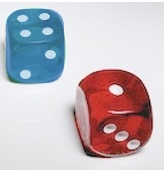 For some reason you keep being invited to dice games.
 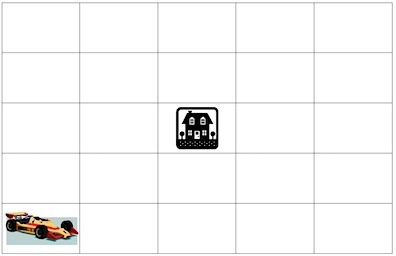 Greta is delivering a parcel to the house shown on the map. She can't drive, so she has to enter the next grid region location and the AI will drive her there. The interface is very simple: she enters U to go up one grid region and R to go right one grid region. Due to the Energy Efficiency Act of 2036 the AI cannot go down or left when making this delivery.
  A bag is filled with 100 red balls and 100 black balls. We randomly remove 150 balls using one of two methods.
 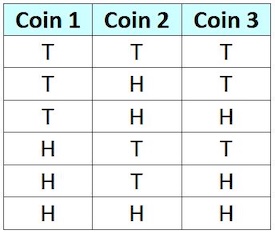 Gerry and Jane are paired-up to do an experiment in a science class. The experiment is looking at flipping 3 fair coins, all at once, to look at outcome probabilities.
  What is the minimum number of fair coins that need to be flipped, all at once, to give a less than one in 1 million chance of not even getting one head?
 In the ancient kingdom of Diceon it has been decreed that the standard 6-sided dice that have been used for millennia are offensive to the gods. From now on, in any game involving dice, the numbers 3 and 4 are no longer acceptable outcomes. If such an invalid number is thrown, the player must utter a simple incantation and take that throw again.
 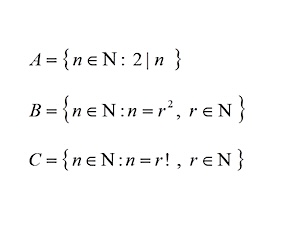 Which of these proper subsets of the naturals is smaller?
  A startup company has lots of young employees so at Xmas they like to do a Secret Santa scheme. Each employee is both a giver of one present and a receiver of one present in one-to-one correspondence, although they are never assigned to give a present to themselves. Drawing names from a hat is horrible because every time somebody draws their own name they have to put the paper back in the hat and try again. And if the last person draws their own name, the whole process is ruined, forcing a complete restart.
  There are 5 otherwise identical balls in a box.
 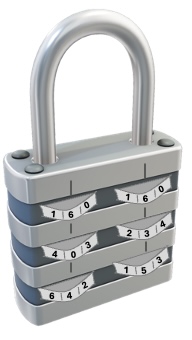 The Mechanical Engineering department of the prestigious LongWeiHaway University constructed a small safe with a beautiful 6-digit combination lock - using only the digits 0 to 6 (all codes being allowed).
 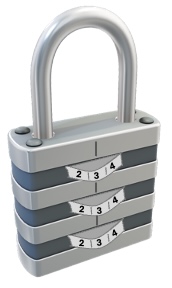 A prototype of a children's combination padlock has been made. It's specification is that it should have 3 digits, where each digit is one of {1, 2, 3, 4 }.
  The original code for the old lock was 4 different digits.
 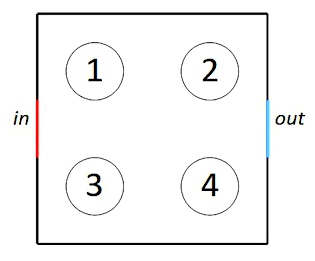 There are four prisoners numbered 1 to 4 (inclusive) with big numbers on their chests. Every Christmas the warden allows them to be released only if all four of them find their numbers in the secret room after at most three guesses. The prisoners have all year to decide on a strategy, but on the day they are not allowed to communicate at all.
 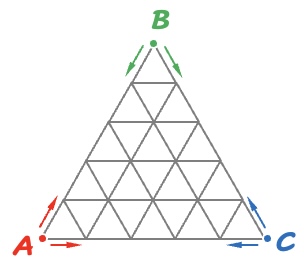 Ann, Ben, and Cenn visit Triangular city.
  In a best-of-three tennis match, the first player to win 2 sets wins the match.
 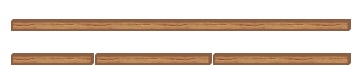 If you randomly break a stick into three pieces, what’s the probability that they can form a triangle?
  An urn contains two red balls, and thirteen blue balls. Jane and Gerry take turns randomly picking a ball from the urn, with Jane going first.
  An urn contains two red balls, one blue ball, and one white ball. Jane and Gerry take turns randomly picking a ball from the urn, with Jane going first.
 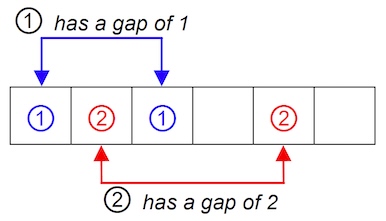 A Langford pairing takes two sets of natural numbers, {1, 2, ... N} and places them in a single row of length 2N such that the gap between each matched-pair of numbers is equal to that number.
  Every day a jar of sugar appears on the kitchen floor, which everyone assumes comes from some vast, all knowing, all seeing, beneficent deity.
  (1) A HUGE number of otherwise-identical consecutively numbered balls, starting from 1, are placed into an urn.
  This infinite geometric series soon settles down (converges) to a definite value.
 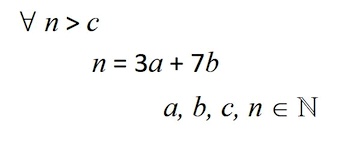 Aarna is excited to have discovered this new equation, which she has written in the cryptic language of mathematicians.
  An algorithmic pseudo-random natural number generator is known to very occasionally start-up in a fault-state, such that it produces only random natural numbers which are not divisible by 10.
 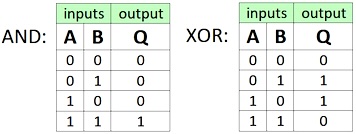 John has a collection of rare artefacts, each of which has a unique barcode label. Each barcode has an error correction scheme built-in so the ID of each item is always read with no reasonable probability of error.
 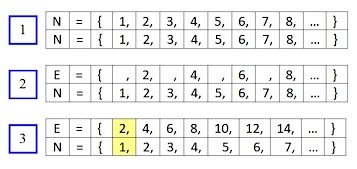 The image shows 3 steps to Galilean 1:1 correspondence between the even numbers and the natural numbers.
 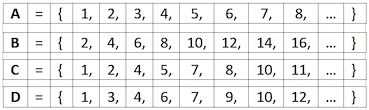 Which of the infinite sets shown have equal quantities of members (elements) in them?
  It is the start of the spring season, and Hilbert's Hotel is currently empty. Sadly, all the odd numbered rooms have yet to be cleaned, so they cannot be allocated to new guests. The new desk clerk has just started his first ever shift, after having completed his mandatory 4 minutes of training. He has simply been informed that Hilbert's Hotel has infinitely many rooms, sequentially numbered 1, 2, 3, 4, and so on.
  I claim that exactly 1 in 3 consecutive natural numbers is evenly divisible by 3.
  A deck of 52 cards is shuffled.
 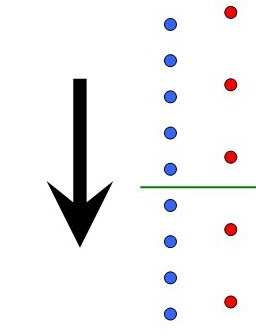 Manty, the mathematical ant, comes from a long line of genius mathematical ants. After a lifetime of mathematical enquiry, Grandad ant learned to count from 0 to 2. Anything above two was too much for his ant brain to comprehend, and was therefore deemed to be infinite. Grandad ant spent hours watching the infinity machine shown in the image. (The arrow is not part of the machine, it just shows the direction in which the pegs move.) Grandad ant counts the pegs as they pass the fixed green line, and sees that there are infinitely many blue pegs, and infinitely many red pegs.
  That infinities can be of different sizes is something which people find hard to think about, especially given the abundance of misinformation available on the subject. We therefore pose an interesting problem to get you to think more clearly on the subject.
 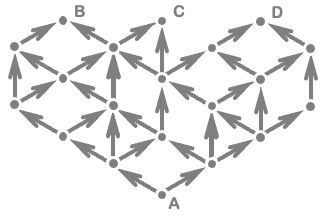 We move from point A randomly choosing one of the available directions.
 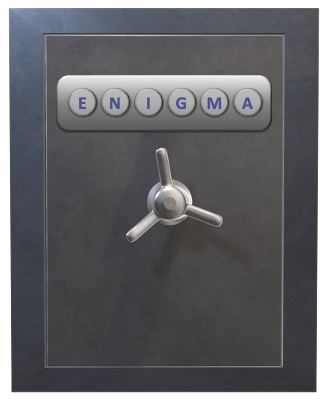 You press three buttons and try opening the safe's door. If it does not work you can start again. The secret combination is MAG in that exact order.
  On day one I was given a half of a pie.
On day two I was given a third of what was left of the same pie.
On day one I was given a half of a pie.
On day two I was given a third of what was left of the same pie.  A square tile has been placed near the middle of a large floor. It is permanently fixed in place.
  Ann hits a small target 80% of the time and Bob only 40% of the time.
  A bunny has four burrows in a field, all in a line. Every night the bunny moves from one burrow to a nearby burrow, not more than one burrow away. Every morning the farmer comes out and checks just one burrow to try to capture the bunny - which is eating the farmer's valuable crop.
  For natural numbers, N, some have the property
 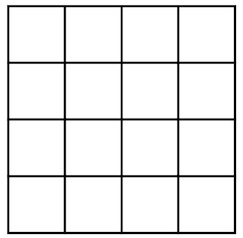 We randomly pick two squares on the 4 x 4 grid.
 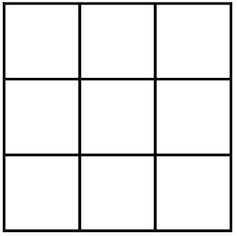 We randomly pick two squares on the 3 x 3 grid.
 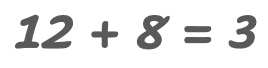 In this type of problem you are required to move one digit in order to make the equality correct.
 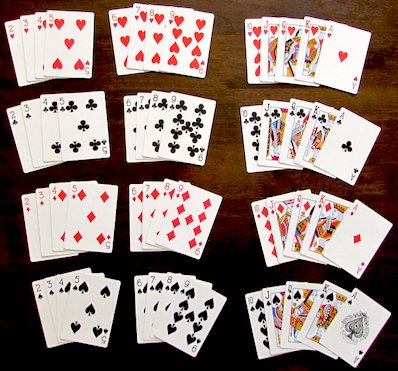 If we split a shuffled deck of playing cards into four sets of 13 cards, all arranged face-up so that all the cards are visible, is it always possible to intelligently select a heart from one pile, a club from a second pile, a diamond from a third, and a spade from the fourth?
  A scientist wishes to run a test using frequencies from 1000 Hertz to 2000 Hertz in 1% steps.
  You are going to test thousands of random numbers which uniformly range between 1 and 8 (inclusive).
  A professional magician invites you to inspect a $1 coin. It is a fake, having two heads. You are then invited to inspect 10 other $1 coins, which are all genuine.
 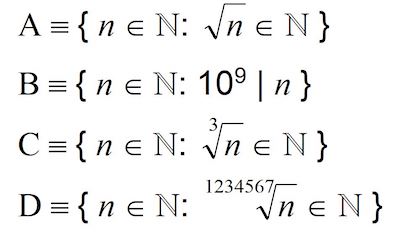 We have four infinite sets, each of which is a proper subset of the natural numbers. These infinities are markedly different in size.
 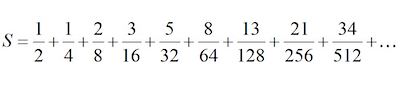 Evaluate the convergent infinite series shown.
 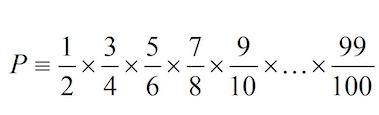 The value P is defined by the finite product shown in the image. It seems difficult to evaluate exactly, so we try to find upper and lower bounds for it. The closer the bounds get to the exact value, the more accurate they are.
 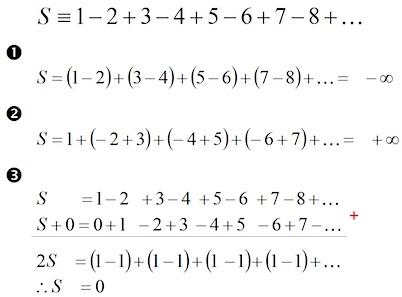 As a task at school, everyone has been asked to evaluate the infinite alternating series S. The teacher has collected the answers, three of which have been presented.
 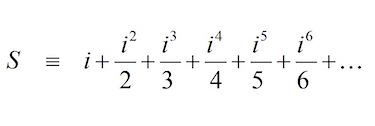 Does this infinite series converge to a definite value?
 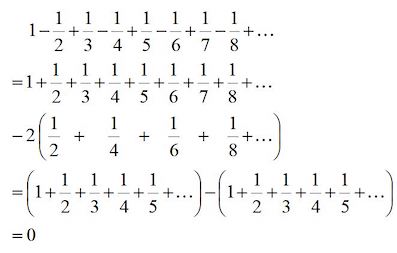 We have an infinite alternating series. To group the negative terms we add and subtract them, producing a bracket containing only negative terms.
 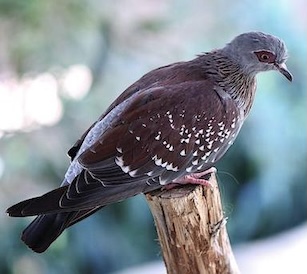 Imagine a dusty prairie where fence posts have been placed at uniform intervals in a straight line, heading off in both directions as far as the eye can see. There are so many fence posts you could say they are uncountable.
 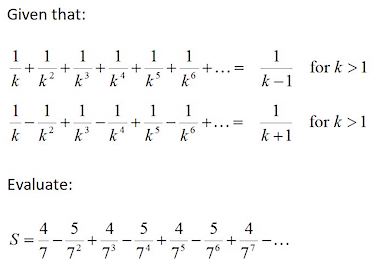 This is more like a logic puzzle than a problem in mathematics.
 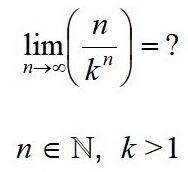 Let us decode the cryptic symbols for you.
 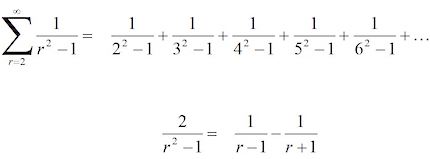 We wish to evaluate the infinite series shown, but we have no clue how to do so.
 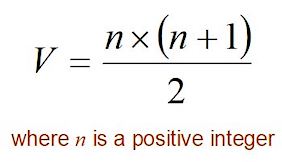 Consider the value V as shown in the picture.
 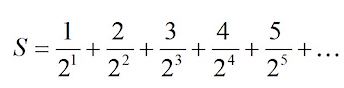 Evaluate S.
  Anne, Bob, and Carrie play a game arranged by an eccentric genius. Anne chooses from 10 identical boxes, exactly one of which contains a fabulously expensive gemstone. Anne was not able to handle the boxes, so her choice was purely random. Bob was standing next to Anne the whole time.
 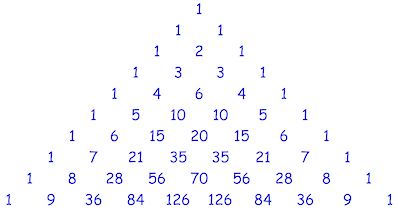 A fair standard 6-sided die is thrown seven times. On each throw a win consists of throwing either a 2 or a 6.
 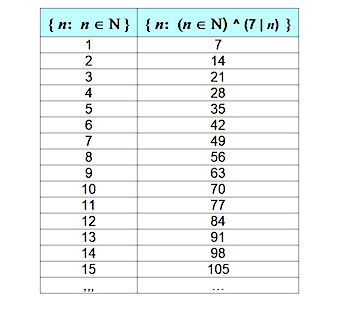 Suppose it were possible to imagine simple infinities which had different sizes. If you matched up the elements of the set of natural numbers with, for example, the elements of the set of natural numbers which are evenly divisible by 7, would it be reasonable to conclude that both sets had the same amount of elements?
 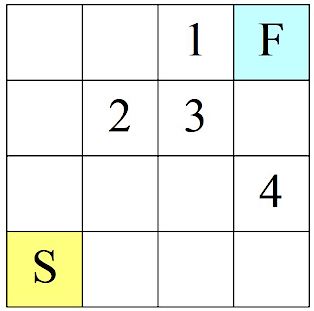 In this game of strategy you start from S. Using only up (U) or right (R) moves you must get to F.
  A binary number consists of exactly N digits, where N is greater than 71, and with each digit initially being set to 1.
  In an after-hours class, 6 students sit in the front row of desks, there being 12 desks in this row.
  There are 5 discs of identical weight, colour, texture and so forth such that they are indistinguishable to your gloved hand. You randomly draw a number of these discs from a bag in such a way that you do not see the number written on the disc.
 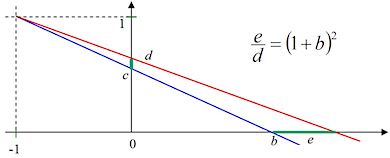 The image is adapted from Fig 14.1 of "Book of Proof" by Richard Hammack (3rd ed). What it is supposed to show is that numbers in the range 0 to 1 (up the y-axis) can be placed in 1:1 correspondence with all the numbers from zero to infinity along the x-axis. This is claimed to mean that there are as many points in the interval (0,1) as there are in the interval (0, INFINITY).
 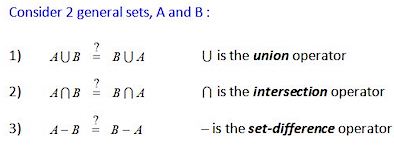 In early school work you would be very happy that if x and y were any sort of numbers then
 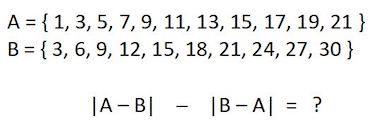 We have two sets, A and B, defined as shown in the image.
  A set is a container which holds things like numbers, letters, or even other sets.
 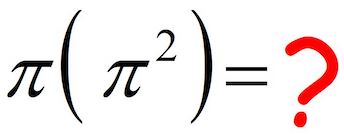 This is a deliberately confusing problem, so pay attention. There is a function called the prime counting function, which is represented by a π symbol outside of function brackets. The question asks what the value of the prime counting function is for the argument π2, where this π is the ordinary ratio circumference/diameter for a circle.
  The Acme Widget Corporation has a problem with its machines. Mostly the Widgets produced are perfect, but on an occasional basis a machine gets into a weird state wherein 1% of the Widgets are randomly faulty. The machines are switched on in the morning and off at night. Only after a batch has been produced do we know if the machine turned on in the faulty state.
 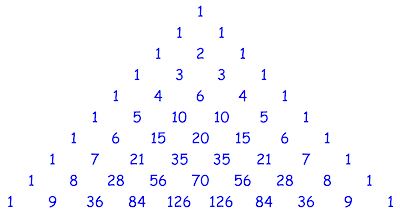 There are more than a few interesting patterns to be found within Pascal's triangle. Here we consider the numbers in any single row.
 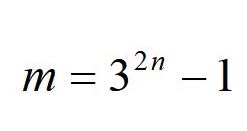 We have a whole number m which is formed by raising 3 to an even power, then subtracting one.
  A grandmother has four grandchildren, Alain, Brain, Cain, and Daine. Alain calls her every second day, Brain calls her every third day, Cain calls her every fifth day, and Daine wants to choose the rule, so that the granny has the smallest number of days without calls.
 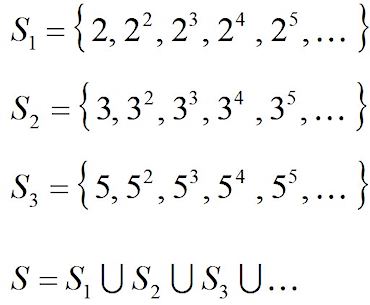 Here we consider an infinite collection of infinite sets, subscripted by the index of the first prime number in the set. The first prime number is 2, so we index that set as 1. The second prime number is 3 so we index that set as 2, and so on. Each subscripted infinite set starts with a prime number.
  More than four coins are placed on a table, with exactly half of them being heads up.
 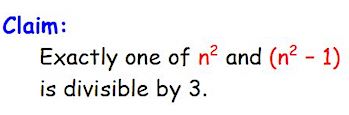 Is this claim true for natural numbers greater than 1?
 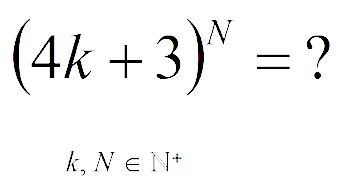 Here we would like to consider numbers of the form (4k + 3), in other words numbers whose modulo 4 residue is 3. Rather than only considering a single such number raised to a power N, we would like to broaden the claim to N such numbers multiplied together. We are just too lazy to write this out as (4a + 3) x (4b + 3) x (4c + 3) x ... for a, b, c, ... all positive integers. We have stipulated that both k and N are positive natural numbers. This is redundant in many cases, since the natural numbers are usually defined to be { 1, 2, 3, 4, ... }. But sometimes zero is included, so by saying only the positive ones we explicitly exclude the zero.
 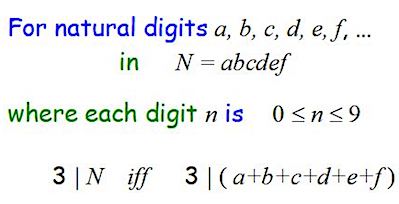 The first step is to be able to read and understand the image.
 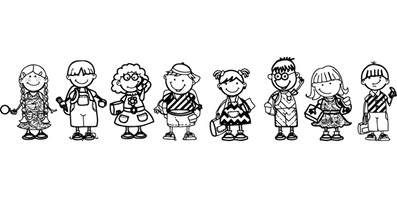 A teacher splits a group of eight kids into two groups of four.
 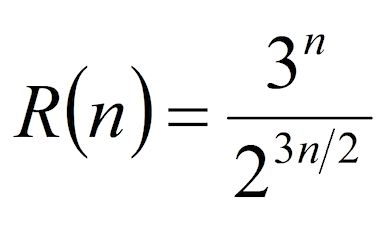 The image shows the definition of the function R( ) for the natural argument n.
  A miner is trapped in a mine at a junction containing 3 unmarked doors. One random door leads to a tunnel that will take him to safety after 10 minutes of walking. Another random door leads to a tunnel that will take him to a similar junction with 3 random doors after 20 minutes of travel. The final random door leads to a tunnel that will take him to yet another similar junction with 3 random doors after 30 minutes of travel. The miner has no idea which door is the safe exit, and he cannot go back.
  What is the chance to get a parking ticket in 15 minutes if the chance to get a ticket in an hour is 0.9984?
  Austin and Bart are serial entrepreneurs with many promising ideas. They need initial investment for their ideas. A venture capitalist Craig decides to invest one million dollars in a new business. One at a time, Austin and Bart ask Craig for the initial investment.
 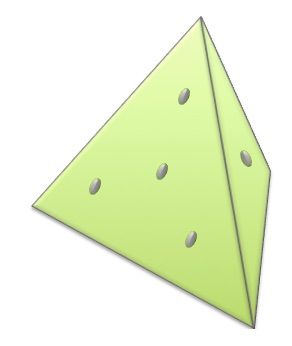 A tetrahedron (triangular-based pyramid) has four faces. Dice can be made from regular tetrahedra, with the faces numbered 1, 2, 3, and 4.
 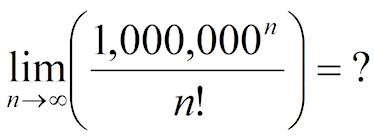 What this scary looking expression means is consider what happens to the value of the ratio of one million raised to the power of n divided by n factorial as n increases indefinitely.
  We wish to form as many distinct (unique) sequences of the letters A, B, A, C and A as possible.
 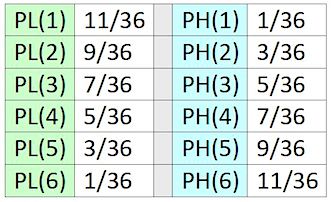 Laura plays a game of dice with her younger brother Harry. Each has two fair 6-sided dice.
 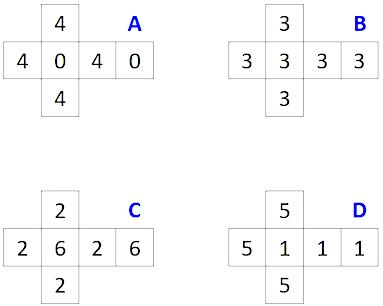 The image shows 4 dice drawn flattened out, each with 6 sides, but with unusual numbers. Four such dice have been made, but it is guaranteed that they have not been biassed with weights or otherwise.
  What can be done in a greater number of ways?
 As at December 2019 the A+click website had 10,000 free problems on it. The site Admin was interviewed by a reporter from the Daily Tattler, and the reporter asked about the possibility of problems being duplicated within that number. The site Admin, without even taking time to breathe, responded that the probability of any two questions being sufficiently similar to be considered as duplicates was "one in a million".
  In some near future postal sorting office, the whole operation is controlled by a central Artificial Intelligence (AI) and a robotic workforce. Due to an outdated deal with the unions, just one human worker per site is retained. The AI gives the human the task of sorting 3 letters per day, one into each of 3 sorting bins. It is improbable that the human will sort all the letters incorrectly, such that no letter gets into its correct bin. In such a case the AI is allowed to dismiss the human worker for deliberate sabotage.
 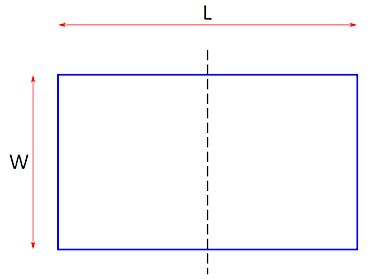 Consider a piece of paper with a long side, L, and a short side, W.
  The probability of the school bus not arriving on time in the morning at some point during the school term is 0.95.
The probability of the school bus being late due to a flat tire (tyre) during term time is 0.31.
The probability of the school bus not arriving on time in the morning at some point during the school term is 0.95.
The probability of the school bus being late due to a flat tire (tyre) during term time is 0.31.  It is hard to describe malaria as simply a very nasty disease, since 1 million people die of it each year. Nevertheless, holidaymakers still travel to locations in which malaria is endemic (constant and widespread within an area).
  If you filled a cup with liquid you would be confident that the internal surface was covered.
  A perfect square is an integer formed as the square of another integer. A perfect cube is an integer formed as the cube of another integer.
 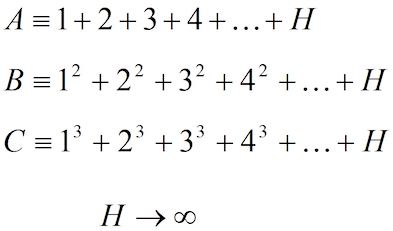 First we should explain the notation being used here. The three-bar equals sign means we are defining the symbols on the left.
 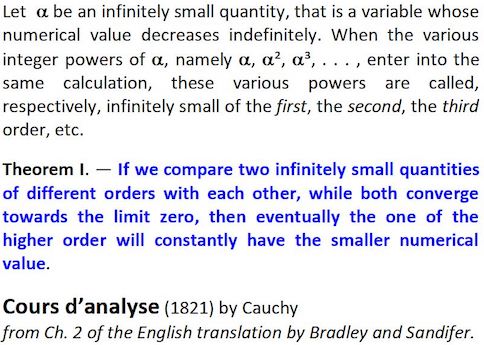 Using the definition of α given, for a positive α, along with three finite positive constants a, b, and c, place the terms in the correct order.
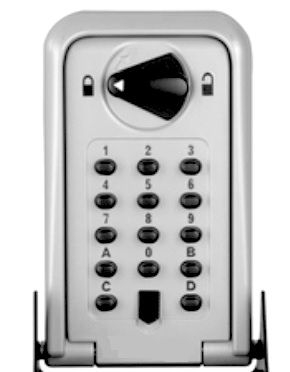 A keysafe, as shown in the picture, is used to store house keys for anyone who knows the code. The code is a combination of pressed keys in the true mathematical sense, since the order in which they are pressed is not relevant.
  A key-safe is a box mounted outside a house which holds spare house keys. This is so that elderly or immobile people who live alone can be easily visited by care-workers who know the code.
 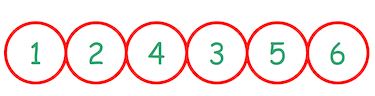 The six counters labelled 1-6 are randomly placed in a line which we can consider as a string of digits. This can be done in exactly 6! = 720 different ways.
  You have counters labelled 0 to 9 as shown, and two identical blank yellow counters.
 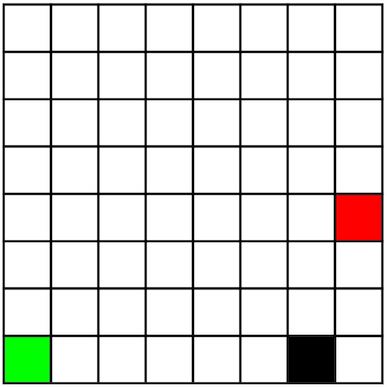 You start on the green square at the left. You move to the red square at the right. Each move is either up, down, left, or right. You are not allowed to step on the black square.
  The long-time caretaker at the local school has been tasked with painting the three walls of the large assembly room. Each wall will take a whole day to paint.
  You are buying a roller online on Amazon. Four similar rollers have the same functions, the same price, the same look, but different ratings.
  There are 12 colored square counters in each of four bags.
  There are 5 counters in a bag.
 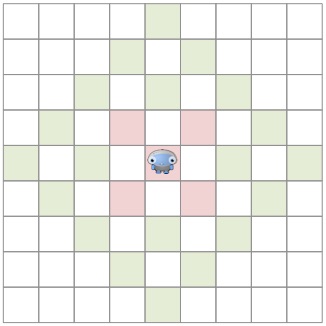 A robot starts at the central square of the grid and makes four moves to a neighboring cell, with each move in a randomly selected direction (north, south, west, or east). It stops in one of the colored cells.
  There is statistical evidence that each of three boys only tell the truth 75% of the time, independent of the nature of the question being asked.
  Jane wrote the number 2020 in the base 2 (binary) system.
 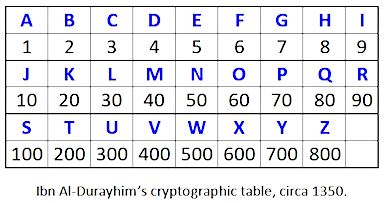 The fire is still glowing, so it is apparent that the spy was here recently. Forensics have noticed that the hidden copy of the book DE CIPHER by Mark Frary was most used on the page showing the cryptographic table in the image.
  A physics student has decided, somewhat arbitrarily, that she does not want to eat the same pair of meals on successive days. For example if she ate stew yesterday, and yoghurt salad today, she does not wish to repeat that pattern, in any order. She has only 6 meal choices.
 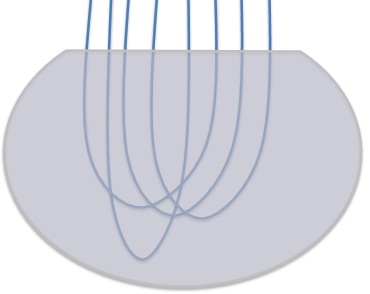 There are four strings in a bag. Jane randomly picks two ends and ties them together, until there are no free ends left.
  The central petting zoo has 100,000 visitors each day, but sadly there have been 10 visitors per day smuggling chocolate into the zoo to feed to the animals. For some animals (including dogs) chocolate is poisonous, so there are signs all around the zoo to try to prevent harm to the animals.
  You have a huge bag filled with equal huge quantities of otherwise identical red and white balls.
  Evaluate the sum given in the picture.
 The maharaja, in his splendid palace, is bored; sooooooo very bored. He has to make everything a game to add interest to his otherwise meaningless life of gluttony and inaction.
 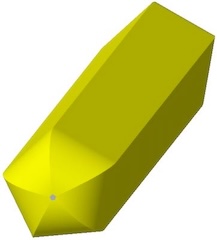 It is not possible to make fair dice with 5 sides, so instead we make dice in the form of long regular pentagonal prisms, the ends being some weird blended hemisphere. The five flat faces are numbered 1 to 5. There is an equal probability of any particular number being face down, this being the only certain way of defining which number was rolled.
  As slaves building the Pharaoh's pyramid, we are allotted one unit of flour per day to make our own bread. However, the wicked Overseer is skimming our rations so that each day we get less than the previous day's ration by the factor (1 - d), where d is very small, positive, and non-zero.
 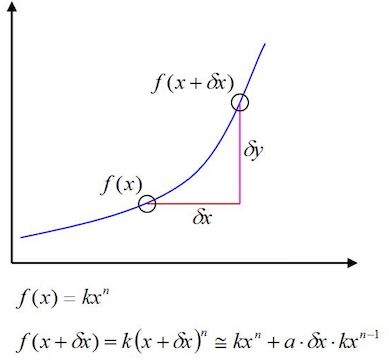 The blue curve is some function of x, written as f(x) , and read as f of x. It does not mean f multiplied by x.
  Infinitesimal lengths are problematic because any finite number of infinitesimal lengths doesn't add up to anything. A lot of almost nothings is still almost nothing.
 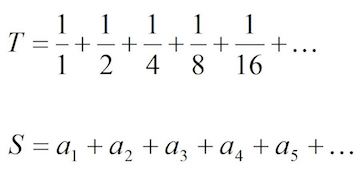 T is an example of a convergent infinite series. S is a more general infinite series, and we suppose that this too is convergent. (Individual a-values can include minus signs.)
  A mathematics professor is fed-up with students passing his examinations simply by randomly answering multiple choice questions. He therefore plants one stupid answer per set of 5 answers to a question. For example if the question was "Which mathematical operation is non-commutative?" the answers would include "appendectomy".
 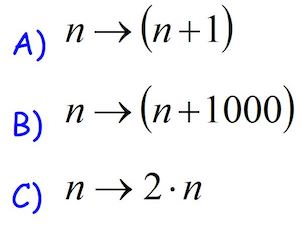 The three different procedures shown go from some positive integer n to a new value at each step.
  The robot starts from the center of the grid, and ends up one unit to the north and two units to the east after not more than five steps of one unit each.
  Eleanor has now reached a televised game show final round. She has picked (but not opened) 1 from the available 12 lockers. One (unknown) locker contains gold coins to the value of $100,000. The other lockers contain gifts to the value of not more than $10 each.
 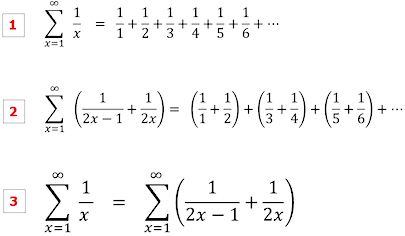 Statement [1] is correct. The big sigma on the left is a summation sign commonly used in mathematics and physics.
  Evaluate the divergent series shown, given that H is a large positive integer.
  There are 9 soldiers in a squad. Every evening three of them are on guard duty, but no two of them are on duty at the same time more than once.
 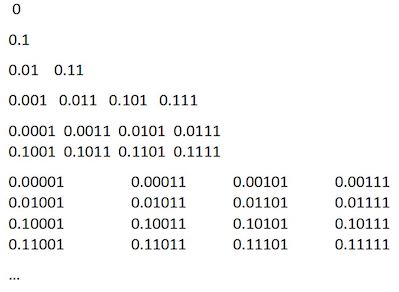 Can you spot the pattern in this infinite sequence of fractional binary values?
  Marek, the pan-dimensional super being, is bored, so she decides to play a game. She telepathically communicates "catch me if you can" to her pan-dimensional super-buddies. She is situated on a vast open desert plain, extending at least 5000 km in all directions. She instantaneously jumps 1000 km due north. Call this jump 1 unit of length. Subsequent jumps are 1/2, 1/3, 1/4, 1/5 units, and so on. Each successive jump is exactly to the right of the previous direction.
 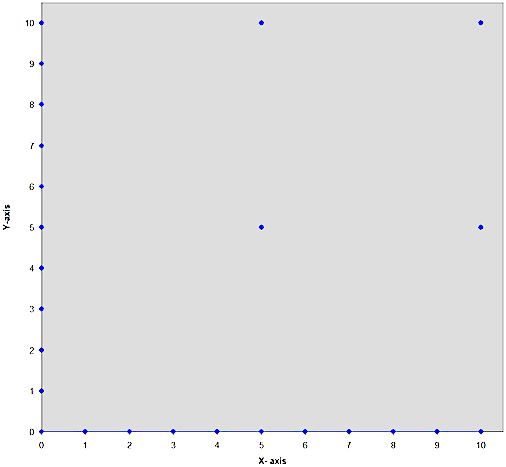 Along the axes every positive integer is marked by a blob. In the middle grey section, blobs only occur when both the x-value and the y-value are evenly divisible by 5.
 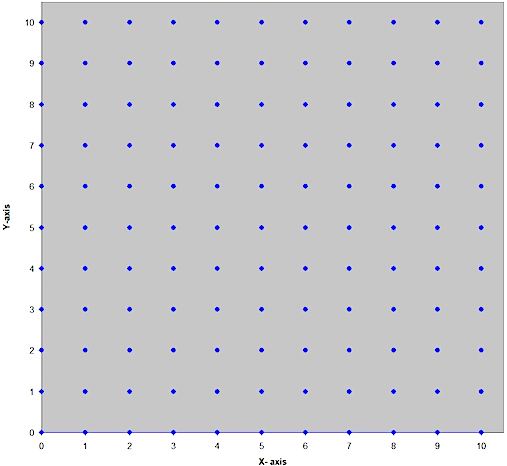 Consider the grid of points with positive integer x and y values.
 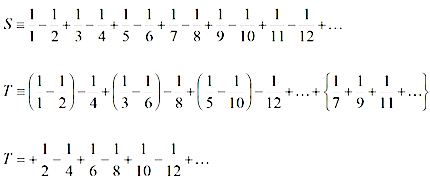 Here we show the convergent infinite series S, which has the definite value of the natural logarithm of 2, ln(2).
 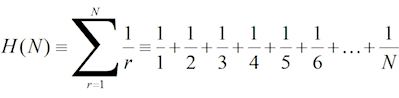 The image shows the partial sum of an infinite series. If we steadily increase N and the partial sums settle down to a definite value, the series is called convergent. If it does anything else it is described as divergent. The series shown is divergent.
 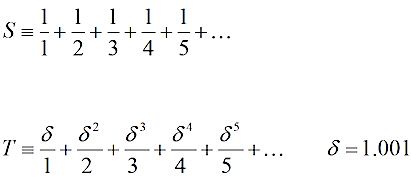 The image shows two infinite sums. The three-bar equals sign just means "identically equal to" or "is defined by".
  A collector has bought 10 old visibly distinct gold coins, exactly one of which is known to be fake. He has a pair of balance scales which will easily identify the fake, since the fake will be much lighter than any of the real coins. The real coins will balance against each other.
  A coin collector has 7 large gold coins, 5 large silver coins, and 8 large bronze coins. His assistant has been told to remove them from the locked security cabinet and dust them, before returning them to their drawers. There are exactly 10 drawers, and the assistant successfully puts two coins in each drawer, albeit in some haphazard way.
 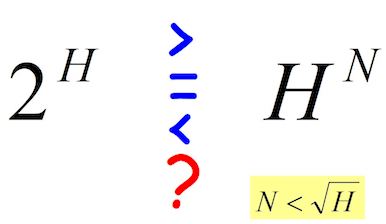 Given that H is a really HUGE value, we wish to compare the expressions on the left-hand-side (LHS) and the right-hand-side (RHS) of the image.
 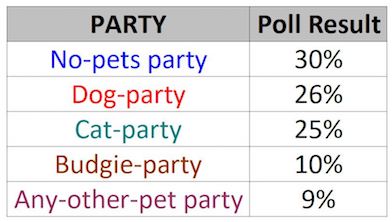 Five different parties are standing in an election for one representative. The poll results are expected to be accurate.
 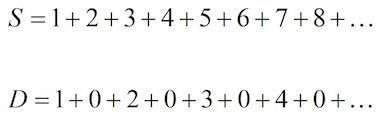 We have two infinite sums: S is the sum of all counting numbers. D is the sum of all counting numbers, but with zeros added between each term.
 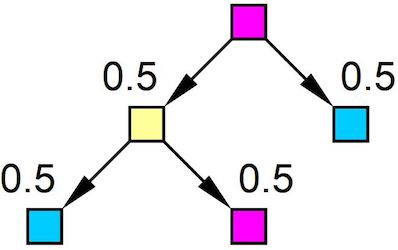 The diagram shows a random walk with equal probability of going left or right. The top purple square is the start point.
 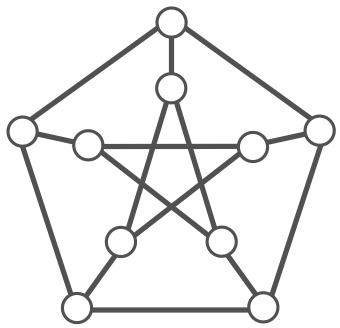 Graph theory is the study of mathematical structures used to model pairwise relations between objects. A graph is made up of vertices (also called nodes) which are connected by edges (also called links).
 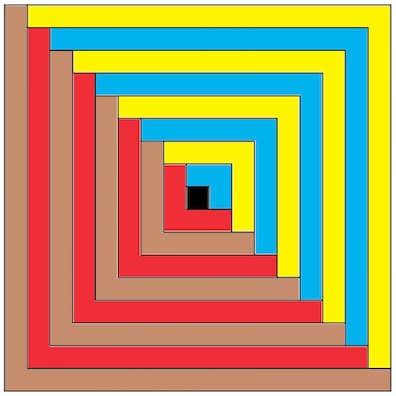 The image shows just the inner part of an infinitely large pattern of squares. The brown and yellow parts together form a square frame. Likewise the red and blue parts form a square frame. The frames are all one unit wide, this also being the side length of the small black square in the middle.
  You have 3 gold coins, all notionally of the same sort. They came from a dubious source, so any number of them could be fake. A fake gold coin is always lighter than a real gold coin. You have 3 real gold coins as references.
 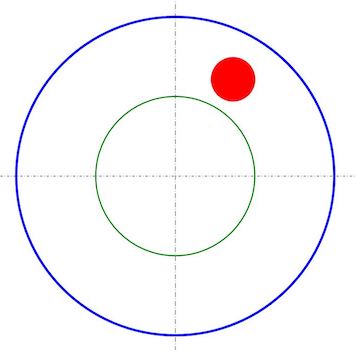 The flat red disc falls randomly, completely within the confines of the blue circle. The green circular line is concentric with the blue circle, the line itself effectively having no thickness.
  We have 2N coins, (N > 8), exactly one of which is a fake coin with either two heads or two tails (and we don't know which). We cannot spot this fake coin by looking at just one face.
  You toss four coins, all at once. At least three of these coins are fair and unbiased. At most one of the four coins is a fake, a magician's coin, fixed with either two heads or two tails. You don't know if you have tossed such a coin, and if you have which type of coin it was.
  When I roll three dice, what is the probability that all three numbers are different?
 Six points are randomly chosen at the edge of a pizza.
  Suppose that you meet 1000 people in your time at college. Further suppose that 40% of those are male. Further suppose that 20% of those are stylish. Further suppose that 10% of those have trendy hairstyles.
  You have $10,000 in a savings account paying 1% annual interest to a different account. By going on to the savings account website you can easily change to a new account (with similar terms and conditions) that pays 1.5% annual interest.
 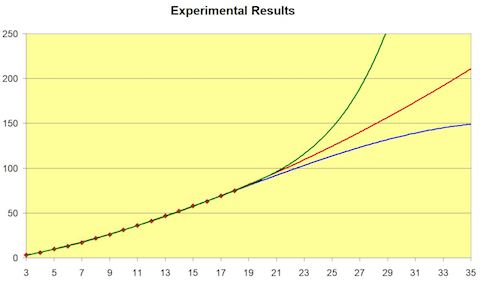 Here we show genuine experimental results (the red diamonds) from points 3 to 18 inclusive. The upper green curve is a best-fit fifth-order polynomial. The lower blue curve is a best-fit fourth-order polynomial. The middle red curve is a best-fit second-order polynomial.
 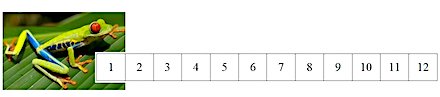 We have to pick one of three specially-trained highly-intelligent frogs for a secret mission. Each frog has two possible jump sizes it has mastered. None can jump directly to any intermediate distances.
 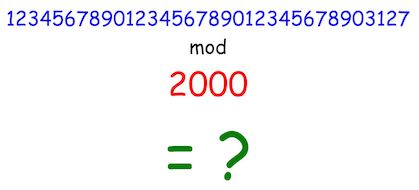 You did 'clock arithmetic' at school when you were little. Maybe it seemed boring as it apparently had no use.
 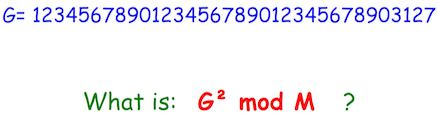 You did 'clock arithmetic' at school when you were little.
 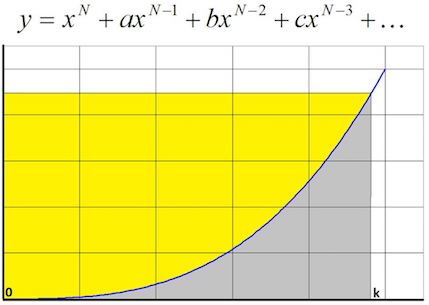 We have a polynomial with fairly general coefficients, as shown in the image using standard Cartesian axes. We want to know what the ratio of the yellow area to the grey area is for some large value k, where k is increased until the ratio is no longer changed by, for example, doubling k.
  We have two standard summation formulae: one for counting numbers, and the other for the squares of counting numbers. Now suppose that instead of having the same number of terms in each we decide to use as many terms as necessary such that the last term in the summation is some horrendously humongously huge value, H.
  The interesting series shown is divergent, even though the terms get progressively smaller. The value of H(N) increases as N increases, and the infinite sum is said to have "an infinite" value. But just how big is that?
  Leslie Green asks:
 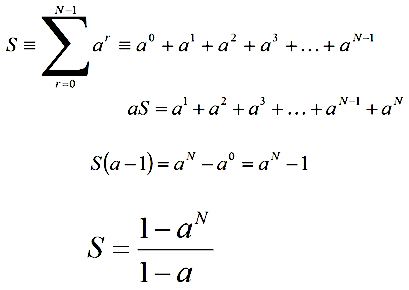 The finite series S is defined as shown in the image.
  Georg Cantor (1845-1918) came up with a method to prove that there are an equal number of rational numbers and counting numbers. This is depicted in the image. We start from the finite set of counting numbers up to 10. Cantor claims that by associating each counting number with the next rational number in the array, every rational number is eventually mapped uniquely to a counting number.
  There are 15 cities (red circles) in Three Pentagons county which are linked by country roads (blue lines).
  The image shows a standard summation formula.
  A scientific expedition to a remote location finds the area infested with fleas. Raised circular sampling plates, covered in flea poison, are placed around the area.
  You wish to simulate a random distribution consisting of points within a circular area, each point being equally probable. To do this you pick random angles (α) in the range of 0 to 2π radians, and random distances (R) up to the required radius of the circular region. This gives random (x,y) points as:
  We have balls which are either red or blue. Their weight, texture, size, and shape are all the same.
  The picture shows a subway map.
  We have balls which are either red or blue. Their weight, texture, size, and shape are all the same.
  There is a low probability (P) that an event (E) will happen on any particular occasion, but the opportunities for this event are quite numerous (N).
  Anna, Catherine, Evelyn, Barbara, and Daisy together have 18 stuffed animals.
  A tree grows quickly in its first year, then its annual growth is always 75% of the growth in the preceding year. It reaches its maximum height at the age of 100 years.
  Each letter is uniquely mapped to a digit, and no digit is re-used. We assume leading zero suppression because that is the natural way that numbers are written.
  Premium cabbages have to be within the range 1 kg ±200 g.
 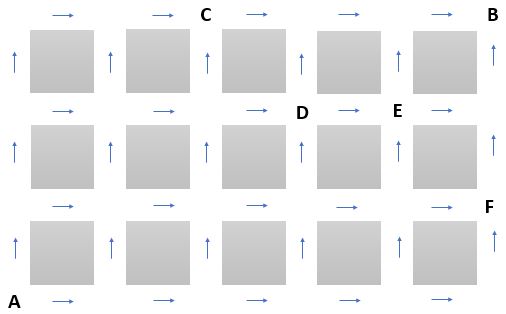 The figure shows a map of a part of a city. Every morning John walks from his home A to his school B every time randomly choosing either north or east if there is such a choice.
  Kevin is watching his niece stack wooden blocks. He wonders what happens to the relative height deviation as the number of blocks increases, supposing all blocks have the same Gaussian height distribution, and the blocks are incompressible.
  Is there any problem with this question?
 A party has been organised with adults and teenagers. It is essential that there are roughly as many adults as teenagers in order to avoid a riot.
  Every morning, a postman puts the same number of letters into a selection of boxes chosen strategically from the available 33 boxes. Typically, on each day the number of letters chosen is different, and the selection of boxes chosen is different.
  We are given a set of outcomes for a secret experiment. The outcomes are too secret to mention, so they have been labelled as A, B, C, D and E.
  Social interactions are very complicated. Jane wants to sit next to Gerry, but would not be so obvious as to save a seat for him. Gerry will sit next to Jane if he can, be he is expected to arrive last out of the group of 4 students. Jane arrives first and has to pick the optimum spot to maximise her chance of sitting next to Gerry.
  At a particular school there is a certain number of boys, B. Some fraction of the boys, H, have brown hair. Some fraction, G, of the students wear glasses.
  One hundred students were surveyed to determine if they regularly use the following services: Amazingon, Goodle, or Factbook.
  If we look back to a time before digital cameras were everywhere (say before 1980) it was common practice when on holiday to get somebody else to take your photo. You would give them your camera and they would take the photo. (Nowadays it seems to be all 'selfies'.)
  A local diary delivers 1000 pots of natural yogurt to a middle school every day. The probability of a single random faulty pot is 0.001, but they are only really concerned about having two or more faulty pots per delivery.
  A particular opportunistic petty thief commits his crimes at a rate of roughly 1500 per year. For any given crime there is a 99.9% chance that he will get away with it.
  There are 77 lights in a concert hall.
  In this game you are going to pick two cards at random, one from each group of pre-selected cards. One group is to your left and one group is to your right.
  From an analysis of road traffic accidents in the last year a fairly large number of accident black spots have been identified where the accident rate is between 2 and 4 times the national average.
  Patricia randomly chooses a pen from a large collection of white, yellow, and blue pens. The numbers of white and yellow pens are the same. There are twice as many blue pens as white pens.
  Leslie Green asks:
  What is the fewest number of people that could have visited a movie show in the open-air cinema, if exactly 99.84% of the people watched the film until the end?
 What is the sum of the unknowns A and B?
 Matrix multiplication in general is non-commutative.
  Multiplication of 2 x 2 matrices is boring and only for little kids ... except perhaps when they contain imaginary numbers.
  What is the value of A?
 You are in charge of quality control in a factory producing tens of thousands of self-sealing stem bolts per day. You measure the length of every bolt and produce a statistics report for the management every month. You have curve-fitted the data to a Gaussian (Normal) distribution and extracted the mean and variance data.
  The manufacturer of a 5000 point linear sensor array for flatbed scanners has a new quality manager. The old quality manager ignored single isolated pixel faults within the array, but rejected an array where two faulty pixels were right next to each other. The new quality manager wishes to improve quality by rejecting dual-fault arrays if the two pixels are within 10 pixels of each other.
  If one elf can make two elves after an hour of work, how many elves are there after 24 hours?
 The numbers W, X, Y, and Z are 1, 2, 3, and 4 in some order.
  The black washer is constrained to randomly fall flat onto the outer square, the outer edge of the washer being within the outer square. The diagram is exactly to scale.
  Consider an extremely rare event which might randomly happen with a probability, P, of 1 in 1 million million (10-12). This might be the probability of your street getting hit by a meteorite during a particular hour, for example, but we don't pretend for an instant that the probability given is actually correct for such an event. Now consider that this event has 10 million chances to occur (N), so for our example we might say our observation period was 10 million hours.
  Leslie Green asks:
  One of the most ancient examples of literature on clay tablets says that Gilgamesh was 1/3 god and 2/3 human.
  The probability of meeting a bear in a 3-day hiking trip in the Wild Life National Park is 0.875.
  Find the sum.
  You have two pairs of socks.
  Ten brave men are in the corners of a pathway that has the shape of a regular star.
  Martin had $100 million three years ago.
  At a factory, a quality controller inspects 5 randomly-selected light sets out of every 800 items produced.
  Compare the security of a 4 digit passcode using two different entry methods:
  Estimate the number of cells on the surface of the sphere.
 Gerry aims at the center (centre) of the large target. He is sufficiently accurate that he always hits the target. He throws 2 darts and adds up the scores.
  Ten bees work today. Each bee, after the first one, collects one less than twice as many grains of pollen as the previous bee.
  There are 4 transparent and 11 green-glass soda bottles in a crate.
  Medical Test.
  Jane and Gerry put the marbles in a bag.
  Jane is studying the subject of fluid mechanics from text books. In the first book she reads she estimates that there were 1000 key facts presented. In the next book she reads this also presents 1000 facts, but half of these are duplicates of what she has already read, but more worryingly, 0.1% contradict previous facts.
  Suppose you want to photograph the cat when it passes through an invisible beam, but you also want to know where it came from. You automatically record the digital camera images to a memory buffer, one after the other, always overwriting the oldest image. The buffer has a certain length, and when you get to the end, you start again at the beginning. Each position in the buffer has a positive index, starting from 0. You write to the current position, then increase the position counter by one. When you increase beyond the end of the buffer you reset the counter to zero.
  Alan, aged 10, has a devious plan to "prove" that he is good at mathematics. He plans to go on to the site ApusClick.com and take on questions for 17 year olds in front of a single adult witness. He will randomly click on answers to two questions only. If he gets both correct he gets his witness to tell everyone what happened, "proving" his brilliance. If he gets any question wrong, he immediately stops, discards that adult, and picks a new witness.
  In a typical carnival game, the player tries to throw a rubber ring over a wooden peg.
  Your boss has asked you to produce a report of average sales figures over the last few years.
  The FastMoney bank decides to only allow passwords with a length of exactly 8 characters. Each position in the password can contain a lower case letter, an upper case letter, a digit, or a special character. For simplicity we will take the sum as 70 possible characters per position.
  The picture shows problem complexity growth curves for computing problems. If N is the number of elements in the problem, then the growth can be proportional to
  Leslie Green asks:
  Gerry moves to an area that has floods with a 100-year recurrence interval and volcanic eruptions with 200-year recurrence interval.
  3! means 3 factorial : 3! = 1 x 2 x 3 = 6
  A Wikipedia article shows parts of the Earth with annual sunshine duration (sunshine hours).
  The shape obtained from rotating the equation about the x-axis resembles a trumpet. Hence, the solid so obtained is called Torricelli’s trumpet or Gabriel’s horn or the horn of infinity.
  Box A contains 3 blue balls and 1 red ball, all of the same size, weight, and texture.
  The Two Envelope Paradox
  In a city, all adults are married and some couples have a child. Exactly half of the population including children are in 2-member families and exactly half of the people are in 3-member families.
  Anna, Bob, Cindy, and Daniel have correspondingly 50%, 60%, 70%, and 80% chances of knowing how to solve each problem correctly in the next test. They know which problem they can and cannot solve.
  John takes a fair coin and tosses it until the sequence head-tail-tail (HTT) is achieved. This is one run. He records the number of tosses to achieve the result then starts again, discarding the recent coin toss history. He averages the number of tosses per run over a great many runs.
  Balls sequentially numbered from 1 to 10 are put into a box at 1 minute to noon, then number 1 is taken out. At 1/2 minute to noon balls numbered 11 to 20 are put in then number 2 is removed. At 1/3 minute to noon balls 21 to 30 are put in and number 3 is removed, and so on.
  John accidentally drops his text book and it falls open at a random position somewhere near the middle of the book. He immediately counts the sum of the two visible page numbers.
  Five students choose their places on a bench that only has space for 5 students. Jane comes first and randomly chooses a place. Any future person will only sit in a seat next to someone who is already sitting down.
  Evguenia's teacher assigns 24 math problems to solve. She sorts them from the simplest to the hardest. She can solve the simplest problem in 1 minute. Each following problem requires 2 seconds more than the previous one.
  Leslie Green asks: " The sinusoidal waveform shown has a peak amplitude of 20 and a period of 2. What is a rough estimate for the mean value of the waveform over the interval shown (from t=0 to t=5)? (There is no need to use Calculus).
  Twenty Knights sit around the Round Table in the following order:
  Martin, the mathematical mole, has dug an extensive network of underground tunnels which he has approximated, in his magnificent mole mind, as a 3D lattice of 30 x 30 x 30 intersections. The distance between intersections is approximately constant. He is currently at intersection (20, 20, 15) and wishes to get to his secret food cache at (25, 25, 20) by one of the many shortest routes available. There are stones blocking the intersections at (21, 22, 10), (22,19,18), (22, 22, 16), (24, 18, 18) and (26, 26, 18).
  Anton, the highest IQ house ant on the planet, is taking his regular nocturnal walk from one corner of the chess board (1,1) to the diagonally opposite corner (8,8), moving only right or up the board at each successive square. He remembers that on square (5,3) there is a 'black-hole', so any valid route must exclude this square.
  Einstein, the hyper-intelligent house cat, is busy walking from one corner of a rectangular room to the diagonally opposite corner in an apparently random manner. His rather stupid human slaves can’t work out what he is doing.
  A team of two geeks, Jane and Gerry, independently answers true-or-false questions.
  Jane was a naughty little girl. When she used to play 2-dice games with her late grandfather she always used to cheat. Her grandfather would pretend not to notice that the dice had landed and that she quickly changed one of the dice to her advantage. Specifically, if it was her throw she changed the lowest die to a 6. If it was his throw she changed the highest die to a 1.
  Leslie Green asks:
  I roll two dice, one with the left hand and one with the right.
  Coin landing on its edge
  I put red and white chocolate candies into a bag.
  Gerry's favorite digit is 7.
  I bought a 20'' (the diagonal size) laptop with the ratio of the screen width to the height 4 : 3.
  How many ways can five runners take first, second, and third place in a competition?
 The cost of living increased in the first year and it decreased in the second year by the same value.
  James the Mathematician wants to find a partner for a serious relationship. He has his own scoring system. He talks with N out of 100 girls, permanently rejects them all, but records the best score. He then talks with the remaining 100 - N girls, seeking one with a score exceeding S. Any girl not exceeding a score of S is permanently rejected. As soon as a girl with a score exceeding S is found, he aborts his search.
  Six dice are thrown.
  When Jane plays against Gerry in her favorite game, the odds are 5 to 3 that she will win.
  A ball rebounds half of the height from which it is dropped in a sport hall.
  How many 3x3 squares are there on a chessboard?
 Veryfast Airlines loses 20% of the luggage.
  When 4 coins are tossed, what is the probability that exactly 2 are heads?
 My car can travel 20 km on one liter of gas on the motorway and 12 km on one liter of gas in the city.
  The sum of the integers from 1 to 2,000 inclusive is 2,001,000.
  Estimate the probability that no two of four sisters were born in the same day of the week?
 If the probability of observing a white car in 10 minutes on a motorway is 0.99999, what is the probability of observing a white car in 2 minutes?
 John and I share a single glass of milk.
  Estimate the total you pay if the meal costs $29, the tax is 5%, and the tip is at least 15%.
  You can throw as many darts as necessary at the board shown in the picture.
  Anna and Bill roll a six-sided die.
  A concert consists of 3 cello pieces and 3 piano pieces.
  This is a standard set of dominoes.
  In a country, a baby is born every 5 seconds, a person dies every 45 seconds, and a new immigrant comes to the country every 20 seconds.
  The picture shows a subway map.
  A player must match three different numbers chosen from the integers 1 to 30 in any order to win a lottery.
  Find the infinite sum:
  Alex possesses 52% of a business and the rest belongs to Bill.
  Place the cards into two boxes so that the probability of randomly drawing a card with the letter B is at its maximum.
  What is the average of the largest of N random numbers from 0 to 1?
 Find the sum of the series:
  We want to merge 4 companies into one large company.
  A chess queen attacks all squares along its path horizontally, vertically and diagonally.
  Logic question.
  Eight bugs are at the eight corners of an equilateral cube.
  Which mass is greater than the mass of a cumulus cloud, which is about 1 cubic kilometer in volume?
  This picture shows the first five rows of Pascal's triangle.
  Alex received a 90 on his essay and an 80 on his final.
  Logic puzzle:
  In a venture investment fund, all investors continue to invest into a new start-up company until the company becomes a great success.
  How many different cubes can I make by using six different colors such that each face has a different color?
  A venture capitalist has choosen to invest in only one of three start-up companies: A, B, or C.
  Make 727 by using three 7s.
  After a rodeo, four cowboys have a meeting in a saloon.
  A 4-character password uses exactly two different digits.
  I randomly place three crosses into different cells of the grid.
  Two princes and two princesses are ready to marry.
  Abbey has a dog Abby.
  What is the units digit of 1! + 2! + 3! + ... + 2011!?
  A boy begins walking from his starting point. Each hour, he either walks one kilometer to the east or one kilometer to the north, but he never walks in the same direction as he did in the previous hour.
  This formula, developed by Austrian mathematician Richard Von Mises, shows the probability that at least 2 people from n have their birthdays on the same day of the week.
  Five people sit at a round table.
  John is sick 6 days per year.
  What is the average of these numbers?
 The probability that two randomly chosen people in a big city are younger than 25 is 25%.
  As each of the five eggs is weighed, the average weight of the eggs weighed to that point (the cumulative average) increases by one gram each time.
  The table shows the results of a competition among 5 teams.
  John has an average of 89 on his three math exams.
  If the area of the left triangle is 100%, what is the area of the second triangle?
 Anna has 3 bags of marbles.