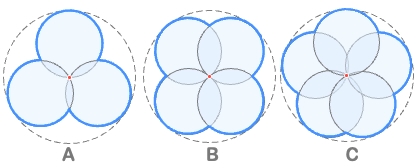
Each of the three rosettes inside a circle with a diameter of 2 meters are made of blue circles with a diameter of 1 meters.
The blue circles passing through the center of the large circle touch it.
The perimeter of which rosette is the largest?
ID 18085
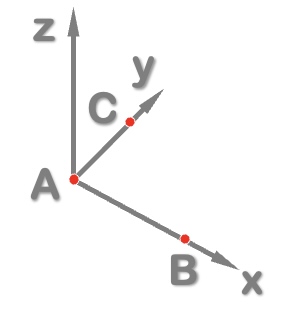
You know the coordinates (x, y, z) of three vertexes of a cube: A (0, 0, 0) B (4.24, 0, 0) C (0, 3, 0)
Is it possible to restore the positions of the other five vertexes?
ID 18083
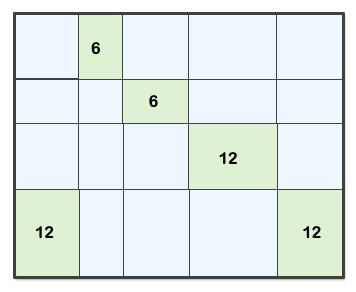
The large rectangle is divided into smaller rectangles by lines parallel to its sides. You can ask questions about the areas of some small rectangles. For example, you know the areas of five small green rectangles.
What is the smallest number of small rectangles of your choice, whose areas you need to know in order to be able to calculate the area of the large rectangle that includes 11 x 9 = 99 small rectangles?
ID 18053
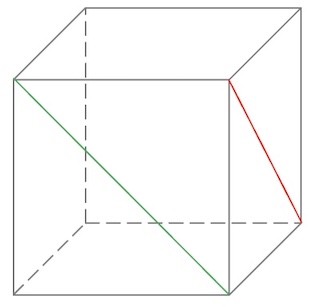
Find the shortest possible distance between two points, one on the green diagonal and the other on the red diagonal of a 1x1x1 meter cube.
ID 17873
Put a finite number of vertex points on a plane such that at least 99.9% of them have 4 equally close nearest neighbouring vertexes.
How could this be done?
by Leslie Green
ID 17451
Which picture represents an arbitrary triangle?
ID 16506
Three ants are sitting in the corner (point A) of bricks (a solid rectangular parallelepiped). They crawl to point B with the same speed by the shortest way.
Which ant reaches the destination first?
ID 16236
We have several logs and put nine of them in a crate.
If we cut each log into 4 pieces as the picture shows, what is the largest number of such pieces that fit into the crate?
ID 15803
Jane celebrates her birthday today.
She prepared a circular cake with the diameter of 20 cm and put as many candles as her age.
Her mom insisted that the distance between two candles is at least 4 cm and the distance from the outer perimeter of the cake to a candle is at least 2 cm.
She put as many candles as possible and it was exactly her age.
How old is Jane?
The picture show the cake surface, a candle in the center, and a circle of diameter 4 cm around the candle.
ID 15793
Gerry cut a cube by three straight cuts parallel to the cube faces, painted the parts either green or yellow, and then put them back together again.
There are four yellow and four green cuboids.
Estimate which surface area is the greatest.
ID 15300
Gerry cut a cube by three straight cuts, painted the parts either green or yellow, and then put them back together again.
The volumes of the four yellow parallelepipeds are 8, 15, 36, and 120 cm3.
What is the volume of the largest green parallelepiped?
ID 15018
How many circles are needed to separate each star from all of the others?
ID 14878
The angles marked by the same colour have the same values.
Find the red angle.
ID 14570
Draw 6 dots on the circumference of a circle.
Dots are not allowed to sit on top of each other.
Connect all possible pairs of dots with line segments.
What is the smallest possible number of intersections of the lines inside the circle?
ID 14351
I want to connect the 20 small red dots using only straight lines and without lifting the pen from the paper.
What is the minimum number of straight lines that connect the dots in such a way?
ID 13811
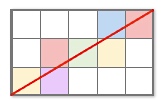
A diagonal intersects 7 small squares in the 5x3 rectangle.
How many small squares does a diagonal intersect in a 997x797 rectangle?
ID 13541
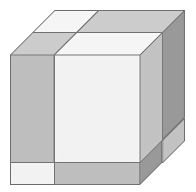
We separate a cube by 3 cuts that are parallel to the cube sides.
The volumes of the four light cuboids are 6, 20, 48, and 90 cubic meters.
What is the volume of the smallest dark cuboid?
ID 13525
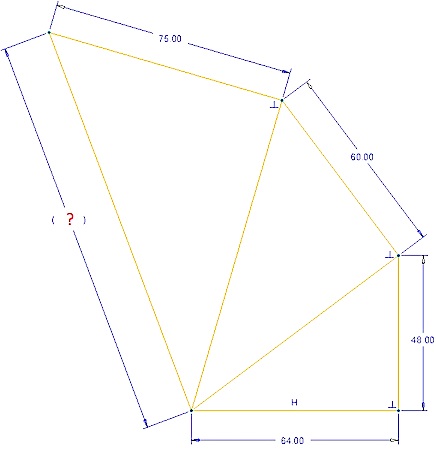
The technical drawing is fully dimensioned, so the ?-marked length is given as a reference dimension.
What is its value?
HINT: Greek triples
The upside-down T symbol shows a perpendicular constraint between adjacent sides at that point.
ID 13524
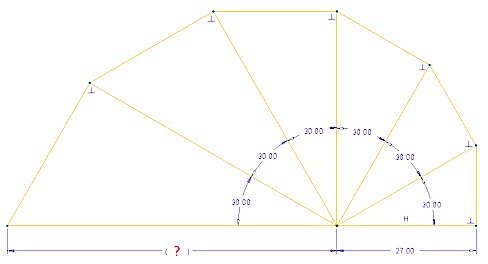
This fully-dimensioned technical drawing shows 6 off 30° right triangles. (The upside-down T is a perpendicular constraint at the vertex).
The reference dimension is shown as a red question mark.
What value should be there?
Hint: sin(30°) = ½
ID 13519
Pick a true statement concerning the image.
ID 13477
A goat is tethered to the middle of a perimeter wall around a square garden. The tether is the same length as the side length of the square.
Estimate the percentage of the square that cannot be grazed by the goat, this region being shaded yellow.
(We also give the analytic answer if you wish to spend more time working on the problem.)
ID 13447
The corner vertex of the square is one third of the way up the hypotenuse of the right triangle.
How big is the yellow area?
(WARNING: Don't rely on undimensioned coincidental shapes.)
ID 13441
It has been claimed, without any substantiation (proof), that a square fits in a quarter circle at a 45° angle, and that the vertices touch on both axes and at two points on the arc.
Which statement(s) can be proved:
(1) The yellow shape is rectangular but not square
(2) All 4 vertices touch only for a trapezoid, but not a square
(3) The non-squareness is around 1% and is therefore not visible
(4) The angle is off by just over 0.5° and is not visible
ID 13440
It has been asserted, without proof, that the yellow square can be inscribed within the quarter-circle, and that each of the 4 vertexes of the square touches the sides and arc of the quarter circle as shown in the image. The square is set at a 45° angle.
Assuming the statements given above are true, what is the area of the square as a function of the radius, r, of the quarter-circle?
ID 13435
In the equilateral triangle shown, two equal length line segments (shown in purple) have been marked.
Two blue construction lines have then been drawn.
What is the value of the marked yellow angle?
ID 13405
What is the area of the green part of the circle, given that the two circles have the same radii, and the blue triangle is equilateral?
The circle radii are denoted by R.
ID 13384
Can you draw an equilateral triangle on a square grid such that each vertex sits exactly on the grid?
HINT: Consider this as an academic question.
by Leslie Green
ID 13382
We have an arbitrary triangle with the base vertices labelled as A and B. Using only a pencil, a straight edge, a sheet of paper, and a pair of compasses, we are required to construct the positions of two new points C and D (as shown) to give equality to the three line segments BC = CD = AD.
The drawing is clearly wrong as the line segments do not have the required equality.
Please sketch your solution on paper.
By all means think about the problem over a period of a couple of days.
by Leslie Green
ID 13369
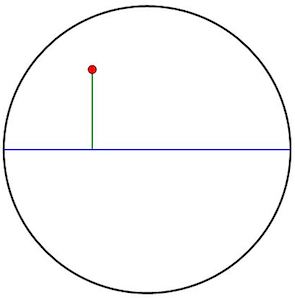
You have been given a drawing of a circle on a piece of paper. A diameter has been drawn across the circle, but the centre is not marked. A point has been randomly chosen within the circle (red blob), but it is not on the diameter or the circumference.
You are required to drop a perpendicular down onto the diameter line using only a pencil and straight edge (unmarked ruler). The task is possible without guessing angles or using other tools such as a protractor.
How many construction line segments are needed?
Please try the problem on a piece of paper, but don't expect success.
ID 13351
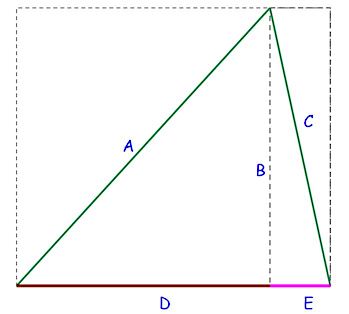
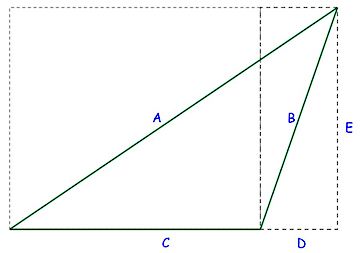
Jason, aged 26, is infeasibly old, and has forgotten at least 95% of the mathematics he knew at the age of 13. Of course we also know that greater than 95% of statistics are made up on the spot.
Jason is required to calculate the area of the triangle shown in the image in order to help his niece with her homework, but he has no idea what the formula for the area is. Was it 2π times the base times the sine of the opposite angle? Who knows?
He does remember the formula for the area of a rectangle is:
AREA = WIDTH x HEIGHT.
Using that formula alone, and without any simplification, write down the area of the triangle in terms of the lengths shown in the diagram.
ID 13350
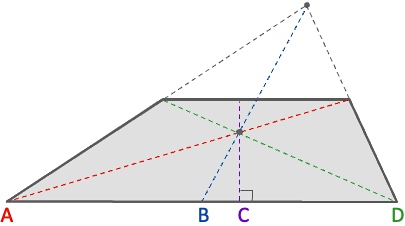
Which line divides the grey trapezium (trapezoid - USA) into two quadrilaterals of equal area?
ID 13349
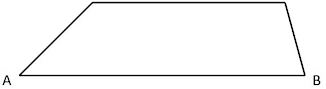
In the asymmetric trapezium (trapezoid - USA) the base and top are parallel, the two sloping sides have different angles to the base.
It is required to bisect the base using a purely geometric construction on the paper copy.
Your only tools are an ungraduated straight edge (unmarked ruler) and a pencil.
You must not draw guessed angles, including perpendiculars and bisected angles.
How many straight construction lines are required to complete the task?
ID 13347
By some quirk of nature you have somehow managed to survive to the decrepit old age of 31. You have forgotten the mathematics you knew aged 15. You no longer remember that the area of a triangle is half base times height. You no longer remember that shearing does not change the area of a planar figure. All you can remember is the formula for the area of a rectangle.
So here you are, apparently stupid when faced with your nephew's homework question.
Solve for the area inside the green triangle without using that forgotten knowledge.
ID 13330
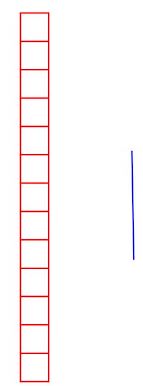
You are given a drawing on paper of a tower of identical red squares on the left, and a blue line segment on the right as shown in the image. The line segment is around 4.12 multiples of the sides of the squares. The line segment is parallel to the edges of the tower.
Your task is to divide the blue line segment into 6 equal pieces. You have a pencil, and a strip of metal which can be used to draw straight lines.
The strip of metal is not marked, and cannot be marked by the pencil. You have no other tools or devices unless specifically requested.
What else do you need to complete the task?
Note: the answer is trivially simple once you are shown it, but can be remarkably difficult to find if you are not shown it. It is well worth struggling with the problem. Guessing the answer without a valid strategy should be regarded as a failure.
ID 11732
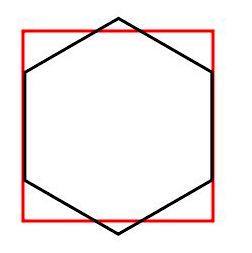
Here we show the plan view of two bolts, one with a square head and one with a hexagonal head. They are scaled to have an equal "across-flats"" (AF) dimension. This dimension is important because an open-ended spanner (aka wrench) needs to be fitted to such a head.
From the image it looks as if the hex head has a smaller plan-area than the square head for a given AF size.
What is the ratio: (square area) / (hex area) for a given AF dimension?
ID 11605
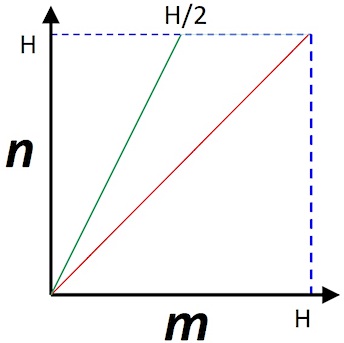
A rational number is the ratio of two natural numbers, n and m, written in the fractional form n / m. Any point within the square dotted region represents a specific rational number. All rational numbers with n < H and m < H are contained within the dotted square region. We consider H to be so HUGE that all possible rational numbers can be included within the dotted square.
The red line has n = m, so that for any values that are within the dotted square and below the red line, the rational value is below 1. Since half the area of the square is below the red line, we can reasonably say that half of all rationals have a value below 1.
What fraction of rationals have a value between 1 and 2?
ID 10845
We know position vector lengths A and B, and angle a in radians. That's all we are given.
What is the value of angle d in radians?
ID 10668
In this sketch we show part of a circle, where a right-angled triangle is used as one face on an N-sided polygon inscribed within the circle. The triangle's apex is at the circle's center.
What is the requirement on N to achieve this goal?
NOTE: N mod 7 can be interpreted as "keep subtracting 7 until the result is between 0 and 6". For example, 9 mod 7 = 2.
ID 10666
Statements:
(1) Any triangle can have a circle touching all three vertexes (circumscribed)
(2) The sum of internal angles within any triangle is 180°
ID 10630
The image shown has 4-fold rotational symmetry, so that all the four colored (coloured) triangles are identical in size.
What is the area of the grey square in terms of the parameter k?
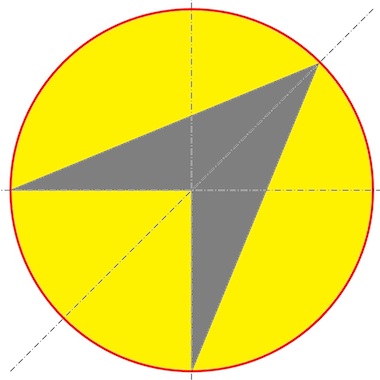
What is the area of the trapezoid if two marked triangles have areas of 1 and 9 square meters?
ID 10043
We wish to cut a 6-dimensional hypercube into as many pieces as possible using 5 hyper-planar cuts.
How many pieces can we create?
by Leslie Green
ID 9588
In the field of topology, shapes are considered to be similar if one object can be morphed into another by stretching (or scrunching) provided that no tearing, drilling, or glueing is involved.
We have 4 shapes: (1) A hollow sphere with two holes in it. (2) A hollow torus (donut) (3) A flat sheet with a hole in it (4) A hollow pipe
The coloring is just an aid to visibility. Size is irrelevant, topologically speaking.
Which is the odd one out?
by Leslie Green
ID 9373
We wish to place as many flat solid plastic circular discs as possible on top of the equilateral triangular base shown. The base and the discs are not sticky, and the discs are not glued in place. The discs are not to be placed on top of each other, and no additional equipment or materials are to be used (eg no string, no mesh, no bags, etc).
The relative proportions of the base and the discs is indicated in the picture.
Estimate the number of discs that could be placed? (Hint: look for what is not there.)
ID 9194
The large rectangle is twice as wide as it is tall. The pale blue area is composed of a large number of horizontal lines of width d. The pale red area is composed of the same matching number of vertical lines, also of width d.
Since all the red lines are half as long as their blue counterparts, the pale red area is half as large as the pale blue area.
Is this proposition true, and if not, why not?
by Leslie Green
ID 9004
There are 3 hockey pucks on ice. A player shoots one of them between the two others. Then he repeats the shots always choosing another puck.
After how many shots can he get the same position of the three pucks?
ID 8490
In the right angled triangle shown, the red angle is equal to the blue angle.
Compare the lengths of the red and blue sides, when the red and blue angles are both equal to 40°.
by Leslie Green
ID 8478
There are 4 points on a line and a point outside the line.
What is the largest number of isosceles triangles I can form, provided that the points are optimally positioned?
Source: kvantik.com 2016
ID 8305
What is the minimum number of straight cuts Gerry has to make in a 12 x 12 carpet so that it fits a room with dimensions 18 x 8?
ID 8128
We start from a square sheet of thin Invar with a side length of d. We then laser-cut the sheet with the pattern shown (but not to scale). f is very small compared to d. The mass of the original sheet was M.
What is the difference in mass between the cut-sheet and M/2?
by Leslie Green
ID 8122
We start from a 6 x 6 x 6 cm solid cube. 6 straight cuts have been made all the way through the cube, the cube having being clamped so that the pieces stay together. All the cuts are at right angles to the edges.
Any edge you can see is either 1, 2 or 3 cm.
How many differently sized blocks have been produced?
by Leslie Green
ID 7831
Estimate the percentage of the inside of the red circle that is shaded yellow.
The construction line is at a 45° angle.
ID 7693
Sticks are available in lengths corresponding to a geometric series. If the first stick has length 1, then next has length R, the next R2, the next R3, and so on.
For religious reasons we insist that no set of three sticks can be used to form a triangle.
What is the minimum acceptable value of R?
by Leslie Green
ID 7487
The image shows a block, viewed from the front.
Which image cannot represent the back view?
(Hint: be careful about what you can actually see.)
by Leslie Green
ID 7366
A diagonal divides a large square into two triangles.
How much larger is the area of the yellow square compared to the area of the green square?
ID 7356
Three lines define seven separate regions.
What is the maximum number of regions divided by six lines in the plane?
ID 7273
A cube has a green face, two yellow faces, and three red faces.
How many different such cubes can I make?
Two cubes are different if one cube cannot be rotated to look like the other.
ID 7195
Leslie Green asks:
Given that the cosine of an angle is 3/5, find the sine of that angle without using a calculator or trig tables.
Hint: use Pythagoras.
ID 6989
I draw different polygons, and then I construct squares on the outside of each polygon, using the whole of each polygon side. For example, the picture shows a pentagon with the squares. I count the sum of the marked angles between the squares.
For what polygon is the sum of the gap angles largest?
ID 6977
Cut a square paper into acute triangles.
What is the smallest possible number of the triangles?
An acute triangle has all angles smaller than a right angle (90°).
ID 6946
Jane's handkerchief has a regular pattern.
What percentage of her handkerchief is red?
ID 6915
Find the diameter of the external circle of the annulus.
π ≈ 3.14159
ID 6687
A regular hexagon with a side length 1 can be decomposed into six regular triangles with the same side length.
Which is the only other regular polygon with unit side lengths which can be decomposed into smaller regular triangles and squares with sides of length 1?
ID 6675
Find the sum of the three angles.
ID 6668
The spiral of Theodorus (also called Pythagorean spiral) is a spiral composed of contiguous right triangles.
Which triangle has an area of 10?
ID 6653
Pretend the round red blobs are tennis balls. Pretend the blue lines are stretchy strings.
Can you move the tennis balls from the pattern on the left to make the pattern on the right?
NOTE: the strings are special so that whatever you do they never get tangled up with each other.
Author: Leslie Green
ID 6648
How many different convex pentagons with the vertexes in 5 of these 8 points can be formed?
A convex polygon is a simple polygon (not self-intersecting) in which no line segment between two points on the boundary ever goes outside the polygon. For example, a regular hexagon is a convex polygon, while a star is not convex.
ID 6532
Find the sum of the marked angles.
ID 6509
A piece of wood is a square with a right-angled isosceles triangle on top.
A carpenter cuts it to form a square tabletop with no pieces left over.
What is the minimum number of saw cuts?
Source: Alex van den Branhof, Jan Guichelaar, Arnout Jaspers Half a Century of Pythagoras Magazine. MAA 2011
ID 6414
Leslie Green asks:
For a small angle d (in radians), the sine of the angle is approximately equal to the angle.
Often the cosine of a small angle is approximated as 1.
Which is the best approximation for the cosine of this small angle?
(Hint: Pythagoras)
ID 6350
John is in the wilderness and encounters a fast flowing river. There is only one spot to cross as the bank is very steep, except at this one point. Directly across from this point is another break in the bank, with no other breaks visible. He therefore has to swim directly across the river.
With his back-pack he can swim at 1 m/s in still water. The river is flowing at 0.8m/s. It is 12 m across the river.
How long does it take him to cross the river, swimming with his normal amount of effort?
Author: Leslie Green
ID 6347
Sine waves are fascinating things. The slope of a sine wave is another sine wave, just shifted in time (phase). You can also add two sinusoidal waves, each of which has a different amplitude and a different zero crossing point (phase) and still end up with a sine wave. Furthermore, the addition of these sine waves obeys the rules of vectors (but using phase instead of direction) so you can draw a triangle and calculate the resulting amplitude and phase from that.
In the picture we are adding a 100V sine wave to a 10V sine wave which is phase shifted by 90° relative to the larger voltage.
What is the amplitude of the resultant sine wave?
Author: Leslie Green
ID 6346
Leslie Green asks:
Which of these graphs is the sine function?
(HINT: Look at the inset picture which shows how the sine function relates to a right-angled triangle.)
ID 6306
Pretend the round red blobs are tennis balls. Pretend the blue lines are stretchy strings.
Can you move the tennis balls from the pattern on the left to make the pattern on the right?
NOTE: the strings are special so that whatever you do they never get tangled up with each other.
Author: Leslie Green
ID 6305
Pretend the round red blobs are tennis balls. Pretend the blue lines are stretchy strings.
Can you move the tennis balls from the pattern on the left to make the pattern on the right?
NOTE: the strings are special so that whatever you do they never get tangled up with each other.
Author: Leslie Green
ID 6214
The ground clearance (C) is measured between the flat ground and the lowest point in the vehicle's undercarriage. The wheel base (B) is measured between the centers of the two wheels. The Breakover Angle (A) is an angle that a vehicle can drive over without the ground touching the vehicle's undercarriage.
What is the formula for the Breakover Angle?
ID 6145
What part of the triangle is blue if all strips have the same height?
ID 6134
Estimate the percentage of the blue area of the rectangle.
ID 6105
I cut a net from a square sheet of paper to form a cylinder A. I cut two nets from the identical sheet to forms 2 small cylinders B.
Compare the volumes of the two sets.
ID 6080
Which area is the largest?
ID 6011
A drop of paint falls onto a horizontal flat sheet of clean glass. We suppose that at a particular instant the drop forms a perfect sphere in the air. The paint has spread out into a uniform circular disc (disk) of a diameter that is twice as large as the initial sphere diameter.
What is the ratio of the disc thickness, t to the initial diameter of the drop?
Author: Leslie Green
ID 6007
The ball's design stitches together 20 hexagons with 12 pentagons for a total of 32 panels. The ball made its World Cup debut as Adidas' Telstar in 1970 in Mexico. The ball's pattern of white hexagons with black pentagons made it easily visible on television.
FInd the sum of the internal angles of the panels.
ID 5991
The ball is covered with hexagons and pentagons. The sum of interior angles of a hexagon on a plane is 720°.
What is the sum of the interior angle of the hexagon on the ball's surface?
ID 5984
What is the ratio of sides of a circumscribed regular hexagon to an inscribed regular hexagon sharing the same circle (as shown in the picture)?
Author: Leslie Green
ID 5880
The picture shows two regular stars with heights of length 1 and 3, which have the same vertical axis of symmetry.
What fraction of the design is blue?
ID 5785
All the circles have the same center. The area of each colored region between the circles is equal to the area of the smaller circle.
We extend the model to 100 circles.
How much larger is the largest circle compared to the small circle?
ID 5696
We measured three perimeters of three different cuboids.
Which cuboid has the largest volume?
ID 5638
A farmer has 36-meter of fence to enclose a field. The fence is given as 6-meter straight sections. He wants to make his field as big as possible.
Estimate the maximum area of his field.
ID 5582
The Bermuda Triangle, also known as the Devil's Triangle, is a loosely defined region, where a number of aircraft and ships are said to have disappeared under mysterious circumstances. The triangle's three vertices are in Miami, Florida peninsula; in San Juan, Puerto Rico; and in the mid-Atlantic island of Bermuda.
The distance from Miami to Bermuda is 1668 km. The distance from Miami to Puerto Rico is 1663 km. The distance from Puerto Rico to Bermuda is 1571 km. Estimate the surface area of the famous triangle.
ID 5526
There are 3 circles of equal diameter. A line is tangent to the third circle, as shown.
Find the length of the line segment AB.
ID 5405
Three semicircles are constructed on the hypotenuse and legs of a right angle triangle. Compare green (G) and red (R) areas.
ID 5389
What is the largest distance if the angle B is right?
ID 5374
Which shape has the smallest perimeter?
ID 5337
My garden fence creates a ten meters by five meters rectangle.
If I reuse all of this fencing to make a new rectangular garden, what is the maximum possible percentage increase of the area?
ID 5307
There are two paths in a rectangular garden.
Find the length of the shorter path.
ID 5265
Estimate the maximum number of smaller 1-inch circles that fit in a larger circle, the diameter of which is three times larger.
ID 5260
Two right-angled triangles have integer side lengths. Whilst all of the sides have different lengths, the hypotenuses are equal.
What is the smallest length of the hypotenuse?
ID 5257
Take two sheets of A4 paper (210 x 297 millimeters or 8.3 x 11.7 inch). Roll one into a short cylinder and the other into a tall cylinder.
Which one holds more air than the other?
ID 5116
Find X.
ID 5112
Gerry has 24 meters of fence and wants to make a rectangular garden with the largest area. He uses the house as the fourth side of the garden.
What length should he make the long side of the garden?
ID 5108
John cuts a large piece of cheese into small pieces using straight cuts from a very sharp cheese wire. He does not move the pieces from the original shape while he cuts the cheese.
How many small pieces of cheese can he get using only five cuts?
ID 5103
What is the largest number of straight lines you can draw through 9 points, so that each line goes exactly through 3 points?
You can move points on the plane as you wish.
ID 4929
The picture shows a large cube 4 x 4 x 4 that was assembled from one-unit cubes. It will be painted on all 6 sides.
For what size of large cube will the total number of painted faces of the small cubes be equal to the number of unpainted faces?
ID 4759
What is the perimeter of a right triangle whose shorter sides are 9 and 12 units?
ID 4657
The numbers show the areas of corresponding triangles.
What is the area of the rectangle?
ID 4560
If I use 30 g of batter to make a crêpe of 30 cm in diameter, how much batter do I need for a square pancake of the same thickness and with a side length of 30 cm?
"Archaeological evidence suggests that pancakes are probably the earliest and most widespread cereal food eaten in prehistoric societies." - Wikipedia
ID 4542
What is the maximum number of sections into which a pancake may be divided by four straight cuts through it?
(NOTE: The pieces cannot be re-arranged between cuts.)
ID 4483
The golden border of the hexagonal brooch with maximum size 60 mm includes a gemstone, whose maximum size is 40 mm.
Which area is the largest?
ID 4458
How many pentagons are there?
ID 4447
The size of an NBA basketball court is about 29 by 16 meters.
How many courts can be planned in an 80 x 67 meter school yard, given that at least 3 meters must separate the courts?
ID 4388
Two perpendicular lines form four segments with lengths a, b, c, and d.
Which is correct?
ID 4386
Which is a better fit?
The smaller the percentage of the ‘area left over,’ the better the fit.
ID 4382
Which triangle has the greatest area?
ID 4373
A rectangular yard with an area of 24 m2 has sides in the ratio 2:3.
What is the length of the fence around the yard?
ID 4342
What is the maximum number of trees that can be planted, not closer than 3 meters apart, in a square plot of 10.5 meters x 10.5 meters?
ID 4324
What is the probability of breaking a stick into three pieces and forming a triangle?
The pieces must intersect at their tips to form the triangle.
ID 4219
A helicopter takes me from Lausanne, Switzerland to the Swiss capital Bern in 20 minutes. Bern is 36 minutes from Brig.
Which of the following could be the time of a flight from Lausanne to Brig?
ID 4129
The figure shows adjacent squares. Find the sum of angles X and Y.
ID 4064
A circle goes through two adjacent vertices of a square and it is tangent to the bottom side of the square.
Find the diameter of the circle X.
ID 4023
The stripes have the same width.
What part of the square is red?
ID 3941
What fraction of this regular octagon is shaded?
ID 3924
If regular stars are placed as shown to form a complete circle, how many stars are needed?
ID 3920
A trapezoid is formed by cutting off the top part of an isosceles right triangle such that the short base is 8 m.
What is the area of the blue trapezoid?
ID 3917
The picture shows three squares with the side lengths of 10, 8, and 4 cm. What is the difference between the areas of the green and blue regions?
ID 3916
What is the greatest possible number of points of intersection for 11 lines in a plane?
ID 3909
How many 1x1 squares fit into the large square with the side length 4.9?
Find the maximum possible number.
ID 3806
Which shape is more symmetrical (i.e. has more planes of symmetries)?
ID 3741
Inspired by Boris Kordemsky.
Four Knights problem:
Cut the chessboard into 4 congruent parts, each with a queen on it.
How many sides does each part have?
ID 3718
I need 1 + 9 + 25 = 35 cubes to build a pyramid with a height of 3 cubes.
Estimate the number of cubes for a pyramid with a height of 30 cubes.
ID 3712
A pyramid and a tetrahedron with edges of the same length are glued together on a triangular face.
How many faces does the resulting solid have?
ID 3696
I connected the midpoints of a polygon and constructed a new polygon that was a quadrilateral with opposite sides parallel.
What shape was the initial polygon?
ID 3678
What is the largest number of intersections of N lines?
ID 3674
I take a map of the city where I live and lay it on my table.
There is a "You are here" point on the map, which represents the same point in the city. The point on the map coincides with its real position.
True or False?
ID 3608
Connect N points on the circumference of a circle.
What is the largest number of intersections for the chords?
ID 3599
The Babylonians used a base 60 number system.
What shape inspired them to decide that a circle has 360 degrees?
ID 3564
What is the volume of the second glass compared to the first one?
ID 3552
I want to place N cubes so that each cube touches every other one.
What is the largest possible N?
Inspired by Martin Gardner
ID 3509
I need 1 + 4 + 9 + 16 + 25 = 55 cubes to build a pyramid with a height of 5 cubes.
Estimate the number of cubes for a pyramid with a height of 30 cubes.
ID 2238
What line divides the green polygon into two parts of equal area?
ID 2198
I want to cut a wooden cube that is five inches on each side into 125 one-inch cubes.
I can do this by making 4 + 4 + 4 = 12 cuts, keeping the pieces together in the cube shape.
What is the minimum number of cuts needed if rearrangement of the pieces after each cut is allowed?
ID 2193
A sphere fits inside a cube. The maximum possible ratio of the volume of the sphere to that of the cube is pi / 6, or about 0.52.
If we put many small spheres inside a cube, then what is the largest possible ratio of the spheres' volume to that of the cube?
ID 2153
In a city, there were seven bridges. There was a tradition that a newly married couple walks and crosses over each of the seven bridges only once. If a couple starts and finishes at the same point, which city plan allows the couple to acomplish this task?
ID 2031
Find the radius of the circle.
ID 1974
Each of these five circles is tangent to at least 3 others. The medium sized circles have a radius 3.
What is the radius of the smallest green circles?
ID 1949
What is the maximum number of pieces that an apple can be divided into with four straight planar cuts?
The pieces do not move.
ID 1878
I drew three lines from the center of a square that has sides with a length of 1 to form two congruent trapezoids and a pentagon. All three shapes have the same area.
What is the length of the pentagon's shortest side?
ID 1876
A, B, and C are squares with sides of length 1; D, E, and F are isosceles right triangles; and G is an equilateral triangle. The net can be folded to form a shape.
What is the volume of the shape?
ID 1614
Estimate the area of the smallest square that can enclose the regular hexagon shown on the right.
ID 1613
There are six ways to travel from point S to point F on a small cube if only right, forward, and up moves are permitted.
Find the number of different pathways available for a 2x2x2 cube.
ID 1587
Two triangles form seven separate regions.
What is the greatest number of such regions that can be formed by three triangles?
ID 1518
The picture shows the areas of three rectangles.
What is the area of the fourth rectangle?
ID 1479
The diagram shows 15 billiard balls that fit exactly inside a triangular rack. The rigid rack prevents the balls from sliding.
What is the largest number of balls that can be removed so that the remaining balls are theoretically unable to move?
ID 1451
The shaded rhombus is formed by joining vertices of the square to the midpoints of its sides.
What is the area of the shaded rhombus?
ID 1399
Two lines trisect (divide into three equal parts) each side of the polygon ABCD.
Which polygon has the largest area?
ID 1348
The diameter of one hair is 0.2 mm.
Estimate the diameter of a plait of 1000 hairs.
ID 1340
What is the maximum number of possible points of intersection of N different circles?
The picture shows four circles.
ID 1280
Four squares have dimensions as indicated in the picture.
What is the area of the green shape?
ID 1264
What is the ratio of the green area to the red area?
ID 1192
How much wrapping paper is needed to entirely cover a box that is 40 cm by 30 cm by 12 cm?
ID 1190
John is using the spinner shown here to define the movement. Blue means one step up and green means one step down. The spinner is moved randomly.
If he starts at point 0 and makes 360 moves, where will he most likely be now?
ID 1109
The following pattern is cut and folded to a square-based pyramid.
What size does the base have to be to maximize the surface area of the resulting pyramid?
ID 1086
How many equilateral triangles can you make using six identical line segments?
ID 1083
The sizes of the sealed bottle with water are shown in the figure. Find the height of the water when the bottle is right side up.
ID 1076
Among the following shapes of equal area, which has the smallest perimeter?
ID 1058
What value of X gives the greatest ratio of red area to the area of the big rectangle?
ID 1054
A square is inscribed in a right triangle.
Find the greatest possible ratio of the area of the square to the area of the triangle.
ID 1050
All inner lines connect the corners of the big square and the midpoints of the opposite sides.
What fraction of the big square is red?
ID 1043
If the length of the hour and minute hand of a clock are 3cm and 6cm respectively, what is the angle shown on the picture at two o'clock?
ID 1041
A ladder leans against a vertical wall. The top of the ladder is 4m above the ground. When the bottom of the ladder is moved 1m closer to the wall, the top of the ladder rests 1m higher than the original position.
How far from the wall was the bottom of the ladder in the initial position?
ID 1004
Twenty matchsticks form five squares (one 3x3 and four 1x1).
How many matchsticks do I need to move to make seven squares?
Find the minimum number.
ID 980
What is the largest semi-circle that can be inscribed in a square with a side of length a=2?
ID 979
Three reservoirs have the same height h=1.
Which reservoir is bigger?
ID 976
A gardener has to reach the island in the middle of a pond without getting wet. The gardener has two planks each X feet long.
What is the smallest length of the planks?
ID 974
What is the maximum number of squares you can make using twelve identical matches?
You cannot cut the matches. (The matches must not cross each other.)
ID 971
The pattern of shading in one quarter of a square is shown in the diagram.
If this pattern is continued indefinitely, what fraction of the large square will eventually be shaded?
ID 969
The area of the external triangle is equal to 1. Its sides' midpoints are connected to form a second triangle, and so forth.
What is the sum of the areas of all the triangles in this infinite series?
ID 968
G is the area of the green region inside the biggest circle. R is the total area of red regions of the two smaller circles.
Which statement is correct?
ID 964
There are 2 identical circles. Circle A remains fixed, while Circle B makes 1 turn around the first one, touching it without slipping.
How many turns has Circle B made around its own axis?
ID 961
AB is parallel to CD.
What is the value of X?
ID 960
Two similar pyramids have volumes of 216 m3 and 64 m3.
What is the ratio of their surface areas?
ID 958
For this rectangular-faced solid (cuboid), which plane(s) contain(s) B and is/are parallel to plane AEH?
ID 957
What is the total number of lines of tangency that are common to circle C1 and circle C2?
ID 956
L3 and L4 are two parallel lines in a plane.
If L3 has 3 points equally spaced along its length, and if L4 has 4 points also equally spaced along its length, how many different triangles can be formed by connecting the points on the two parallel lines?
A triangle must be formed by 2 points on one line and 1 point on the other.
ID 949
The three circles have fixed centers, and the diameter of a circle is 10% less than that of its 'left neighbor'.
The left circle completes a hundred revolutions per minute.
How many revolutions does the right circle complete?
ID 948
The side of the colored square is x cm.
What is the area of the red rectangle in terms of x?
ID 947
If the volume of a cube is X cubic meters and the total surface area of the cube is X square meters, then what is the cube's edge length?
ID 942
The figure shows a red equilateral triangle inscribed within another equilateral triangle. The side of the bigger triangle measures 10 meters.
We want to obtain the smallest area of the red triangle. What would be the distance x in this case?
ID 940
A six-pointed regular star consists of two areas.
What is the ratio of the shaded region in the area of the star?
ID 938
A boy stacked colored cubes in a square pyramid like the one shown here. The top layer had 1 cube, the second layer had 4 cubes, and so on.
If the pyramid were 15 layers high, how many cubes would be in the fifteenth layer?
ID 936
Identify the area of the rounded square.
ID 934
These two shapes are similar.
What is the length of x?
ID 932
Which is the best estimate of the area of the colored shape?
ID 931
A wire is wound around a circular rod. The wire goes exactly 5 times around the rod. The circumference of the rod is 12 cm and its length is 25 cm.
Identify the length of the wire.
ID 930
A rectangle has width W, length L, and area A.
If integer W ≤ 9 and L is an even number between 9 and 99 which of the following CANNOT be the area of the rectangle?
ID 927
S varies proportionally to the square of (H+1).
S = 54 when H = 5
Find H when S = 96.
ID 925
Tim travels 15 meters north of the flag in the football stadium. He turns west and travels 8 meters. He turns south and travels 6 meters and then comes back directly to the flag.
Calculate Tim's travel distance.
ID 924
The volume of water in a glass of V cubic centimeters (cc), varies directly as its height, H centimeters (cm). The volume is 100 cc when the height is 5 cm.
Calculate the volume when the height is 11 cm.
Note: Older text books use cubic centimeters. This unit is the same thing as cm3 and milli-liters.
1 cc = 1 cm3 = 1 mL
ID 922
A fence around a rectangular garden has a perimeter of 14 meters. Its length is 4 meters.
Find the length of the diagonal of this rectangular garden.
 Each of the three rosettes inside a circle with a diameter of 2 meters are made of blue circles with a diameter of 1 meters.
  You know the coordinates (x, y, z) of three vertexes of a cube:
  The large rectangle is divided into smaller rectangles by lines parallel to its sides. You can ask questions about the areas of some small rectangles. For example, you know the areas of five small green rectangles.
  Find the shortest possible distance between two points, one on the green diagonal and the other on the red diagonal of a 1x1x1 meter cube.
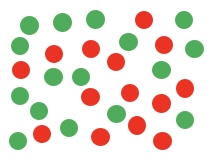 Put a finite number of vertex points on a plane such that at least 99.9% of them have 4 equally close nearest neighbouring vertexes.
 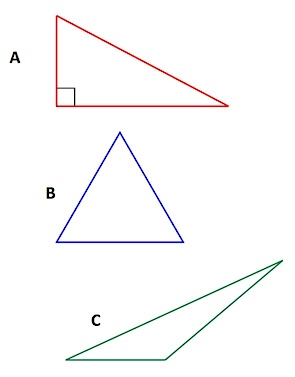 Which picture represents an arbitrary triangle?
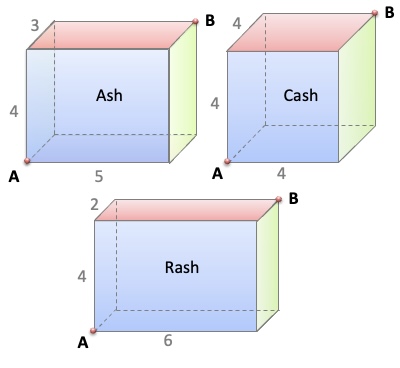 Three ants are sitting in the corner (point A) of bricks (a solid rectangular parallelepiped). They crawl to point B with the same speed by the shortest way.
 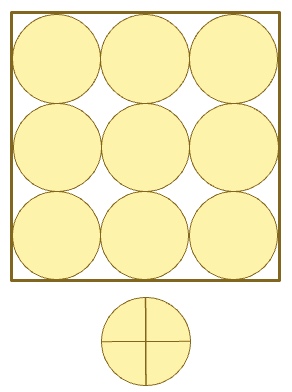 We have several logs and put nine of them in a crate.
  Jane celebrates her birthday today.
  Gerry cut a cube by three straight cuts parallel to the cube faces, painted the parts either green or yellow, and then put them back together again.
 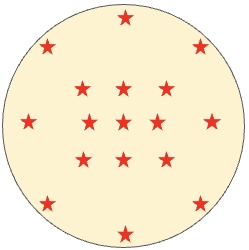 How many circles are needed to separate each star from all of the others?
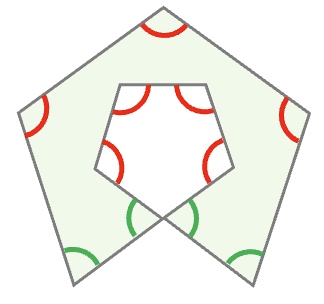 The angles marked by the same colour have the same values.
 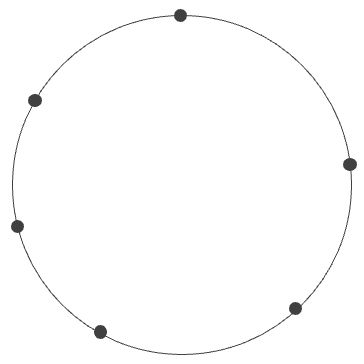 Draw 6 dots on the circumference of a circle.
 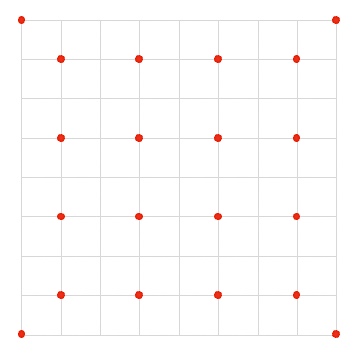 I want to connect the 20 small red dots using only straight lines and without lifting the pen from the paper.
  A diagonal intersects 7 small squares in the 5x3 rectangle.
  We separate a cube by 3 cuts that are parallel to the cube sides.
  The technical drawing is fully dimensioned, so the ?-marked length is given as a reference dimension.
  This fully-dimensioned technical drawing shows 6 off 30° right triangles. (The upside-down T is a perpendicular constraint at the vertex).
 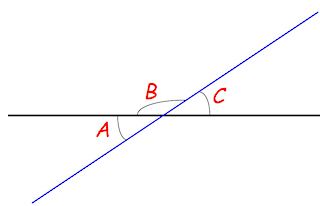 Pick a true statement concerning the image.
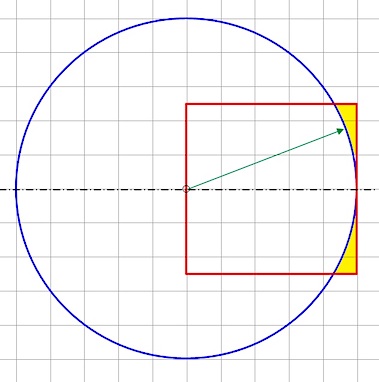 A goat is tethered to the middle of a perimeter wall around a square garden. The tether is the same length as the side length of the square.
 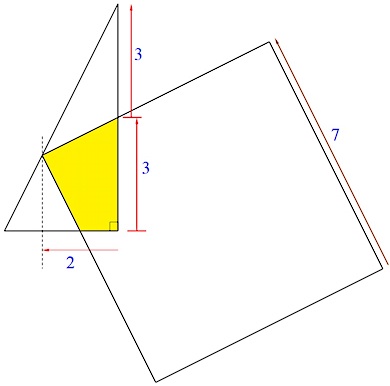 The corner vertex of the square is one third of the way up the hypotenuse of the right triangle.
 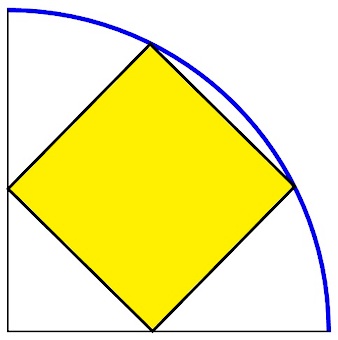 It has been claimed, without any substantiation (proof), that a square fits in a quarter circle at a 45° angle, and that the vertices touch on both axes and at two points on the arc.
 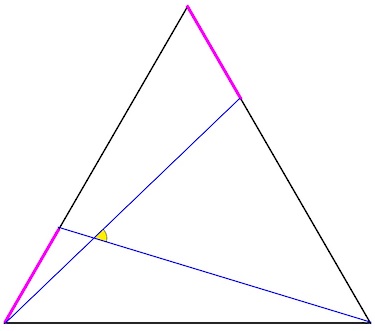 In the equilateral triangle shown, two equal length line segments (shown in purple) have been marked.
 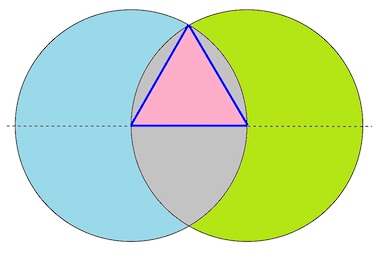 What is the area of the green part of the circle, given that the two circles have the same radii, and the blue triangle is equilateral?
 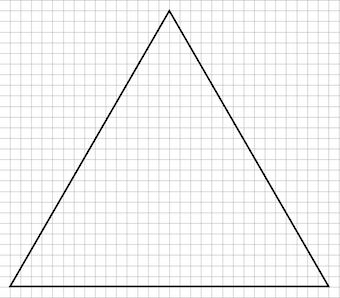 Can you draw an equilateral triangle on a square grid such that each vertex sits exactly on the grid?
 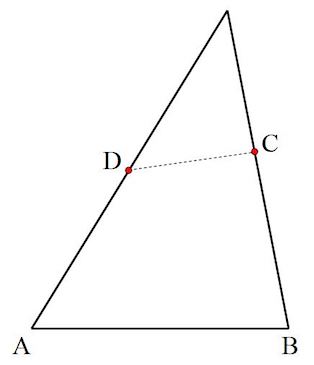 We have an arbitrary triangle with the base vertices labelled as A and B. Using only a pencil, a straight edge, a sheet of paper, and a pair of compasses, we are required to construct the positions of two new points C and D (as shown) to give equality to the three line segments BC = CD = AD.
  You have been given a drawing of a circle on a piece of paper. A diameter has been drawn across the circle, but the centre is not marked. A point has been randomly chosen within the circle (red blob), but it is not on the diameter or the circumference.
  Jason, aged 26, is infeasibly old, and has forgotten at least 95% of the mathematics he knew at the age of 13. Of course we also know that greater than 95% of statistics are made up on the spot.
  Which line divides the grey trapezium (trapezoid - USA) into two quadrilaterals of equal area?
 In the asymmetric trapezium (trapezoid - USA) the base and top are parallel, the two sloping sides have different angles to the base.
  By some quirk of nature you have somehow managed to survive to the decrepit old age of 31. You have forgotten the mathematics you knew aged 15. You no longer remember that the area of a triangle is half base times height. You no longer remember that shearing does not change the area of a planar figure. All you can remember is the formula for the area of a rectangle.
  You are given a drawing on paper of a tower of identical red squares on the left, and a blue line segment on the right as shown in the image. The line segment is around 4.12 multiples of the sides of the squares. The line segment is parallel to the edges of the tower.
  Here we show the plan view of two bolts, one with a square head and one with a hexagonal head. They are scaled to have an equal "across-flats"" (AF) dimension. This dimension is important because an open-ended spanner (aka wrench) needs to be fitted to such a head.
  A rational number is the ratio of two natural numbers, n and m, written in the fractional form n / m.
 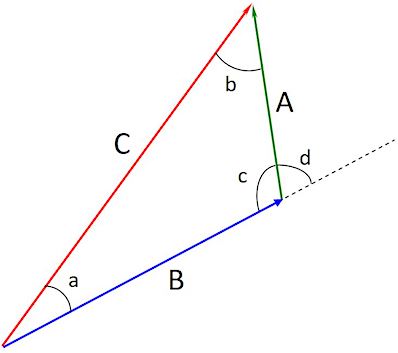 We know position vector lengths A and B, and angle a in radians. That's all we are given.
 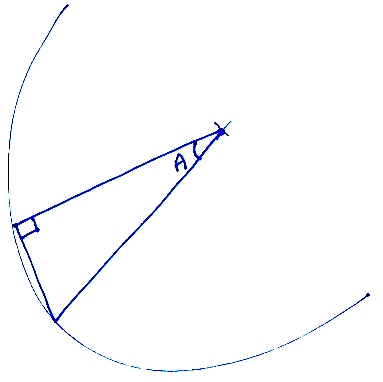 In this sketch we show part of a circle, where a right-angled triangle is used as one face on an N-sided polygon inscribed within the circle. The triangle's apex is at the circle's center.
 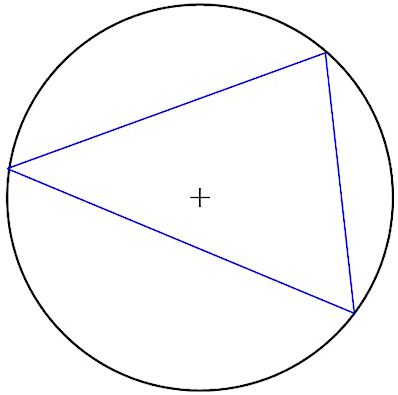 Statements:
 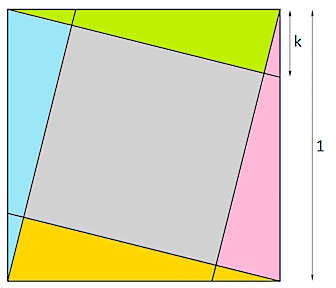 The image shown has 4-fold rotational symmetry, so that all the four colored (coloured) triangles are identical in size.
 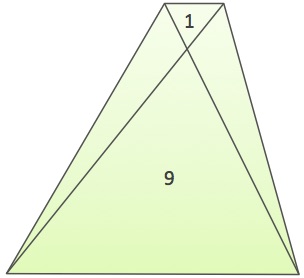 What is the area of the trapezoid if two marked triangles have areas of 1 and 9 square meters?
 We wish to cut a 6-dimensional hypercube into as many pieces as possible using 5 hyper-planar cuts.
 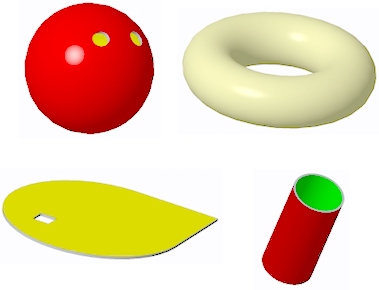 In the field of topology, shapes are considered to be similar if one object can be morphed into another by stretching (or scrunching) provided that no tearing, drilling, or glueing is involved.
 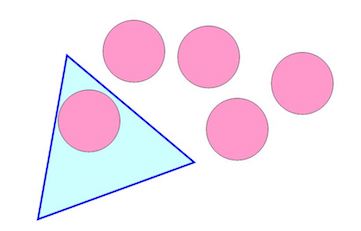 We wish to place as many flat solid plastic circular discs as possible on top of the equilateral triangular base shown. The base and the discs are not sticky, and the discs are not glued in place. The discs are not to be placed on top of each other, and no additional equipment or materials are to be used (eg no string, no mesh, no bags, etc).
 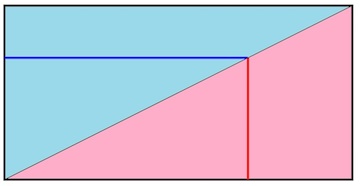 The large rectangle is twice as wide as it is tall. The pale blue area is composed of a large number of horizontal lines of width d. The pale red area is composed of the same matching number of vertical lines, also of width d.
  There are 3 hockey pucks on ice.
 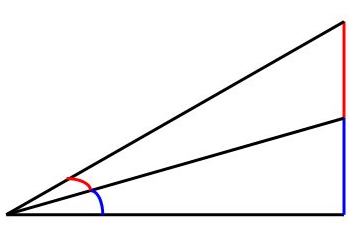 In the right angled triangle shown, the red angle is equal to the blue angle.
 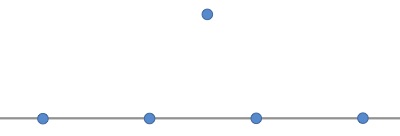 There are 4 points on a line and a point outside the line.
  What is the minimum number of straight cuts Gerry has to make in a 12 x 12 carpet so that it fits a room with dimensions 18 x 8?
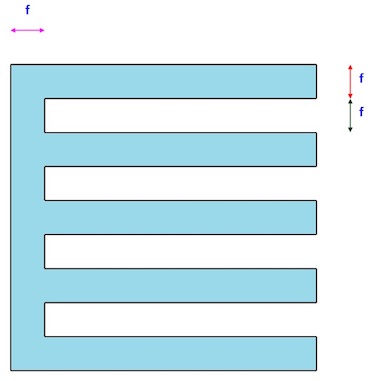 We start from a square sheet of thin Invar with a side length of d. We then laser-cut the sheet with the pattern shown (but not to scale).
 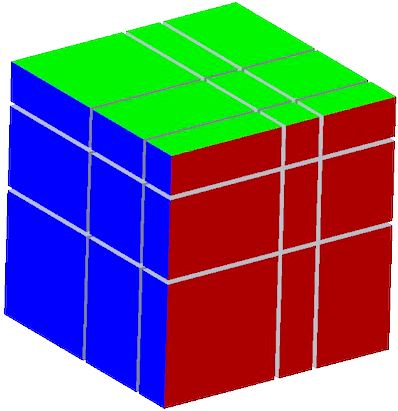 We start from a 6 x 6 x 6 cm solid cube. 6 straight cuts have been made all the way through the cube, the cube having being clamped so that the pieces stay together. All the cuts are at right angles to the edges.
  Estimate the percentage of the inside of the red circle that is shaded yellow.
  Sticks are available in lengths corresponding to a geometric series. If the first stick has length 1, then next has length R, the next R2, the next R3, and so on.
  The image shows a block, viewed from the front.
  A diagonal divides a large square into two triangles.
  Three lines define seven separate regions.
  A cube has a green face, two yellow faces, and three red faces.
  Leslie Green asks:
  I draw different polygons, and then I construct squares on the outside of each polygon, using the whole of each polygon side.
  Cut a square paper into acute triangles.
  Jane's handkerchief has a regular pattern.
  Find the diameter of the external circle of the annulus.
  A regular hexagon with a side length 1 can be decomposed into six regular triangles with the same side length.
  Find the sum of the three angles.
 The spiral of Theodorus (also called Pythagorean spiral) is a spiral composed of contiguous right triangles.
  Pretend the round red blobs are tennis balls. Pretend the blue lines are stretchy strings.
  How many different convex pentagons with the vertexes in 5 of these 8 points can be formed?
  Find the sum of the marked angles.
 A piece of wood is a square with a right-angled isosceles triangle on top.
  Leslie Green asks:
  John is in the wilderness and encounters a fast flowing river. There is only one spot to cross as the bank is very steep, except at this one point. Directly across from this point is another break in the bank, with no other breaks visible. He therefore has to swim directly across the river.
  Sine waves are fascinating things. The slope of a sine wave is another sine wave, just shifted in time (phase). You can also add two sinusoidal waves, each of which has a different amplitude and a different zero crossing point (phase) and still end up with a sine wave. Furthermore, the addition of these sine waves obeys the rules of vectors (but using phase instead of direction) so you can draw a triangle and calculate the resulting amplitude and phase from that.
  Leslie Green asks:
  Pretend the round red blobs are tennis balls. Pretend the blue lines are stretchy strings.
  Pretend the round red blobs are tennis balls. Pretend the blue lines are stretchy strings.
  The ground clearance (C) is measured between the flat ground and the lowest point in the vehicle's undercarriage.
  What part of the triangle is blue if all strips have the same height?
 Estimate the percentage of the blue area of the rectangle.
  I cut a net from a square sheet of paper to form a cylinder A.
  Which area is the largest?
 A drop of paint falls onto a horizontal flat sheet of clean glass. We suppose that at a particular instant the drop forms a perfect sphere in the air. The paint has spread out into a uniform circular disc (disk) of a diameter that is twice as large as the initial sphere diameter.
  The ball's design stitches together 20 hexagons with 12 pentagons for a total of 32 panels. The ball made its World Cup debut as Adidas' Telstar in 1970 in Mexico. The ball's pattern of white hexagons with black pentagons made it easily visible on television.
  What is the ratio of sides of a circumscribed regular hexagon to an inscribed regular hexagon sharing the same circle (as shown in the picture)?
  The picture shows two regular stars with heights of length 1 and 3, which have the same vertical axis of symmetry.
  All the circles have the same center. The area of each colored region between the circles is equal to the area of the smaller circle.
  We measured three perimeters of three different cuboids.
  A farmer has 36-meter of fence to enclose a field. The fence is given as 6-meter straight sections.
  The Bermuda Triangle, also known as the Devil's Triangle, is a loosely defined region, where a number of aircraft and ships are said to have disappeared under mysterious circumstances. The triangle's three vertices are in Miami, Florida peninsula; in San Juan, Puerto Rico; and in the mid-Atlantic island of Bermuda.
  There are 3 circles of equal diameter.
  Three semicircles are constructed on the hypotenuse and legs of a right angle triangle.
  What is the largest distance if the angle B is right?
 Which shape has the smallest perimeter?
 My garden fence creates a ten meters by five meters rectangle.
  There are two paths in a rectangular garden.
  Estimate the maximum number of smaller 1-inch circles that fit in a larger circle, the diameter of which is three times larger.
 Two right-angled triangles have integer side lengths.
  Take two sheets of A4 paper (210 x 297 millimeters or 8.3 x 11.7 inch).
  Find X.
 Gerry has 24 meters of fence and wants to make a rectangular garden with the largest area.
  John cuts a large piece of cheese into small pieces using straight cuts from a very sharp cheese wire.
  What is the largest number of straight lines you can draw through 9 points, so that each line goes exactly through 3 points?
  The picture shows a large cube 4 x 4 x 4 that was assembled from one-unit cubes.
  The numbers show the areas of corresponding triangles.
  If I use 30 g of batter to make a crêpe of 30 cm in diameter, how much batter do I need for a square pancake of the same thickness and with a side length of 30 cm?
  The golden border of the hexagonal brooch with maximum size 60 mm includes a gemstone, whose maximum size is 40 mm.
  How many pentagons are there?
 The size of an NBA basketball court is about 29 by 16 meters.
  Two perpendicular lines form four segments with lengths a, b, c, and d.
  Which is a better fit?
  Which triangle has the greatest area?
 A rectangular yard with an area of 24 m2 has sides in the ratio 2:3.
  What is the maximum number of trees that can be planted, not closer than 3 meters apart, in a square plot of 10.5 meters x 10.5 meters?
  What is the probability of breaking a stick into three pieces and forming a triangle?
  A helicopter takes me from Lausanne, Switzerland to the Swiss capital Bern in 20 minutes. Bern is 36 minutes from Brig.
  The figure shows adjacent squares.
  A circle goes through two adjacent vertices of a square and it is tangent to the bottom side of the square.
  The stripes have the same width.
  What fraction of this regular octagon is shaded?
 If regular stars are placed as shown to form a complete circle, how many stars are needed?
 A trapezoid is formed by cutting off the top part of an isosceles right triangle such that the short base is 8 m.
  The picture shows three squares with the side lengths of 10, 8, and 4 cm.
  What is the greatest possible number of points of intersection for 11 lines in a plane?
 How many 1x1 squares fit into the large square with the side length 4.9?
  Which shape is more symmetrical (i.e. has more planes of symmetries)?
 Inspired by Boris Kordemsky.
  I need 1 + 9 + 25 = 35 cubes to build a pyramid with a height of 3 cubes.
  A pyramid and a tetrahedron with edges of the same length are glued together on a triangular face.
  I connected the midpoints of a polygon and constructed a new polygon that was a quadrilateral with opposite sides parallel.
  What is the largest number of intersections of N lines?
 Connect N points on the circumference of a circle.
  The Babylonians used a base 60 number system.
  What is the volume of the second glass compared to the first one?
 I want to place N cubes so that each cube touches every other one.
  I need 1 + 4 + 9 + 16 + 25 = 55 cubes to build a pyramid with a height of 5 cubes.
  What line divides the green polygon into two parts of equal area?
 I want to cut a wooden cube that is five inches on each side into 125 one-inch cubes.
  A sphere fits inside a cube. The maximum possible ratio of the volume of the sphere to that of the cube is pi / 6, or about 0.52.
  In a city, there were seven bridges.
  Find the radius of the circle.
 Each of these five circles is tangent to at least 3 others.
  What is the maximum number of pieces that an apple can be divided into with four straight planar cuts?
  I drew three lines from the center of a square that has sides with a length of 1 to form two congruent trapezoids and a pentagon.
  A, B, and C are squares with sides of length 1;
  Estimate the area of the smallest square that can enclose the regular hexagon shown on the right.
  There are six ways to travel from point S to point F on a small cube if only right, forward, and up moves are permitted.
  Two triangles form seven separate regions.
  The picture shows the areas of three rectangles.
  The diagram shows 15 billiard balls that fit exactly inside a triangular rack.
  The shaded rhombus is formed by joining vertices of the square to the midpoints of its sides.
  Two lines trisect (divide into three equal parts) each side of the polygon ABCD.
  The diameter of one hair is 0.2 mm.
  What is the maximum number of possible points of intersection of N different circles?
  Four squares have dimensions as indicated in the picture.
  What is the ratio of the green area to the red area?
 How much wrapping paper is needed to entirely cover a box that is 40 cm by 30 cm by 12 cm?
 John is using the spinner shown here to define the movement.
  The following pattern is cut and folded to a square-based pyramid.
  How many equilateral triangles can you make using six identical line segments?
  The sizes of the sealed bottle with water are shown in the figure.
  Among the following shapes of equal area, which has the smallest perimeter?
  What value of X gives the greatest ratio of red area to the area of the big rectangle?
 A square is inscribed in a right triangle.
  All inner lines connect the corners of the big square and the midpoints of the opposite sides.
  If the length of the hour and minute hand of a clock are 3cm and 6cm respectively, what is the angle shown on the picture at two o'clock?
 A ladder leans against a vertical wall. The top of the ladder is 4m above the ground. When the bottom of the ladder is moved 1m closer to the wall, the top of the ladder rests 1m higher than the original position.
  Twenty matchsticks form five squares (one 3x3 and four 1x1).
  What is the largest semi-circle that can be inscribed in a square with a side of length a=2?
 Three reservoirs have the same height h=1.
  A gardener has to reach the island in the middle of a pond without getting wet.
  What is the maximum number of squares you can make using twelve identical matches?
  The pattern of shading in one quarter of a square is shown in the diagram.
  The area of the external triangle is equal to 1.
  G is the area of the green region inside the biggest circle.
  There are 2 identical circles. Circle A remains fixed, while Circle B makes 1 turn around the first one, touching it without slipping.
  AB is parallel to CD.
  Two similar pyramids have volumes of 216 m3 and 64 m3.
  For this rectangular-faced solid (cuboid), which plane(s) contain(s) B and is/are parallel to plane AEH?
 What is the total number of lines of tangency that are common to circle C1 and circle C2?
 L3 and L4 are two parallel lines in a plane.
  The three circles have fixed centers, and the diameter of a circle is 10% less than that of its 'left neighbor'.
  The side of the colored square is x cm.
  If the volume of a cube is X cubic meters and the total surface area of the cube is X square meters, then what is the cube's edge length?
 The figure shows a red equilateral triangle inscribed within another equilateral triangle. The side of the bigger triangle measures 10 meters.
  A six-pointed regular star consists of two areas.
  A boy stacked colored cubes in a square pyramid like the one shown here.
  Identify the area of the rounded square.
 These two shapes are similar.
  Which is the best estimate of the area of the colored shape?
 A wire is wound around a circular rod.